- Web Desk
- 8 Hours ago
274 Taliban killed, 150 tanks and 73 posts destroyed, says ISPR chief
-

- Web Desk
- Feb 27, 2026
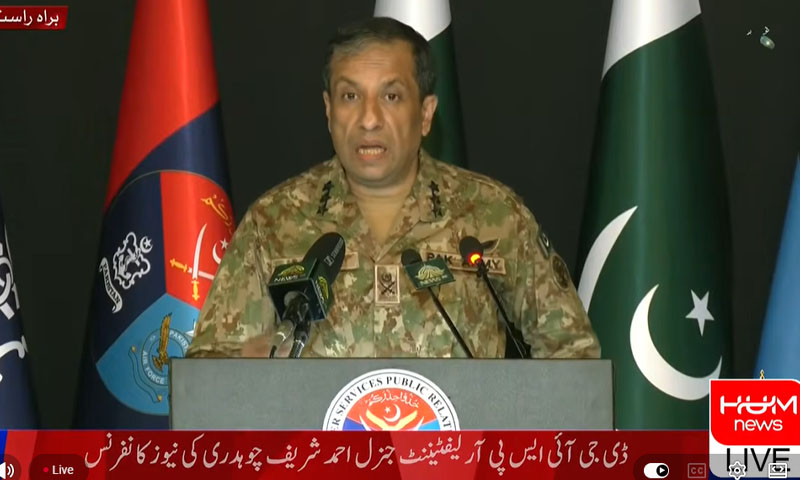
ISLAMABAD: Pakistan’s military said on Friday it had killed 274 members of the Afghan Taliban regime and destroyed 115 tanks, armoured and artillery vehicles, as well as 73 border posts in a major cross-border operation following attacks from across the border.
Addressing a press conference, Inter-Services Public Relations (ISPR) Director-General Lt-Gen Ahmed Sharif Chaudhry said that Prime Minister Shehbaz Sharif had been briefed on the operation, named “Operation Ghazab lil-Haq”, shortly before the media address.
“The purpose of the briefing was to inform the prime minister in detail about Operation Ghazab lil-Haq,” Chaudhry said.
He said that Pakistan carried out strikes on the night of February 21–22, targeting what he described as militant hideouts near the Afghan border after Afghan Taliban forces initiated firing across 53 locations in 15 sectors along the Pakistan-Afghanistan border.
“Wherever attacks were launched from, Pakistan responded in a manner the world has seen,” he said, accusing the Afghan Taliban regime of backing militants involved in attacks inside Pakistan.
According to the military spokesperson, 18 Taliban posts are now under Pakistan’s control, while more than 400 Taliban personnel were wounded in the fighting.
Chaudhry said that Pakistani forces targeted 22 locations linked to what he called “Fitna al-Hindustan” and “Fitna al-Khawarij”, striking positions in Kabul, Kandahar and Paktia with precision. He added that air strikes were carried out at 22 locations in Kabul, Kandahar, Paktia, Nangarhar and Khost.
Among the targets were an infantry brigade headquarters in Kabul and a logistics brigade headquarters in Kandahar, he said.
Militant hideouts and weapons depots were destroyed, and gun positions and posts used in cross-border fire were specifically targeted, he said adding, “Terrorists fled, leaving behind the bodies of their accomplices.”
He denied allegations that civilians had been targeted, calling such claims “false propaganda”. “Pakistan’s armed forces acted professionally and only engaged military targets,” he said.
The ISPR chief said that 12 Pakistani soldiers were martyred in the operation, 27 were wounded and one was missing.
“Our effective response reflects the full vigilance of the armed forces,” he said, adding that the military remains ready for immediate and effective retaliation against any further aggression.
He warned the Afghan Taliban that it must choose between supporting terrorist groups or maintaining peaceful relations with Islamabad, saying militant attacks on Pakistani soil would be met with a strong response.
Lt-Gen Ahmed Sharif said groups including the TTP, BLA, ISIS and al-Qaeda were all considered terrorist organisations by Pakistan, and that the country would respond “in their own language” to anyone carrying out attacks inside Pakistan.
“Those who commit or facilitate terrorism in Pakistan will not be safe,” he said. “The Afghan Taliban must decide whether they are with terrorists or with Pakistan.”
Chaudhry accused India of supporting terrorism in Pakistan through proxy groups operating in areas under Taliban influence. “The Pakistani armed forces and security agencies will never hesitate to sacrifice for the protection of our people,” he said.
He also referred to previous commitments made by the Afghan government in Doha, saying Kabul had promised that Afghan territory would not be used against Pakistan. He noted attempts by militants to strike Pakistani targets via quadcopters and drones in Sibi, Abbottabad, and Nowshera had been foiled by Pakistan’s anti-drone systems.
“The world understands that Operation Ghazab lil-Haq is being carried out for the protection of our citizens,” Chaudhry said, referring to the ongoing military campaign along the Pakistan-Afghanistan border.
He added that Pakistan’s political parties and security forces were united against terrorism. “Our nation stands together against terrorism, transcending political differences,” he said, praising the sacrifices of the Khyber Pakhtunkhwa police in maintaining law and order.
Chaudhry concluded by reaffirming Pakistan’s commitment to protecting its national interests at all costs and lauded the public’s support for the country’s armed forces.
Pakistani launched the strikes after Afghan forces attacked Pakistani border positions.
The latest confrontation marks one of the most serious flare-ups between the two countries in recent months.
Earlier in October, border clashes killed dozens of soldiers on both sides before negotiations facilitated by Turkey, Qatar and Saudi Arabia led to a fragile ceasefire. However, that truce has repeatedly come under strain.
Pakistan had welcomed the Taliban’s return to power in 2021. Then-prime minister Imran Khan had said Afghans had “broken the shackles of slavery”.
However, relations deteriorated as Islamabad accused Kabul of failing to curb militant groups operating from Afghan soil.
Pakistan maintains that the banned Tehreek-e-Taliban Pakistan (TTP) leadership and many of its fighters are based in Afghanistan. It also alleges that Baloch insurgents use Afghan territory as a safe haven.
Militant attacks inside Pakistan have increased since 2022, with assaults by the TTP and Baloch groups rising each year, according to international conflict monitoring data.
Kabul has denied allowing militants to use Afghan territory to launch attacks in Pakistan.
Islamabad says repeated militant attacks originating from Afghanistan have undermined ceasefire efforts, leading to recurring border clashes and closures that disrupted trade and cross-border movement.
What triggered the latest clashes?
Pakistani security sources said they had “irrefutable evidence” linking militants in Afghanistan to a recent surge in attacks and suicide bombings targeting Pakistani military and police personnel.
Officials cited seven attacks since late 2024 that they said were connected to Afghanistan.
One recent attack in Bajaur district, which claimed lives of 11 security personnel and two civilians, was reportedly carried out by an Afghan national and was later claimed by the TTP.
Who are the Pakistani Taliban?
The banned Tehreek-e-Taliban Pakistan (TTP), formed in 2007, is an umbrella group of militant factions operating mainly in northwest Pakistan.
The group has carried out attacks on markets, mosques, airports, military bases and police stations. It has also held territory along the Afghan border and in areas such as Swat Valley.
The TTP was responsible for the 2012 attack on schoolgirl Malala Yousafzai, who later won the Nobel Peace Prize.
The group also fought alongside the Afghan Taliban against US-led forces in Afghanistan. Pakistan has launched multiple military operations against the TTP bases in Afghanistan, achieving temporary reductions in violence.
‘Taliban wants to resolve conflict with Pakistan’
Afghan Taliban spokesperson Zabihullah Mujahid told reporters on Friday
That Afghanistan wanted to resolve its latest conflict with Pakistan through dialogue.
Russia, Turkey urge Pakistan, Afghanistan to halt fighting
Meanwhile, Russia on Friday called on Pakistan and Afghanistan to immediately stop cross-border attacks and resolve their differences through diplomatic means amid escalating tensions between the two neighbours.
Russia, which is the only country to have officially recognised the Taliban government in Afghanistan, maintains good relations with both Kabul and Islamabad.
Kremlin spokesman Dmitry Peskov said the military clashes were concerning.
“Of course, the direct military clashes that have taken place do not bode well. Therefore, we hope that they will cease as soon as possible. Like everyone else, we are closely monitoring this situation,” Peskov told reporters.
He also confirmed that preparations were under way for a visit to Russia by Prime Minister Shehbaz Sharif, though he did not specify a date. Russian state news agency RIA reported that the visit is expected next week.
Separately, Russian Foreign Ministry spokeswoman Maria Zakharova expressed concern over the sharp military escalation.
“We call on our friends Afghanistan and Pakistan to abandon this dangerous confrontation and return to the negotiating table to resolve all differences through political and diplomatic means,” she said in a statement posted on Telegram.
Meanwhile, Turkey also urged Pakistan and Afghanistan to return to dialogue and de-escalate tensions through negotiations.
Meanwhile, China and Malaysia on Friday expressed deep concern over rising tensions between Pakistan and Afghanistan, calling for restraint and dialogue to resolve disputes.
The Chinese Foreign Ministry said both sides should exercise patience and immediately end hostilities. China said it is actively mediating between the two neighbours and is ready to play a constructive role to reduce tensions and improve bilateral relations.
“China urges an early cessation of fighting and encourages both parties to resolve their differences through dialogue,” a Chinese Foreign Ministry spokesperson said.
Meanwhile, Malaysian Prime Minister Anwar Ibrahim in a telephone call with Prime Minister Shehbaz Sharif also voiced concern over the escalation, calling the reported casualties on both sides “extremely regrettable and saddening.” He said Pakistan’s security concerns should be addressed and urged both countries to show restraint.
“Immediate cessation of all military actions is necessary. The resolution of all disputes is possible only at the negotiation table,” the Malaysian prime minister said.
The statements come amid repeated cross-border clashes along the Pakistan-Afghanistan frontier, which have raised fears of a wider conflict in the region.
You May Also Like