- Web
- 4 Hours ago
A spirited past, a sober legacy: Bhutto’s path from casino nights to the alcohol ban
-

- Web Desk
- Dec 23, 2025
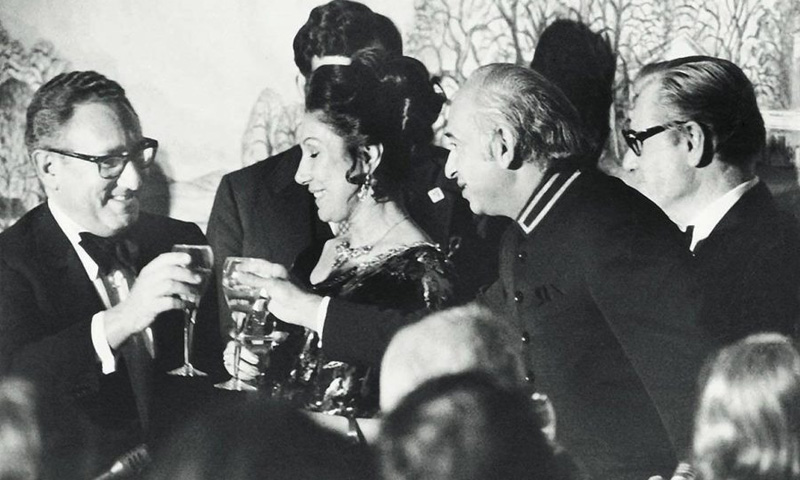
In a bombshell revelation that peels back the layers of Pakistan’s high-society history, Zarin Shroff, a respected leader of Karachi’s Parsi community and a guardian of the city’s heritage, has detailed the glittering, whiskey-soaked evenings of the man who ironically signed the death warrant for Pakistan’s nightlife: Zulfikar Ali Bhutto.
Shroff’s accounts paint a vivid, cinematic picture of a Karachi lost to time, where the scent of expensive cigars and the clink of ice in crystal glasses defined the city’s elite social circuit.
THE “SOCIALITE-IN-CHIEF”
Long before he was the populist “Quadi-e-Awam,” Bhutto was a fixture of Karachi’s jet-set. Shroff recalls a man of immense charisma and unapologetic appetites, frequenting the city’s upscale casinos and private clubs. He was the life of the party, the stories suggest. A man who knew his malts as well as he knew his Marx.
Before 1977, alcohol was openly sold and consumed in Pakistan. Nightclubs, bars, and liquor stores were common in major cities like Karachi, and even Pakistan International Airlines (PIA) featured wine and spirits on its in-flight menus. Bhutto’s government had nearly completed a massive casino in Karachi, intended to attract tourists from the West and oil-rich Arab countries.
For the Parsi community, the traditional custodians of Karachi’s hospitality and trade, Bhutto wasn’t just a politician; he was a contemporary who thrived in the very cosmopolitan atmosphere he would later dismantle for political survival.
THE ULTIMATE POLITICAL BETRAYAL
The “oomph” of Shroff’s revelation lies in the sheer hypocrisy of the 1977 Prohibition. As a populist movement led by the religious right – the Pakistan National Alliance (PNA) – began to threaten his grip on power, Bhutto committed the ultimate act of political harakiri:

The Sacrifice: In April 1977, Bhutto, the man who loved his whiskey, as Shroff recounts, banned alcohol for Muslims and shuttered the casinos he once frequented.
The Famous Quote: Facing criticism for his lifestyle, he famously told a rally, “Haan, main sharab peeta hoon, lekin logon ka khoon nahi peeta” (“Yes, I drink alcohol, but I do not drink the people’s blood”).
The Backfire: The ban didn’t save him. Instead, it emboldened the religious right and provided the legislative “skeleton” that his successor would flesh out into a regime of public floggings.
FROM BHUTTO’S BAN TO ZIA’S LASH
If Bhutto’s ban was a cynical political chess move, General Zia-ul-Haq’s response was a religious crusade. In 1979, Zia took Bhutto’s 1977 executive order and weaponized it with the Prohibition (Enforcement of Hadd) Order.
Through the Hadd Order, drinking was no longer viewed merely as a social vice to be regulated, but was codified as a crime against God. This shift to “Hadd” (Islamic corporal punishment) meant that the consumption of alcohol by Muslims became punishable by 80 lashes and imprisonment, representing a total “Islamisation” of the penal code that remains a defining feature of the country’s legal structure today.
A VANISHING WORLD
Zarin Shroff’s testimony is a eulogy for a pluralistic Karachi. Her memories of Bhutto at the casino table serve as a stinging reminder of how quickly a nation’s social fabric can be re-stitched. The very casinos where Bhutto once spent his evenings became, under Zia, the silent ghosts of a “liberal” Pakistan that was traded away in a smoke-filled room in 1977.

Shroff’s “insider” perspective reminds us that the laws governing Pakistan today weren’t born out of sudden piety, but out of a desperate struggle for power by a man who eventually lost his life to the very forces he tried to appease. Today, the laws initiated by Bhutto and solidified by Zia remain on the books. While non-Muslims (including Parsis, Christians, and Hindus) are technically allowed a “quota” of alcohol for religious ceremonies, the social landscape of Karachi, and Pakistan, remains permanently altered.
You May Also Like