
- WEB DESK
- August 28, 2026
After three decades on the throne, Norway’s King Harald V dies at 89
-

- Reuters
- August 28, 2026
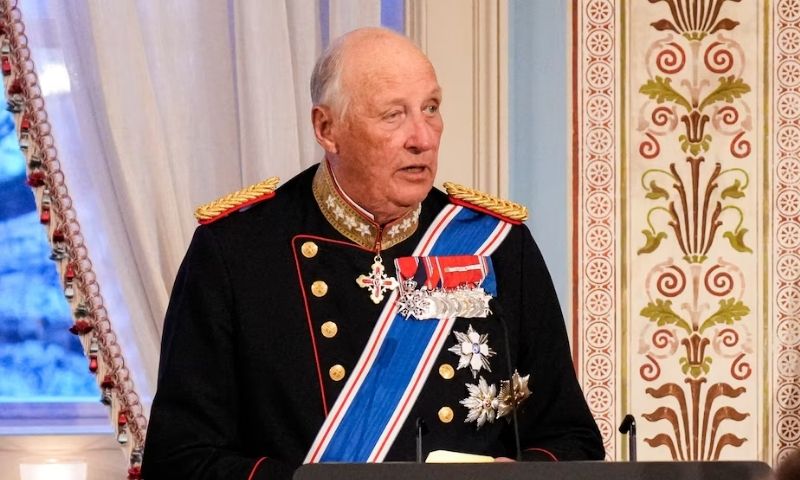
Norway’s King Harald V, who served as the country’s ceremonial head of state for more than three decades and became known for his modernising approach to the monarchy, died on Friday at the age of 89, the Royal Palace said.
The palace said Harald died peacefully at Oslo University Hospital at 6:35am local time. He had been admitted to the hospital on August 17 and was receiving treatment for a bacterial infection in his bloodstream.
Harald had been Europe’s oldest reigning monarch. His death comes as the Norwegian royal family faces a period of heightened scrutiny and several challenges.
The king had experienced a number of health problems in recent years. In 2024, he was hospitalised while on holiday in Malaysia after developing an infection and was fitted with a temporary pacemaker. He was subsequently flown back to Norway by the country’s armed forces and later received a permanent pacemaker.
Harald became king in 1991 following the death of his father, King Olav V. Over his long reign, he gradually established his own public identity, moving beyond the shadow of his popular and outgoing predecessor.
In 2024, Harald announced that he would scale back his official duties because of his age and health. He nevertheless rejected any suggestion that he might abdicate, saying his oath as king was a lifelong commitment.
Multiple challenges
Harald’s death comes at a tumultuous time for the royal family.
Crown Princess Mette-Marit, married to Harald’s son Crown Prince Haakon, is facing intense scrutiny for her friendship with the late sex offender Jeffrey Epstein, a relationship for which she has apologised.
Her son Marius Hoiby, born from a relationship predating her marriage to Haakon, was found guilty in June of two out of four counts of rape and one count of domestic violence and sentenced to four years in prison after a seven-week trial. Both he and the prosecution have appealed the sentence.
Two days after Marius was convicted, the palace said Mette-Marit had undergone a successful lung transplant, without specifying when the procedure took place.
After several weeks of recovery in hospital, she returned home and celebrated her silver wedding anniversary with Haakon in August. Support for the monarchy dropped to 60% in February 2026, from 70% the previous month, according to a Norstat poll published by public broadcaster NRK, rising slightly to 64% in May.
Harald had constantly remained popular with Norwegians. According to the February poll, he was the royal who best represented the Norwegian royal family, with a note of 9.2, on a scale of 1 to 10.
A descendant of Queen Victoria
A great-great-grandchild of Britain’s Queen Victoria, Harald acceded to the throne in 1991 and slowly introduced modern touches that brought a ceremonial post seen mainly as a symbol of national independence into the 21st century.
The popular king played a crucial role comforting the nation in times of mourning.
When far-right, anti-Islam fanatic Anders Behring Breivik killed 77 people in 2011 in Oslo and on Utoeya island, the king consoled the nation with a powerful televised speech. His voice trembling with emotion, he said that “freedom is stronger than fear”.
After floods, storms and other disasters, he would travel to the scene wearing rubber boots and a well-worn jacket to meet those who had lost homes or loved ones.
Late in life he spoke up for tolerance, declaring in a 2016 speech that Norwegians could have many backgrounds, beliefs and sexual orientations.
In November 2005, Harald and his wife, Sonja Haraldsen, invited 550 Norwegians to a ball to celebrate the centenary of the country’s independence from Sweden.
Harald said in an interview at the time that Europe’s royal families should not be tempted to reverse moves towards openness and retreat to their palace towers.
“If you’ve opened the gate it’s very difficult to close it again,” he told Reuters. “I’m not sure I’d want to close it. So far so good, as far as I’m concerned.”
Like his father Olav, Harald was a sports and automotive enthusiast and often drove his own car, particularly to informal events.
A sailor, he captained his boat to win a world championship title and competed in several Olympics, but failed to repeat his father’s feat of winning Olympic gold.
Harald also took a great interest in the preservation of nature. He realised a lifelong dream when, aged 76, he spent four days deep in the Amazon jungle of Brazil, living with the Yanomami people and sleeping in a hammock.
Birth and reign
Harald’s birth on February 21, 1937, was cause for national celebration – he was the first royal heir to be born in Norway in almost 570 years. Danish and Swedish monarchs had ruled over the Scandinavian nation for centuries, until 1905.
Just three years after Harald was born, Nazi Germany invaded the country. King Haakon and then-Crown Prince Olav fled to Britain, where they led Norway’s government-in-exile, while the 3-year-old Harald went with his mother, Crown Princess Märtha, to neutral Sweden, then to the United States.
After living briefly at the White House, and then for five years in Bethesda, Maryland, Harald, his older sisters Ragnhild and Astrid and their mother met frequently with U.S. President Franklin D. Roosevelt, whom Harald years later described as like a grandfather.
When he returned to Norway after the war ended in 1945, Harald attended state schools rather than the private lessons his father had received.
His marriage in 1968 to a commoner broke with tradition and followed a nine-year stand-off with his father that ended only after Harald threatened never to marry rather than give up Sonja.
Later years
In 1998, the king faced an unprecedented wave of public criticism over press reports that he had accepted a 4-million-crown ($400,000) yacht from a group of industrialists as a birthday present, and that palace repairs had cost the government 500 million crowns.
Around the same time, his former deputy private secretary suggested that Harald should abdicate at the egalitarian country’s normal retirement age of 67.
Opinion polls gave the king firm backing to stay on for life, however, and the criticism subsided. A year later, in another Reuters interview, Harald joked that he would remain on the throne for life unless he went mad.
“There is no tradition in Norway for that (abdication). But you never know. If you go completely bonkers,” he said. Queen Sonja laughed and said: “But who will ever tell you that?”
Harald’s son Haakon, 53, will be Norway’s fourth king since the country gained independence from Sweden in 1905, with Mette-Marit, also aged 53, as his queen.
You May Also Like

- WEB DESK
- August 27, 2026
Petrol, diesel prices reduced, new rates notified
- Reuters
- August 27, 2026
