- Web
- Mar 09, 2026
AI between apocalypse and illusion: A critical look at two competing narratives
-

- Sadiq Khan
- Jan 19, 2026
Artificial intelligence is increasingly described in extremes. To some, it is an unstoppable force that will erase jobs, reorder society, and divide humanity into winners and casualties. To others, it is an overhyped statistical tool–useful, yes, but fundamentally incapable of replacing human intelligence, creativity, or meaning. Two recent public interventions capture this divide with striking clarity.
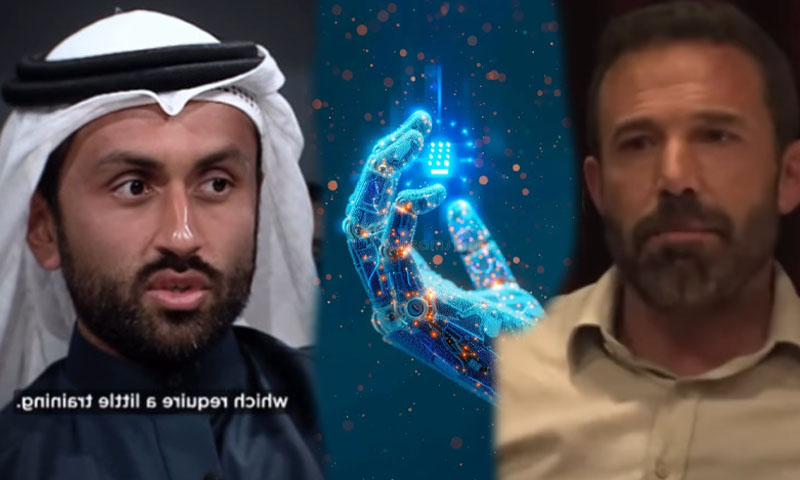
On one side stands an unnamed expert pushing back against what he calls the illusion of AI as a mind. On the other hand is Emirati entrepreneur Ali Sawani, who warns that the world is entering a “survival of the fittest” era driven by AI-led job displacement. Together, their views expose a deeper question: Is AI genuinely transforming human capability, or is society mistaking acceleration for intelligence?
The claim of replacement
Sawani’s warning is direct and emotionally resonant. He argues that within two to three years, AI will replace workers across the professional spectrum—engineers, lawyers, consultants, accountants—triggering unprecedented unemployment. In his framing, adaptability becomes a moral and economic dividing line: those who embrace AI will thrive; those who don’t will fall behind.
This narrative has become increasingly common in tech discourse. It feeds on real trends—automation, productivity tools, declining demand for certain tasks—but extrapolates them into a near-total labor upheaval. The implied premise is that AI systems are becoming autonomous agents, capable of performing complex human roles independently and at scale.
The unnamed expert fundamentally rejects this premise.
Some counterarguments strongly dispute the idea that AI could ever replace the enduring central role of human beings.
According to a critic given in the attached video clip, generative AI systems like ChatGPT, Claude, and Gemini are widely misunderstood. They do not think, create, or judge. They predict statistically likely outputs based on human-generated language. As a result, they gravitate toward the average, not excellence.
This, he argues, explains why AI-generated writing often feels generic and hollow. It is not insight; it is aggregation. Not creativity; imitation.
“ChatGPT can’t write anything for you unless you already know what you want,” he notes. The intelligence is not intrinsic, as it is borrowed from the user and from the vast archive of human expression on which the model is trained.
From this perspective, the idea that AI will independently replace human professionals collapses. Without human intent, direction, and judgment, AI systems do not function meaningfully. They rearrange language; they do not produce understanding.
Fear as an economic strategy
He also challenges the political economy behind AI panic. He suggests that much of the “AI will change everything” rhetoric is driven less by technological reality than by financial necessity. Massive investments in data centres, energy infrastructure, and compute power require justification—and fear is a powerful motivator.
Claims that “there will be no more work in two years,” he argues, are not predictions but pressure tactics designed to accelerate adoption and legitimise inflated valuations.
This critique directly undermines the “survival of the fittest” framing. If AI is fundamentally dependent on human input and increasingly expensive to improve marginally, as he claims with newer models costing multiples more for modest gains, then the narrative of inevitable human replacement becomes far less convincing.
Where the two views overlap and where they don’t
Interestingly, for both Sawani and the critic, AI is a tool, not magic. Sawani urges people to learn how to use it, while the other in the video insists it cannot function without human guidance. The disagreement lies in what happens if people fail to adapt.
Sawani sees adaptation as a race against obsolescence. The other sees non-adoption not as extinction, but as resistance to a misleading technological myth.
Crucially, the expert reframes AI not as an existential threat, but as an existential distraction—diverting attention from deeper economic, social, and political problems by attributing them to machines.
But what kind of work is being replaced?
What both narratives often obscure is a more precise issue–AI replaces tasks, not minds. Repetitive, bureaucratic, and efficiency-driven functions are indeed vulnerable. But work rooted in judgment, ethics, creativity, and human relationships remains stubbornly resistant to automation.
Even in areas like film, writing, or performance–frequently cited as AI’s strongest domains–the expert points out that AI cannot operate without human artistic direction. Virtual actors, automated scripts, and synthetic media still depend on human meaning-making. Without it, they collapse into noise.
Between panic and complacency
The danger today is not choosing the wrong side in the AI debate—it is accepting either extreme uncritically. Treating AI as an all-powerful evolutionary force breeds panic and fatalism. Treating it as harmless hype breeds complacency.
AI is neither destiny nor deception. It is a tool embedded in human systems, shaped by economic incentives, cultural assumptions, and political choices. Whether it deepens inequality or enhances human capacity depends less on the technology itself than on how honestly we understand its limits.
As the unnamed expert puts it: AI is a mirror. It reflects what we give it. Without humans, it reflects nothing at all.
You May Also Like

- Web Desk
- Feb 16, 2026
X service restored after global disruption