
- Web Desk
- 7 Minutes ago
AI disruption and the future of Pakistan’s job market
-

- Syeda Masooma
- Dec 01, 2025
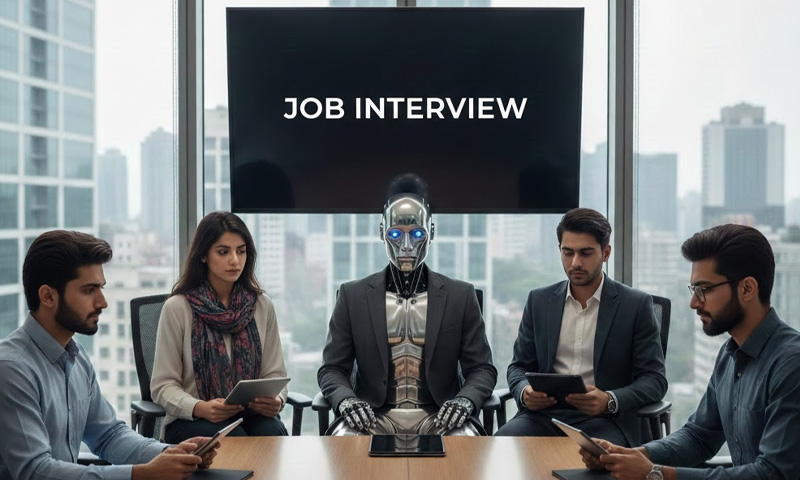
The rapid global diffusion of artificial intelligence is reshaping labour markets and challenging long-held assumptions about which academic pathways guarantee economic security. Pakistan, despite its unique economic dynamics, is increasingly vulnerable to these global shifts.
ERODING CERTAINTY AROUND “HIGH-VALUE” DEGREES
For decades, degrees in economics, mathematics and medicine have been perceived as among the most stable and financially rewarding professions. This perception has been reinforced by international evidence, such as data from the UK Department for Education showing consistently high long-term earnings for graduates in these fields.
However, the same datasets reveal an emerging contradiction: entry-level hiring in traditional high-earning sectors has declined sharply, by up to 32 per cent in certain markets, since the widespread adoption of advanced AI tools like ChatGPT. Automation has begun to absorb tasks once assigned to junior analysts and early-career professionals, narrowing entry points into industries previously considered safe bets.
EARLY SIGNS OF THE SAME PATTERN IN PAKISTAN
Economists warn that Pakistan is already experiencing similar pressures. Sectors that historically absorbed large cohorts of economics and mathematics graduates; banking, consulting, finance, research, are increasingly deploying AI systems for data analysis, forecasting, auditing, risk assessment, and report generation. As employers automate routine functions, they require fewer generalist graduates and more workers with specialised digital and analytical competencies.
Paradoxically, the very degrees that once promised upward mobility are now among the most vulnerable to AI-driven displacement. Financial modelling, statistical tasks, diagnostic analysis, and even segments of economic policy design can now be executed rapidly and at scale by AI systems, raising uncertainty for young graduates facing student debt and limited employment pathways.
In contrast, sectors requiring physical presence, interpersonal judgement, and hands-on technical skills, nursing, caregiving, engineering, skilled trades, and field-based scientific work, remain difficult to automate. These professions are experiencing rising demand within Pakistan and internationally, especially as global demographic ageing accelerates the need for healthcare and care-sector workers.
PAKISTAN’S POSITION: SHIELDED, BUT ONLY TEMPORARILY
Haroon Sharif, policy expert and former chairman of the Board of Investment (BOI), argues that Pakistan currently enjoys a buffer against some aspects of AI disruption due to its relatively low labour costs. With manufacturing costs rising sharply in China, Vietnam and Cambodia, Pakistan has an opportunity to attract manufacturing investment in the short term.
Yet, this window is narrowing quickly, since AI is transforming manufacturing faster than industries can relocate geographically. Sharif warns that advanced economies, driven partly by anti-immigration sentiment, are aggressively adopting AI to reduce reliance on foreign labour altogether. Even in Pakistan, automation is advancing rapidly: textile machinery that once required 400 workers can now operate with as few as eight, Sharif noted.
WHAT GLOBAL TRENDS MEAN FOR PAKISTAN?
According to Sharif, three major global trends are reshaping the future of work. Firstly, Educational specialisation is losing value; operational and technical specialisation is gaining importance. The ability to operate AI systems and emerging technologies will matter more than traditional academic credentials.

With manufacturing costs rising sharply in China, Vietnam and Cambodia, Pakistan has an opportunity to attract manufacturing investment.
Policy expert Haroon Sharif
Secondly, manufacturing worldwide will continue shifting from labour-intensive to AI-driven production. Countries dependent on cheap labour as a competitive advantage must adapt or risk long-term marginalisation.
And finally, future export competitiveness will hinge on knowledge-based products rather than physical goods. For Pakistan, this represents both an opportunity and a challenge: the potential to leapfrog into new sectors but only with the right skills and policy frameworks.
A DOMESTIC LANDSCAPE UNPREPARED FOR THE FUTURE
Despite mounting evidence and consistent cautions from analysts like Haroon Sharif, Pakistan’s skills development framework remains stubbornly misaligned with the realities of a rapidly transforming global job market. Technical and vocational institutes continue to prioritise efficiency maintenance – training mechanics, electricians, and machinery operators – rather than cultivating higher-order digital, analytical or design capabilities needed in AI-driven industries.
The policy environment is similarly lagging. With unemployment officially at 5.5 per cent and three million young people entering the workforce every year, Pakistan faces the dual pressures of shrinking entry-level opportunities and an education system ill-equipped to prepare graduates for new kinds of work.
Sharif argues that Pakistan’s reliance on outdated governance models, characterised by perverse incentives rather than meritocratic, skill-based development, is exacerbating the problem. “When we try to resolve our economic issues from a geopolitical angle,” he notes, “that is not the right way.”
A CRITICAL MOMENT FOR REORIENTATION
AI’s global disruption represents both a threat and an opportunity for Pakistan. Without urgent reforms, focused on skills, technology adoption, and competitiveness, the country risks being blindsided by a rapidly evolving labour landscape. Yet with proactive policymaking and a shift toward knowledge-based growth, Pakistan can still position itself to benefit from the transition rather than be overwhelmed by it.
Jobs are changing. The world is changing. The only question now is will Pakistan change fast enough to survive it?
You May Also Like