- WEB DESK
- October 27, 2026
Mountaineer Asma Mushtaq’s body recovery operation at Spantik halted amid severe weather
-

- WEB DESK
- August 23, 2026
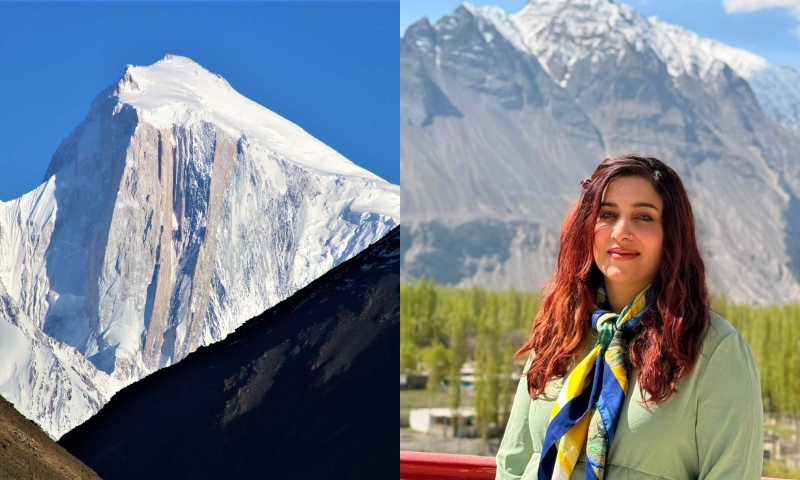
ISLAMABAD: Severe weather has forced a rescue team to abandon its attempt to reach Camp 3 of Spantik peak to retrieve the body of Pakistani mountaineer Asma Mushtaq, Information Minister Atta Tarar said on Sunday.
In a post on X, Tarar said that high-altitude porters were expected to reach Camp 3 and bring Mushtaq’s body down to base camp by Monday.
However, the rescue team managed to reach close to Camp 3 before heavy snowfall and strong winds forced its members to turn back and return to Camp 2.
“A helicopter has been authorised and coordination has been done between the Gilgit-Baltistan government and FCNA,” Tarar said, adding that alternative arrangements were also in place.
He said that Prime Minister Shehbaz Sharif was being kept updated on the situation and assured that “whatever can be done in these circumstances, will be done”.
The latest development comes amid extremely difficult weather and high-altitude conditions on Spantik, also known as Golden Peak, where Mushtaq died on August 20 while descending from the 7,027-metre summit.
According to a report in Dawn, the body of the 34-year-old doctor remains at an altitude of around 6,250 to 6,400 metres at Camp 3 in the Shigar district of Gilgit-Baltistan.
Mushtaq died after suffering a serious high-altitude medical emergency while descending from the summit.
She had successfully reached the summit of Spantik before developing what her expedition company described as a serious high-altitude medical problem at around 6,400 metres.
Her mountain guide Akbar Ali and another expedition guide, Muhammad Amin, reportedly assisted her in difficult weather and high-altitude conditions, but she could not survive despite efforts to help her.
The recovery operation has been particularly challenging because of continuing snowfall, strong winds and the extreme altitude at which the body is located.
According to media reports, a six-member team of high-altitude porters had reached Camp 2 and attempted to proceed towards Camp 3, but worsening weather forced them to retreat.
Baltistan Division Commissioner Kamal Khan told Dawn that the team was unable to safely remain at Camp 2 because of continuous heavy snowfall and extremely strong winds.
The team subsequently returned safely to base camp, with further efforts dependent on the availability of a suitable weather window, he said.
Helicopter rescue authorised
The authorities are now exploring an aerial option to assist in the recovery, with Tarar confirming that a helicopter has been authorised on humanitarian grounds.
However, the extreme altitude presents a major challenge.
According to the Alpine Club of Pakistan, the recovery team must first bring the body down from the high-altitude location before it can potentially be transported by helicopter.
Alpine Club of Pakistan General Secretary Ayaz Shigri said that the recovery operation was being coordinated by Mushtaq’s expedition company in consultation with the tourism department, local government and the club.
The club said the recovery team comprised climbers from different expeditions and that operations had been halted because of heavy snowfall.
The Alpine Club also stressed that it was not itself a dedicated rescue organisation and did not have specialised high-altitude rescue resources.
It said search and rescue operations depended largely on government resources, highlighting what it described as the absence of a dedicated and properly established high-altitude rescue system in Pakistan.
The club said it was working with relevant authorities under its new leadership to help develop a more effective rescue framework and improve the country’s mountaineering infrastructure.
The Alpine Club said that the circumstances surrounding Mushtaq’s death, as well as the conduct and response of the expedition company, would be investigated once the teams had safely returned and her body had been recovered.
It said that any necessary action would be taken in light of the findings of the investigation.
The club also urged people to avoid spreading misinformation or making unverified claims about the recovery operation, stressing that the immediate priority was the safe and dignified recovery of Mushtaq’s body.
Spantik climbing season
Spantik, commonly known as Golden Peak, is a 7,027-metre mountain in the Karakoram range and is one of Pakistan’s prominent mountaineering destinations.
Mushtaq had successfully reached its summit before falling ill during the descent.
Her death comes during the summer climbing season in Pakistan, when local and international mountaineers attempt some of the country’s highest peaks.
You May Also Like

- WEB DESK
- October 27, 2026
Punjab govt moves to provide life insurance cover to employees

- AFP
- October 27, 2026