
- Web Desk
- 9 Hours ago
Assault beyond the battlefield: Earth pays the environmental cost of US-Israeli strikes on Iran
-

- Web Desk
- 5 Minutes ago
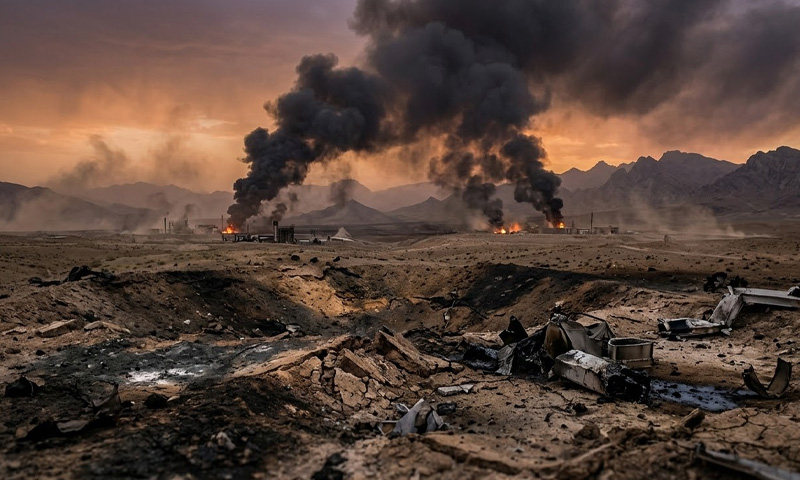
The recent wave of military escalation involving the United States and Israel targeting Iran has drawn global attention not only for its geopolitical implications, but also for its environmental consequences. According to an analysis reported by The Guardian, the first two weeks of the conflict alone generated more than 5 million tons of greenhouse gas emissions, raising urgent concerns about the hidden ecological toll of modern warfare.
While much of the global focus remains on military outcomes and strategic gains, experts argue that the more pressing question may be what the planet is losing. The emissions recorded in this short period are reportedly comparable to the annual output of dozens of low-emission countries, which shows how the armed conflict is accelerating climate change at an alarming rate.
WAR’S EXPANDING FOOTPRINT
Modern warfare is no longer confined to immediate human casualties and infrastructure damage. Researchers increasingly describe it as a full-scale environmental crisis. With global military spending reaching $2.7 trillion in 2024, the environmental cost of conflict is becoming harder to ignore.
Regions including Ukraine, Gaza, Sudan, Lebanon, and Iran are currently affected by war or rising tensions. However, scientists warn that environmental impacts, ranging from polluted air to contaminated water systems, extend far beyond national borders.
Bombing campaigns that destroy homes, hospitals, power grids, and agricultural land leave behind toxic soil and unsafe water, triggering long-term cycles of disease, displacement, and food insecurity.
ENERGY AND ECOSYSTEMS AT RISK
The latest Middle East tensions have also highlighted how energy infrastructure has become a central target. Strikes on Iranian oil facilities and fears of retaliation have heightened risks in ecologically sensitive areas like the Persian Gulf.
Heavy tanker traffic through the Strait of Hormuz, a vital artery for global oil transport, has further raised concerns about potential oil spills that could devastate marine ecosystems.
THE HIDDEN SOURCE OF EMISSIONS
Contrary to common assumptions, experts note that the majority of war-related emissions do not come directly from explosions. Instead, the destruction of buildings is a primary contributor. The collapse of thousands of civilian structures releases large amounts of stored carbon, while reconstruction efforts create additional long-term emissions.
Military logistics also play a significant role. Warplanes, naval fleets, and armored vehicles consume millions of liters of fuel, turning modern conflict into an energy-intensive operation. Burning oil depots and refineries release thick plumes of toxic smoke, posing severe health risks. Reports of phenomena such as “black rain” in Tehran have further illustrated the human and environmental dangers.
WAR AS AN INDUSTRIAL PROCESS
From production to deployment, weapons themselves contribute to environmental degradation. The manufacturing and use of missiles, drones, and bombs generate emissions at every stage, effectively making war a continuous industrial process with global ecological consequences.
Historical precedents reinforce these concerns. The legacy of chemical exposure from the Vietnam War, oil well fires during the Gulf War, and pollution-related health crises in Iraq demonstrate that environmental damage from conflict can persist for decades.
A WARNING FOR THE FUTURE
Experts increasingly argue that dependence on fossil fuels lies at the heart of both geopolitical tensions and environmental harm. As long as oil and gas dominate the global economy, the link between war and ecological damage is likely to persist.
Renewable energy sources such as solar and wind are being presented as potential alternatives, not only for their environmental benefits but also because they are less vulnerable to centralised disruption during conflict.
Ultimately, analysts suggest that the question is no longer who wins or loses wars. Instead, the deeper concern is the cumulative damage to the planet. As ecosystems degrade and air, water, and soil become increasingly unsafe, even the concept of victory begins to lose meaning.
Peace, experts accentuate, must be understood not just as the absence of conflict, but as the restoration of conditions that allow life to thrive. Without addressing the environmental costs of war, future conflicts may extend far beyond borders, threatening the stability of the entire planet.
You May Also Like