- AFP
- October 30, 2026
Aviation body urges govt to act over local airlines’ recruitment of foreign pilots
-

- Muhammad Zareef
- October 30, 2026
ISLAMABAD: The Aircraft Owners and Operators Association (AOOA) Pakistan has urged the government to review rules governing the recruitment of foreign pilots by domestic airlines, saying that more than 1,500 Pakistani aviators are unemployed while over 150 foreign pilots have been hired by local carriers.
In a letter sent to the defence secretary on October 29, AOOA founder Imran Aslam Khan called for immediate intervention by the Aviation Division, arguing that the recruitment of foreign flight crews was depriving qualified Pakistani pilots of employment opportunities and contributing to the outflow of foreign exchange.
The association said that foreign pilots were being paid tax-free salaries of up to $15,000 per month. Based on its estimate of more than 150 foreign pilots, it put the potential monthly foreign exchange outflow at over $2.25 million, equivalent to approximately Rs623.25 million.
Khan said that airlines, including Airblue, Fly Jinnah and AirSial, were relying heavily on foreign pilots instead of investing in the training and aircraft type-rating of Pakistani aviators.
These claims were made in the letter and have not been independently verified.
The association also expressed concern over what it described as a change in regulations that had extended the permissible period for foreign pilots from six months, with a possible six-month extension, to three years.
It alleged that the change had been introduced without consultation with key stakeholders in the domestic aviation industry and warned that airlines could exploit the arrangement by rotating foreign flight crews, effectively extending their presence in the country.
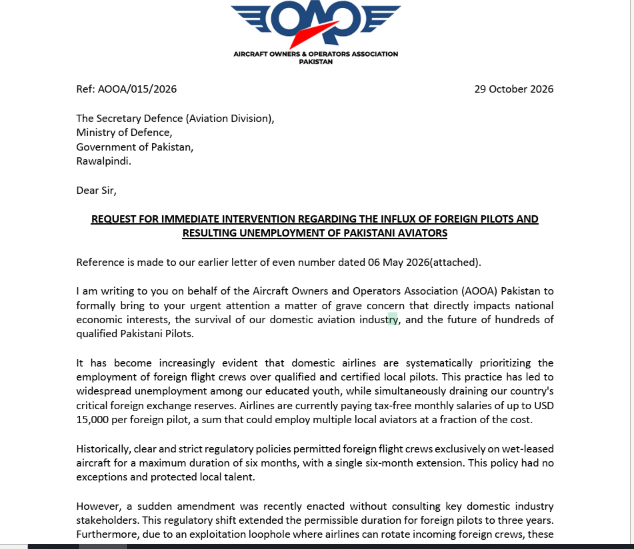
The association asked the government to review and reverse the regulatory changes, strengthen oversight to prevent the alleged misuse of crew-rotation arrangements, and require domestic airlines to prioritise the recruitment and training of qualified Pakistani pilots.
Khan argued that the cost of training a local pilot and obtaining the necessary aircraft rating was lower than the monthly salary paid to a foreign pilot, and questioned why airlines were not investing in developing local aviation talent.
The issue of foreign pilot recruitment has previously been raised by the association.
In February 2024, the AOOA had criticised local airlines for favouring foreign pilots, alleging that hundreds of Pakistani aviators were without jobs.
However, the regulatory framework involves separate provisions for foreign pilots’ licence validation and the temporary induction of foreign-registered aircraft under wet-lease arrangements.
Pakistan’s National Aviation Policy 2023 provides for the validation of foreign flight-crew licences for a maximum period of one year under Civil Aviation Authority procedures.
In January 2025, the federal cabinet approved a three-year validation period for foreign pilots joining Pakistani airlines in 2025, while also approving a two-year extension for 86 foreign pilots already working in the country.
Separately, the Civil Aviation Authority’s rules for the temporary induction of foreign-registered aircraft under wet-lease arrangements provide for an initial period of up to 120 days, extendable to a maximum of 180 days.
The distinction is significant because the validation of a foreign pilot’s licence and the period for which a foreign aircraft may operate under a wet lease are separate regulatory matters.
The AOOA said keeping qualified Pakistani pilots out of employment while relying on foreign crews undermined the development of the country’s aviation industry and placed additional pressure on foreign exchange reserves.
It urged the Ministry of Defence to take immediate steps to protect local employment and encourage airlines to invest in training and employing Pakistani aviators.
You May Also Like


- WEB DESK
- October 30, 2026
Pakistan witnesses sharp drop in gold prices

- WEB DESK
- October 30, 2026