- Web
- 5 Hours ago
Bangladesh’s first woman prime minister Khaleda Zia dies at 80
-

- Web Desk
- Dec 30, 2025
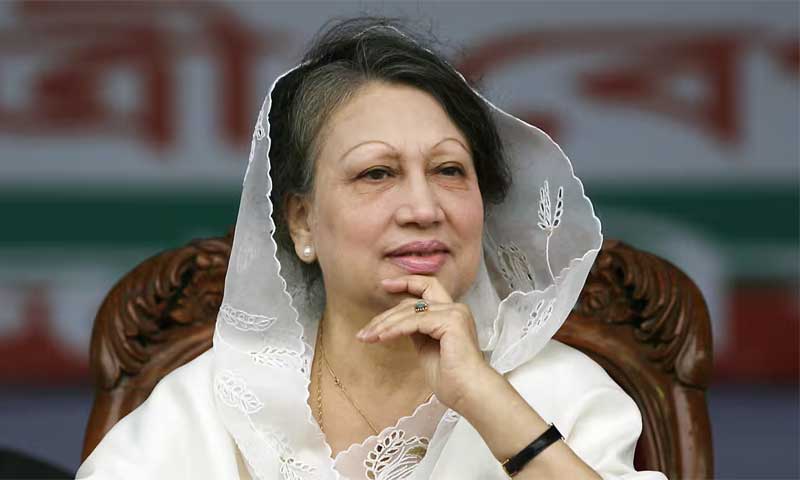
WEB DESK: Khaleda Zia, a towering and polarising figure in Bangladesh’s politics and the country’s first female prime minister, passed away on Tuesday at the age of 80 after a prolonged illness, her party said.
The veteran leader of the Bangladesh Nationalist Party (BNP) had been suffering from multiple health complications, including advanced liver disease, diabetes, arthritis and heart-related ailments. She had travelled to London earlier this year for treatment and remained there for several months before returning home.
Though she had not held public office for nearly two decades and spent years either in prison or under house arrest, Khaleda retained deep influence over national politics through the BNP, which continues to command a strong support base.
A nation at a political crossroads
Khaleda’s death comes at a critical moment for Bangladesh, which is preparing for parliamentary elections scheduled for February. The BNP is widely regarded as a leading contender in the polls.
Her elder son, Tarique Rahman, the party’s acting chairman, returned to Bangladesh last week after nearly 17 years in exile and is seen as a key political figure ahead of the vote.
Since August 2024, the country has been governed by an interim administration led by Nobel Peace Prize laureate Muhammad Yunus, following a student-led uprising that forced longtime prime minister Sheikh Hasina from power. In November, Hasina was sentenced to death in absentia over her government’s violent crackdown on those protests.
From private life to political leadership
Often referred to simply as “Khaleda,” she was initially known as a reserved figure focused on family life. Her entry into politics followed the assassination of her husband, President Ziaur Rahman, during a failed military coup in 1981.
In 1984, she assumed leadership of the BNP, the party founded by her late husband, pledging to pursue his vision of economic self-reliance and poverty reduction.
She later joined forces with Sheikh Hasina—daughter of Bangladesh’s founding leader Sheikh Mujibur Rahman—to lead a mass movement that ended the military rule of Hussain Mohammad Ershad in 1990, paving the way for democratic elections.
The ‘battling Begums’
The alliance between the two women soon collapsed, giving rise to one of South Asia’s most enduring political rivalries. Khaleda and Hasina came to be known as the “battling Begums,” a term reflecting both their prominence and the intensity of their feud.
Supporters portrayed Khaleda as composed, traditional and measured in speech, but firm and unyielding in political combat. Hasina, by contrast, was seen as more forceful and outspoken. Their sharply different styles helped shape decades of confrontational politics in Bangladesh.
First woman to lead Bangladesh
In the landmark 1991 election, widely viewed as Bangladesh’s first genuinely free vote, Khaleda defeated Hasina to become prime minister, with backing from Islamist party Jamaat-e-Islami. The victory made her the first woman to head the government of Bangladesh and only the second woman, after Pakistan’s Benazir Bhutto, to lead a democratic government in a Muslim-majority country.
During her first term, she restored the parliamentary system, shifting power from the presidency to the prime minister’s office. Her government also eased restrictions on foreign investment and introduced free, compulsory primary education.
She lost office in 1996 but returned to power in 2001 with a landslide victory.
Controversy and decline
Khaleda’s second term was overshadowed by the rise of militant Islamist groups and persistent allegations of corruption. Tensions peaked in 2004 when a grenade attack on a rally addressed by Hasina killed more than 20 people and injured hundreds. While Hasina survived, Khaleda’s government and its allies faced widespread blame.
Although her administration later moved against extremist outfits, political instability deepened. In 2006, an army-backed interim government took control, jailing both Khaleda and Hasina on corruption-related charges. They were released about a year later ahead of the 2008 election, which Khaleda lost.
The BNP subsequently boycotted elections in 2014 and 2024, while Khaleda’s rivalry with Hasina continued to dominate public life, often triggering protests, shutdowns and deadly clashes that hampered economic progress in the flood-prone, densely populated nation of around 175 million people.
Legal battles and final years
In 2018, Khaleda and her associates were convicted in a corruption case involving foreign donations to a charitable trust and sentenced to prison terms. She rejected the charges as politically motivated. Due to declining health, she was shifted from jail to house arrest in 2020.
Following Hasina’s removal in 2024, Khaleda was released from house arrest. In early 2025, Bangladesh’s Supreme Court overturned her conviction, while Tarique Rahman was also cleared in both the corruption case and the 2004 grenade attack.
Her death marks the end of an era defined by fierce rivalry, political upheaval and the outsized influence of two women who shaped Bangladesh’s modern history.
You May Also Like


- Web
- 7 Hours ago
SpaceX IPO signals arrival of the space economy