- Web Desk
- Yesterday
Bhutto hanging reference: ‘court can only examine case to extent of fair trial’
-

- Web Desk Javed Somroo
- Feb 26, 2024
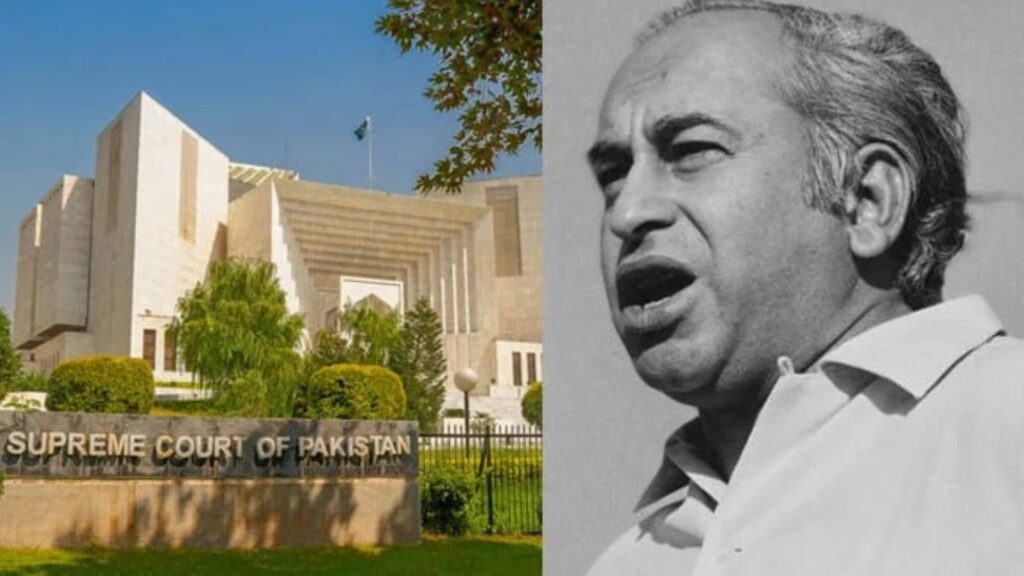
ISLAMABAD: During the hearing of the presidential reference against the hanging of former prime Mminister Zulfikar Ali Bhutto in the Supreme Court, Justice Mansoor Ali Shah observed that, in his opinion, the court can only scrutinize the case to the extent of trial’s transparency.
A nine-member larger bench headed by Chief Justice Qazi Faez Isa heard the case. The bench included Justice Sardar Tariq Masood, Justice Mansoor Ali Shah, Justice Yahya Afridi, Justice Aminuddin, Justice Jamal Mandokhail, Justice Muhammad Ali Mazhar, Justice Hasan Azhar Rizvi, and Justice Musarrat Hilali.
Court assistant Khalid Javed Khan initiated the arguments by stating that the Supreme Court cannot reopen the trial of the Zulfikar Ali Bhutto case; rather, it can only declare whether the Bhutto case was conducted improperly. In response, Justice Mansoor Ali Shah remarked that the Supreme Court cannot delve into the merits of the Bhutto case.
Chief Justice Qazi Faez Isa emphasized that the Supreme Court is obligated to give an opinion on the presidential reference, with judges having only two questions before them: whether the crime occurred and whether the trial was fair.
Khalid Javed Khan contended that the court must address matters beyond political considerations. Justice Mansoor Ali Shah reiterated his view that the court’s jurisdiction is limited to the transparency of the trial.
During the proceedings, the court assistant noted that the entire state machinery was under the control of dictator ZiaulHaq during Bhutto’s trial.
Chief Justice Qazi Faez Isa highlighted that the Zulfikar Ali Bhutto case is the only criminal verdict in history spanning 935 pages, prompting discussion among the judges about the unusually detailed nature of the judgment.
Court assistant Khalid Javed Khan further argued that Lahore High Court Judge Aftab Ahmed’s comments on Bhutto’s religious adherence should not have been included in the judgment.
The chief justice inquired whether the Lahore High Court judge had indeed made such remarks. Khalid Javed Khan referenced the written verdict of the Supreme Court where the observation of the High Court judge was noted. The chief justice stressed the importance of correcting any judicial mistakes according to Islamic principles. Justice Mansoor Ali Shah urged the presentation of evidence showing pressure on the judges or biased decision-making.
‘If the judiciary was free, Bhutto would not have been hanged’
In response, court assistant Khalid Javed Khan stated that if the judiciary was free, Bhutto would not have been hanged, adding that the judicial bench that heard the case in the Supreme Court on appeal also included ad hoc judges.
The attorney general said that a nine-member bench initially heard the case, but later it was reduced to seven. Justice Mansoor Ali Shah remarked that recently, a nine-member bench started the election case, which was later reduced to six.
Justice Aminuddin Khan explained how Naseem Hasan Shah could hear the case as an ad hoc judge. Court assistant Khalid Javed Khan continued by stating that the the Bhutto reference was transferred to the high court without giving notice to the accused. The chief justice of Pakistan noted that while such examples may exist elsewhere, the parliament holds the authority to enact laws in Pakistan, not the court.
Khalid Javed Khan further mentioned that Justice Athar Minallah had expressed in a verdict that the decision to hang Bhutto was incorrect. Justice Mansoor Ali Shah commented that it was a declaration. After Khalid Javed Khan concluded his arguments, court assistant Barrister Salahuddin began his arguments.
Barrister Salahuddin argued that the court often revises its previous decisions, raising the question of whether the court can do so under Article 3/186. Referring to a verdict from the Indian Supreme Court, he highlighted the principle of redefining laws.
The chief justice questioned his reliance on Indian verdicts, to which Barrister Salahuddin responded by citing Pakistani verdicts as well, including the Supreme Court’s judgment on judges’ appointments in 2013. Justice Mansoor Ali Shah inquired about the legal question in the Bhutto case, to which Barrister Salahuddin replied that it pertains to the biasness of the verdict following a judge’s revelations.
“He might have thought that if he was not punished, he would become a prosecutor tomorrow and impose Article 6 on us.”
Justice Qazi Faez Isa asked the court assistant why he was ignoring one aspect of about biasness in the case. “He might have thought that if he was not punished, he would become a prosecutor tomorrow and trial them Article 6. These things are not in the Bhutto verdict but are part of history,” the chief justice observed.
Barrister Salahuddin replied, “Some things are indeed part of history, but the problem is which decisions of that era should be upheld and which ones should be abolished.”
The chief justice of Pakistan said, “I will solve your problem by saying that we have only one reference before us.” Barrister Salahuddin responded, saying that the concern is that after this, more cases of that era will be opened.
Justice Mansoor Ali Shah remarked, “You are saying that the judge was not free and it was murder of justice.” The court assistant replied, “Yes, this is my position.”
Later, in the Bhutto reference, Barrister Salahuddin cited an important reference from Justice Naseem’s book and told that after giving the verdict against Bhutto, the Chief Justice of the High Court, Mushtaq, took the Attorney General Pirzada to meet Justice Naseem Hassan Shah and said that you should sit in the bench of appeal against the verdict, so only on this point the death penalty should have been void.
The chief justice inquired whether Justice Mushtaq was alive when the book was published. The court assistant said that Sharifuddin Pirzada was alive. After this meeting, the bias of against the Chief Justice of the Lahore High Court against Justice Naseem Hassan Shah had been revealed, but despite this, his petition challenging biasness was dismissed.
Barrister Salahuddin further said that Justice Naseem Hassan Shah said that no one told us to do this, then he said, maybe the talked to the chief justice of that time and maybe telling them indirectly, do this and that, and it would be better.
On this, the chief justice asked the court assistant what does it mean to say indirectly? The court assistant replied that I am just pointing out his words.
Barrister Salahuddin cited an interview given by Naseem Hassan Shah to Iftikhar Ahmed and said that he admitted in the interview that the then chief justice had enmity with Bhutto.
Naseem Hassan Shah said that the punishment could have been reduced but Bhutto’s lawyer had angered him, so should a judge in a death penalty case punish someone on the lawyer’s conduct?
On this, Chief Justice Qazi Faez Isa remarked that the client could not be punished on his lawyer’s conduct.
Barrister Salahuddin completed his arguments.
Later, the chief justice said that tomorrow we will hear the criminal aspect of the matter.
Meanwhile, Aitzaz Ahsan also appeared in the court as an assistant. On his arrival, the chief justice inquired why he was not coming earlier.
Talking to Aitzaz Ahsan, Justice Yahya Afridi said that someone had given a statement on your behalf that you will not appear.
The chief justice remarked that if there is no objection, we will listen to Aitzaz Ahsan, and tomorrow we will hear the court assistant Manzoor Malik.
On this, Farooq H Naik said that before hearing the criminal aspect, I should be heard on behalf of Bilawal Bhutto as he had requested to be a party on behalf of Bilawal, I have no relation with the president in this case, he said.
After that, the court adjourned the hearing till Tuesday.
Chief Justice Qazi Faez Isa later wrote a verdict stating that court assistants Khalid Javed and Salahuddin have completed the arguments, and further hearing on the reference will be held at 11:30 am tomorrow.
It may be recalled that on February 20, during the hearing of the presidential reference against the hanging of Zulfikar Ali Bhutto, Justice Mansoor Ali Shah had said that the real question in this case was whether the judicial process was followed correctly or not.
The chief justice of Pakistan had said that “our domain to hear is very clear, there can be no review twice, how can we draw a line in this case?”
He had inquired whether is there a question of bias in this case or accept the wrong decision?
The court assistant had argued that one judge said in an interview that he was under pressure. On which Qazi Faez Isa said that he did not say that “I harboured bias, if I could not bear the pressure, I should have left the judicial bench. One person can say that someone is biased, but it is possible that the other does not have this opinion.
Makhdoom Ali Khan had argued regarding the interview of Justice Naseem Hassan Shah and told the court that it was almost difficult to prove biasness.
You May Also Like