- Web Desk
- Yesterday
Bhutto hanging reference: SC grapples with intricate details of decades-old case
-

- Web Desk Javed Somroo
- Feb 27, 2024
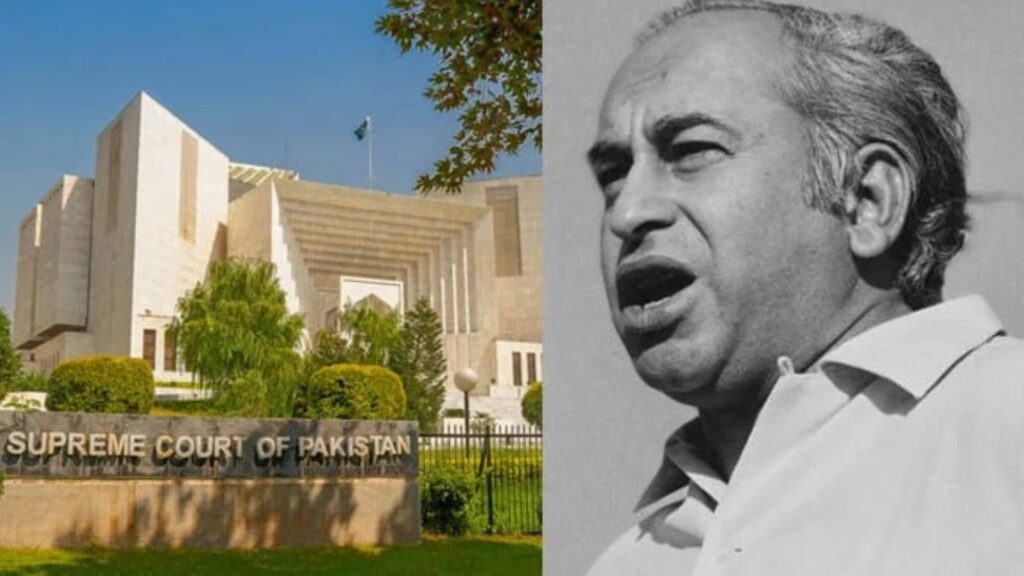
ISLAMABAD: The hearing on the presidential reference against the hanging of former prime minister Zulfikar Ali Bhutto in the Supreme Court was adjourned until 11:30 tomorrow. During the hearing, Chief Justice Qazi Faez Isa remarked that our court is very democratic and we also disagree with each other.
Chief Justice of Pakistan Justice Qazi Faez Isa presided over a 9-member larger bench hearing the case.
The bench included Justice Sardar Tariq Masood, Justice Mansoor Ali Shah, Justice Yahya Afridi, Justice Amin-ud-Din, Justice Jamal Mandokhail, Justice Muhammad Ali Mazhar, Justice Hassan Azhar Rizvi, and Justice Mussarat Hilali.
Court assistant Manzoor Malik presented arguments, stating that “I have prepared the summary of this case. This incident occurred between November 11 and 12, 1974. This incident occurred at Shadman Chowk in Lahore. The case was registered at the Ichhra Police Station Lahore and was closed stating that the culprits could not be traced.”
He said that Zulfikar Ali Bhutto was not a nominated accused in the case; the case record was taken again for investigation on August 8, 1977. No written permission was taken from the magistrate for re-investigations. The record of the case was taken later according to the documents; the investigation had already started again.
The court assistant said that on February 6, 1979, a 7-member bench of the Supreme Court heard the appeal against Bhutto’s sentence, and the Supreme Court upheld the sentence of Zulfikar Ali Bhutto and his co-defendant. The case was registered on the application of Ahmed Raza Qasuri.
He further said that how the first investigation into the murder was closed and how it was restarted is important. It was said before closing the first investigation that the whereabouts of the accused could not be traced. The police had requested the magistrate to enter the case in the register; the magistrate had accepted the police request, and the magistrate issued a formal order to close the case. This order of the magistrate was not challenged anywhere.
Manzoor Malik said that the magistrate’s order is still valid today, but the FIA conducted a separate investigation, on which the Chief Justice observed that the Supreme Court has not said anything on this matter?
The court assistant replied that the Supreme Court only wrote it, but the FIA conducted a separate investigation; this was not just prejudice but also injustice.
The court assistant further said that it was said that it was conspired to murder Ahmed Raza Qasuri but Ahmed Raza Qasuri is still alive today; may Allah grant him a long life. He said Session Judge Ejaz Nisar had sought a report from the public prosecutor on the matter but the case was transferred to the High Court the next day.
The court assistant responded, “Zulfikar Ali Bhutto had levelled charges of bias.” The Chief Justice commented, “That was just an allegation up to the extent of one judge.” To this, Manzoor Malik said, “When the Chief Justice is accused of bias, everyone else gets involved.”
Justice Sardar Tariq Masood asked the court assistant, “Who are you referring to as the elephant?” Manzoor Malik replied, “I am not saying this; it was said by the one who created the dialogue.”
“Differences mean you are alive,” remarked the Chief Justice. The court assistant responded, “This is a very healthy thing; differences mean you are alive.”
Justice Jamal Mandokhail remarked, “Whoever disagrees, breaks away like an elephant.”
Later, Justice Qazi Faez Isa suggested, “You have been standing for quite a while; take a break or let’s proceed to complete the point raised about the transfer of the case.”
Afterwards, the court adjourned the hearing on the presidential reference against Zulfikar Ali Bhutto’s hanging until 2:30 p.m.
Following the break, Manzoor Malik informed the court that the first hearing was held on September 24, 1977, and the next hearing was adjourned for the presentation of evidence.
Justice Qazi Faez Isa inquired, “Were Zulfikar Ali Bhutto’s lawyers present?” Manzoor Malik clarified, “The first hearing was not held yet; they were not presented yet. There was a clear violation of legal procedure.”
The Chief Justice remarked, “I am looking at the order sheet; it seems like it was a criminal case.” Justice Muhammad Ali Mazhar commented, “The individual crime was charged on October 11.”
Justice Jamal Mandokhail inquired, “What will happen if there is insufficient evidence against someone for a criminal offense?” The court assistant responded, “In such a case, the accused will be acquitted. In Bhutto’s case, individual charges were filed separately against each accused, disregarding the principle that multiple accused would share a single criminal charge. It was predetermined from the first day that as soon as an accused appeared, the trial would commence. On the very first day, it was decided to seek testimonies.”
The court assistant continued, “The question also arises whether the chief justice of that time should have heard this case? When he wrote that he was displeased, he had already formed a party.”
To this, the chief justice commented, “Let’s examine the first charge against Bhutto. This charge suggests elements of a murder conspiracy. Can someone explain where and how this conspiracy took place? I am puzzled. The basis of a murder conspiracy has been alleged in this case.”
While presenting arguments, the court assistant revealed that one witness claimed he had taken an oath to kill the retired chief justice, and later, another witness clarified that the statement was actually intended for Justice Jamil Hussain Rizvi. Upon this revelation, the acting chief justice said, “The chief justice’s turn hasn’t come yet?” To which Bhutto responded, “His turn will come.”
Manzoor Malik further explained, “Upon this, the then acting chief justice had said if something like this happened, you would be held responsible. The then acting chief justice said, ‘If something happens to me, then catch him.’ So, when you are accusing someone like this, what will be the outcome if you also conduct their trial? The then acting chief justice initiated this conversation himself.”
Justice Mussarat Hilali inquired, “Was there any statement recorded from the complainant in the case?” Manzoor Malik explained, “They were back in the People’s Party in ’77, seeking tickets, speaking in favor of Bhutto, but there’s no record; they weren’t given a ticket in the elections.”
To this, Justice Mussarat Hilali asked, “When was the complaint registered again?”
The court assistant replied, “There’s no record; the matter resumed after the martial law.”
Later, the court adjourned the hearing on the presidential reference against Zulfikar Ali Bhutto’s hanging until 11:30 tomorrow.
It’s worth recalling that during the hearing yesterday in the Supreme Court on the presidential reference against former prime minister Zulfikar Ali Bhutto’s hanging, Justice Mansoor Ali Shah had remarked that, in his opinion, the court could only examine the Bhutto case to the extent that the trial was transparent.
Chief Justice Justice Faiz Esa stated that the Supreme Court is bound to give its opinion on the presidential reference; there are only two questions before the judge: whether a crime was committed or not.
The chief justice had mentioned that Zulfikar Ali Bhutto’s case is the only unique military decision in history, spanning 935 long pages. Has there ever been such a lengthy military decision? The court extended the hearing until the 27th of February after Barrister Salahuddin and Khalid Javaid Khan concluded their arguments during yesterday’s hearing.
You May Also Like