- Web Desk
- 16 Minutes ago
Can ‘Plastic Credits’ be Pakistan’s green leverage on the world stage?
-

- Syeda Masooma
- Nov 26, 2025
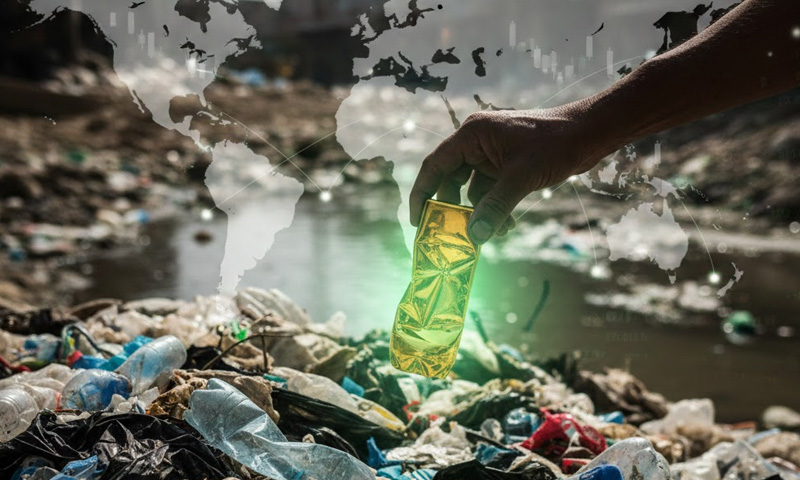
Plastic credits have emerged as one of the most contested instruments in global sustainability debates. While some multinational companies have distanced themselves from the concept, a compelling experiment is quietly unfolding in Thailand, demonstrating the model’s potential. Advocates, including officials in Pakistan, see plastic credits not only as a tool for incentivising cleaner environments but also as a lever for economic growth and international diplomacy. Critics, however, argue that the system can fall short, failing to deliver tangible environmental impact and, in some cases, even enabling continued plastic production.
Modeled on the carbon-credit system, the concept is deceptively simple: a company can offset its plastic footprint by paying for an equivalent amount of plastic to be collected, recycled, or kept out of the environment – the polluter effectively funds the clean-up. Pakistan’s perspective, however, is broader. Musadik Malik’s climate ministry sees plastic credits not merely as an environmental tool but as a strategic lever; one that could spark a new industry, elevate Pakistan’s role in global climate governance, boost exports, and advance both environmental and economic justice. And there’s reason to believe it could succeed. Here’s why…
WHAT ARE PLASTIC CREDITS?
Plastic credits are still an emerging concept. The World Bank noted in a recent report that there is no universally accepted definition. Drawing from carbon-credit architecture, a plastic credit generally represents a measurable unit of plastic that has been avoided, collected, managed, or recycled through a verifiable project. These credits can be sold to plastic producers or consumer-goods companies seeking to offset their footprint, with payments tied to demonstrable outcomes. In short: if a company produces one kilogram of plastic, it may pay another entity to remove or recycle one kilogram on its behalf, aligning corporate responsibility with environmental action.
Pakistan is not a major plastics producer, nor a petrochemical powerhouse. Yet the country sits at a unique intersection of the global recycling economy. Recycled plastic is currently more expensive than virgin plastic, due to high labor and processing costs, while the price of virgin plastic tracks oil markets. For low-income countries like Pakistan, this creates a dilemma: use cheaper virgin plastic or bear the higher cost of recycled content. As Pakistan’s climate minister, Dr Musadik Malik, explains, wealthier countries can focus solely on sustainability, but Pakistan must balance “access, affordability, and sustainability simultaneously.” The opportunity lies not in consuming recycled plastic locally, but in producing it for global markets.
A SHIFT IN GLOBAL RESPONSIBILITY
Dr Malik and his team are advocating a shift from “extended producer responsibility” to “extended consumer responsibility.” The reasoning is clear: per capita plastic consumption in the US is 105-216 kilograms; in China, 76 kilograms; in Pakistan, just 6-7 kilograms. Yet countries with low consumption often shoulder a disproportionate share of global plastic waste. Pakistan’s approach aligns responsibility with consumption, focusing on “climate justice” – a principle already shaping negotiations on carbon, adaptation, and loss-and-damage finance. High-consumption countries, the argument goes, should fund recycling infrastructure in lower-income countries with the labor capacity and environmental need to manage the waste.
PAKISTAN’S PROPOSAL
At the fifth UN negotiating session on the global plastics treaty in Geneva, Pakistan proposed the creation of a Global Plastic Fund: a marketplace where plastic credits could be traded, allowing high-consumption states to support verified recycling, waste collection, and prevention projects in lower-income countries. The mechanism mirrors carbon markets; major consumers purchase credits generated by projects in developing nations, and the revenue flows into building recycling plants, improving waste-management systems, and formalising informal waste labor.
With per capita consumption at only 7 kilograms, Pakistan contributes little to global plastic pollution yet lacks the domestic financial capacity to establish recycling systems. Under an Extended Consumer Responsibility (ECR) framework, the financial burden should shift to those consuming the bulk of plastic. A functional plastic-credit market could provide startup capital for industrial recycling that is otherwise difficult to secure. As Dr Malik puts it, “We are not even asking high-consumption countries for money. We are asking them to establish a marketplace.” In doing so, Pakistan positions itself as a potential leader in shaping the next phase of global environmental governance.
DO PLASTIC CREDITS WORK?
Practical examples suggest they can. Verra, a nonprofit standard-setter, issued the first Plastic Waste Reduction Credits to Second Life Thailand under its Plastic Waste Reduction Program. The credits – Waste Collection Credits (WCCs) and Waste Recycling Credits (WRCs) – represent one metric ton of plastic removed or recycled. Second Life Thailand focuses on preventing plastic pollution, particularly on islands, by funding the collection, sorting, and recycling of hard-to-reach plastic waste, including fishing nets, while providing training, protective equipment, and fair wages to workers.
Companies such as French cosmetics brand Caudalie purchase these credits to offset their plastic footprint beyond their supply chain, supporting projects that make packaging recyclable and fund sustainable plastic waste management. By connecting private companies with verified projects like Second Life Thailand, plastic credits enable measurable environmental impact and promote corporate stewardship.
Yet critics caution that credits do not directly reduce the production of new plastic – they are a mitigation tool, not a solution to the root cause of pollution. Nevertheless, they do fund verified plastic collection and recycling projects that might not otherwise exist, improving local livelihoods and contributing to the circular economy. For Pakistan, this provides enough justification to pursue the concept, while offering the world a tangible example of how a plastic-credit system can function.
PAKISTAN’S CAPACITY AND POLICY LANDSCAPE
Pakistan already has a National Plastic Action Partnership and several policies aimed at reducing plastic pollution. Yet, much of the framework focuses on limiting production rather than recycling. According to the August 2025 study Micro-sectoral Study on Plastics: Greening Challenges and Environmental Impact, only 3-4 percent of the country’s plastic waste is recycled. Some private enterprises, such as Saaf Suthra Sheher in Islamabad, are recycling plastics on a small scale, but these efforts remain fragmented, with no formal integration into a national system or recognition of the labor that collects and sorts plastic. Despite these gaps, the potential for scaling exists.
THE POLITICAL ECONOMY OF PARTICIPATION
A functioning plastic-credit market could address one of Pakistan’s persistent climate-policy challenges: low private-sector engagement. Although the country has pledged to cut projected emissions by 50 percent by 2030, there are no mandatory emissions-reduction targets for individual firms. Climate responsibility remains largely rhetorical. Plastic credits could change that by creating a verified, revenue-generating system tied to global markets, incentivising private firms to participate in environmental action.
The mechanism also addresses the shortage of bankable environmental projects – a concern repeatedly voiced by Finance Minister Muhammad Aurangzeb. As the finance ministry explores the retirement of coal plants and instruments like green panda bonds, plastic-recycling infrastructure could emerge as a parallel pipeline of viable green investments.
A CONVERGENCE OF INDUSTRY, TRADE, AND CLIMATE AMBITION
If Pakistan’s ministries, including climate, foreign affairs, industries, and finance, coordinate effectively and secure global support for a consumer-responsibility model, the country could become a regional recycling hub. Pakistan has the labor supply, geographic position, and diplomatic momentum to stake this claim.
Dr Malik has noted that domestic political debates often overshadow substantive climate proposals. Plastic credits are frequently framed as a technical matter, rather than a strategic tool for economic growth, climate diplomacy, and environmental equity. By reframing them as such, Pakistan could position itself at the intersection of global sustainability and trade, contributing to a just and viable global plastics transition!