- Zahid Gishkori Web Desk
- Yesterday
‘Civilians’ manage security, traffic as AJK police’s indefinite strike enters Day 2
-

- Web Desk
- Jul 22, 2025
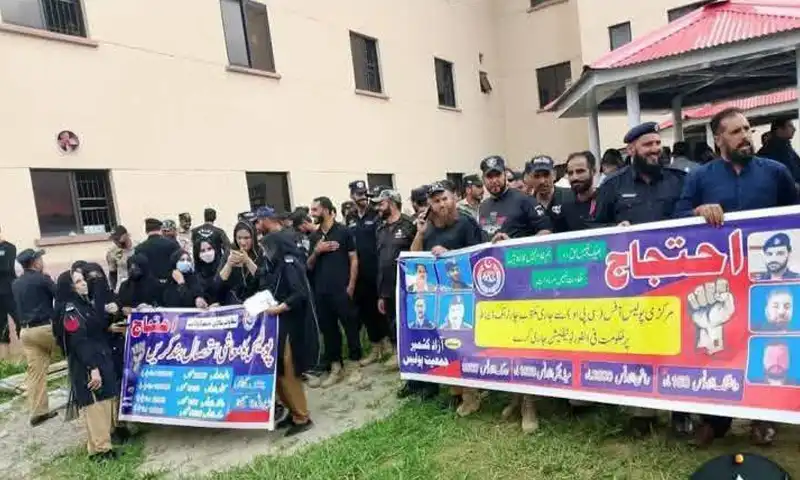
RAWALAKOT: With the Azad Jammu and Kashmir (AJK) police strike entering another day, civil defence personnel and magistrates have taken over policing duties in Poonch, while local volunteer groups have stepped in to manage traffic and maintain order.
The AJK police launched an indefinite pen-down strike on Monday in support of their 12-point charter of demands, calling for urgent revisions in pension benefits, risk allowance, and pay structures in line with recent federal updates.
A large of personnel, from grade 1 to grade 16, observe the pen-down strike across the state to call for addressing long-standing concerns regarding their welfare and the need to bring parity with other security institutions.
A key demand is related to the pension and family benefits of martyred personnel. The police have called for lifetime pension benefits to the families of martyrs, even after the widow reaches the age of 60, aligning it with the system used for army martyrs.
Police high-ups denied strike
When the police force announced to launch their protest from July 21, the AJK police department issued statement to media, categorically denying any protest.
“A fake post attributing to AJK police force is being circulating on social media, announcing that police personnel are going to observe pen-down strike on July 21 for nonfulfillment of their charter of demand. AJK police department totally disassociates itself from this baseless and ungrounded post.”
However, time proved that the posts were not from what the AJK Police department called “miscreants” but from the force, which not only held protest on the said date, but also continuing their strike.
Who handles police job?
According to district administration Poonch, civil defence officials and magistrates have been deployed across Rawalakot to ensure smooth traffic flow.

In parallel, the Awami Action Committee has mobilised its volunteers at major junctions, offering services to prevent disruptions, with updates and images of their efforts circulating on social media.
Sabotaging the police movement
Earlier, the Action Committee – while announcing an indefinite, state-wide shutdown from September 29 – had vowed full support to the AJK police personnel’s strike. However, analysts view the committee’s voluntary support for managing public duties as inadvertently aiding the government’s efforts to undermine the strike.
They point out that in several districts – Bhimber, Mirpur, Kotli, and Muzaffarabad – the authorities have partially succeeded in breaking the strike. Poonch Division remains the only stronghold where the strike is being observed in full force.

Observers say that in such protests, states typically attempt to bypass disruptions by using alternate means to maintain essential services – often labelling anyone who fills the vacuum as a “state facilitator.”
They argue that while the Action Committee openly supports the police strike, its role in keeping civic operations running could ultimately demoralise striking officers and allow the government to delay or reject their demands.
Disciplinary action against aggrieved cops
Meanwhile, disciplinary action has been initiated against protesting police personnel as the police’s strike and sit-in at the district complex in Rawalakot continues.
The AJK Police department has begun issuing show-cause notices, with five personnel from the Muzaffarabad Anti-Riot Force already served notices.
‘External elements fuelling protest’
Meanwhile, Inspector General of Police (IGP) AJK has reportedly dismissed the strike as being fuelled by external influence, stating in a recent address to officers that the protest is not representative of the entire force.
He also assured that notifications addressing key issues would be issued within two weeks, while subtly warning that further disciplinary action may follow if the strike continues.

However, sources within the police force say the protesting officers have rejected the two-week timeline and remain firm on continuing the strike until their demands are accepted.
Due to fear of retaliation, the striking officers have not appointed an official spokesperson, and their stance is being conveyed only through indirect channels.
Lollypops and traps
In a related development, the AJK government has issued a notification approving the Disparity Reduction Allowance (DRA) at 30% of the basic pay for all government employees from grade 1 to 22, effective from July 1.
Although the notification does not explicitly exclude police personnel, officers claim they have never received the allowance in the past.

One of the key demands of the ongoing protest is to extend the DRA to police employees as well. The allowance is intended to bridge the pay gap among employees within the same cadre across various departments.
The police strike shows no signs of abating, as frustration builds over longstanding issues and perceived injustices in pay and benefits.
Other demands
The AJK police’s 12-point charter further demands:
- Revised commutation formula as per Finance Division’s 2022 notification.
- Implementation of pension rates effective from July 1, 2022, instead of the outdated 2008 scale.
- Increase in risk allowance to Rs500 per month.
- Rs1,500 monthly medical allowance in line with federal hospital staff.
- Designation of major hospitals in Pakistan as referral hospitals for AJK police in critical cases.
- Improvements in uniform quality and central procurement through police headquarters.
- Better facilities for constables and junior ranks.
- Revision of washing allowance based on prevailing inflation.
- Application of 2025 pension scale on 2012 pensioners.
- Pension calculation for those retiring in 2025 to be based on updated basic pay.
- Clarity and justice in applying 2008 pension scales to multiple retirement cases.
- Inclusion of police in the 100 percent special allowance granted to AJK secretariat staff and 32 percent ad hoc relief from 2022.
The police have urged authorities to address these concerns without delay, warning of growing discontent among ranks if parity with other departments is not ensured.
You May Also Like