- Web Desk
- Mar 24, 2026
Climber Samina Baig evacuated from K2 base camp over respiratory problem
-

- Tanveer Abbas Web Desk
- Jul 05, 2024
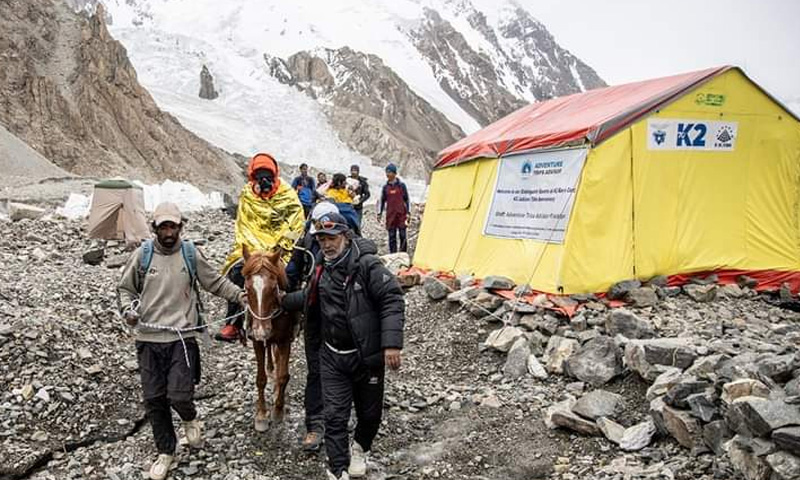
GILGIT: Pakistani climmber Samina Baig, who was part of the Italian-Pakistani female expedition team of the Italian Alpine Club K2-70, was evacuated from K2 base camp on Friday due to respiratory problems.
The K2-70 project features an Italy-Pakistan all-woman team aiming to summit the world’s second-highest peak, K2, in honor of the platinum jubilee of the first ascent of the 8,611-meter-high mountain. The expedition team includes four Pakistani climbers — Samina Baig, Amina Bano, Nadeema Sahar, Samana Rahim—and four Italian women climbers — Federica Mingolla, Silvia Loreggian, Anna Torretta, and Cristina Piolini.
“Samina Baig is the leading climber of our Pakistani group. But health mishaps, linked to the extreme environment and high altitude, can affect anyone, even the most trained climbers. And high altitude has a negative impact on the ability to heal,” said expedition leader Agostino Da Polenza in a statement.
He said that expedition doctor Lorenza Pratali and the team decided to have her leave base camp as her symptoms were worsening.
Polenza said the airlift through helicopters was impossible due bad weather. “Dr. Lorenza Pratali, Samina Baig’s brother and I have decided to take her down on a horse to the village of Askole. The goal is to reach Askole in 24 hours. Accompanying Samina Baig are her brother, a few Pakistani porters and fellow Pakistani climber Amina Bano, also a member of the K2-70 expedition,” he added.
Avalanche damages ice memory research camp
Earlier on Wednesday, the Ice Memory project work camp of the K-2-70 initiative suffered significant damage after a large summit serac broke away from the east face of K2, triggering an avalanche that impacted the Godwin-Austen glacier.
Fortunately, all members of the glaciological mission, including researchers and high-altitude porters, were unharmed and have safely returned to base camp.
The incident occurred around 7 PM on Wednesday when a massive serac fell over 3000 metres onto the glacier, located at an altitude of 5600 metres. The work camp, positioned more than two kilometres from the avalanche’s point of impact in an area deemed safe, experienced severe displacement of air and glacial debris, permeating the tents where the team was preparing for the night.
According to a statement from Club Alpino Italiano, one of the mission’s organizers, the team members in the camp included researcher Jacopo Gabrieli, alpine guide Paolo Conz, operator Riccardo Selvatico, and Pakistani high-altitude porters Muhammad Nazir, Muhammad Sharif, and Muhammad Ali. In light of the unexpected damage and agreement with the expedition leader, the decision was made to evacuate the camp immediately. The group reached base camp around midnight, all in good health.
The team plans to return to the site in the coming days to assess the damage and recover their equipment. Despite this setback, the mission’s objectives remain focused on studying the region’s snow and ice to understand the impacts of climate change and prepare for a future Ice Memory mission on the Godwin-Austen glacier.
The ongoing mission on K2 is organized by the Institute of Polar Sciences of the National Research Council and the Ca’ Foscari University of Venice, both co-founders of the Ice Memory Foundation. The project also involves collaboration with EvK2CNR and support from the Environmental Protection Agency of Gilgit-Baltistan, Ca’ Foscari University Foundation of Venice, the Italian Alpine Club, and the Ministry of University and Research.
Ice Memory, an international research project recognized by UNESCO, aims to collect and preserve ice samples from glaciers worldwide that are at risk of disappearing or being significantly reduced due to global warming. The K2-70 mission represents a critical effort to document and protect these invaluable natural archives, ensuring future generations have access to this vital climate data.
The group is led by Jacopo Gabrieli, a researcher at the CNR, and mountain guide Paolo Conz, along with two technicians from the Gilgit-Baltistan EPA, and Maurizio Gallo, an engineer and mountain guide at EvK2CNR. The mission is set to operate for about ten days above the advanced base camp of K2, in a remote camp specifically established for the scientists at an altitude of approximately 5,600 meters. The research will cover an area of about 20 kilometres between 5,500 and 6,000 meters above sea level.
You May Also Like