- Web Desk
- Mar 13, 2026
Court expunges para on ‘terrorist states’ from verdict against Imaan Mazari, Hadi Chatha
-

- Web Desk Nadir Baloch
- Jan 30, 2026
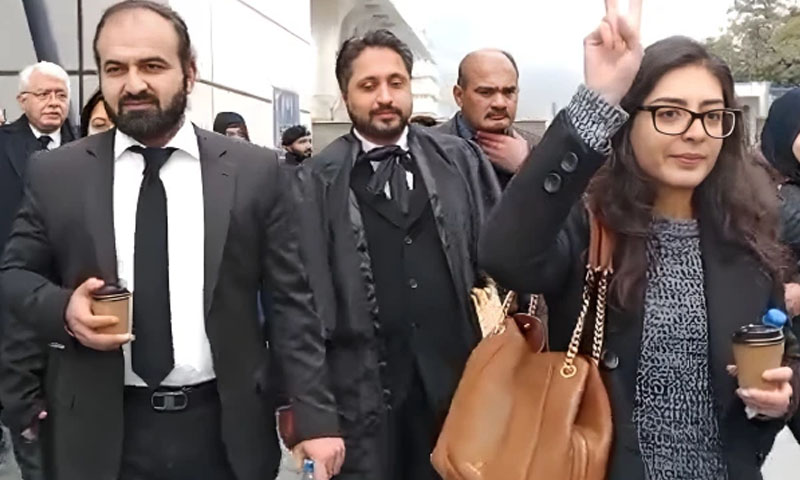
ISLAMABAD: An Islamabad court has removed a paragraph in its written judgment in a controversial tweets case against human rights lawyer Imaan Mazari and her husband Hadi Ali Chatha that had labelled Iran, North Korea, Syria, and Cuba as “terrorist states,” officials said on Friday.
On 24 January, Additional District and Sessions Judge Afzal Majoka had written in the original judgment: “Currently, four countries — Cuba, Democratic Republic of Korea, Iran and Syria — are designated as terrorist states.”
Pakistan’s Foreign Office said the government does not endorse the observation. No official list of terrorist states exists under United Nations or international law, FO spokesperson Tahir Hussain Andrabi told a weekly briefing. “The decision reflects the judge’s personal view. Pakistan certainly does not endorse it,” he said.
The prosecution requested Judge Majoka to expunge the paragraph, citing it as a likely clerical error. In his revised written judgment, the judge described the reference to the four countries as a “clerical mistake.”
He explained that while drafting the judgment, the stenographer had initially removed the countries’ names, but they reappeared in the final printed version in error.
The Islamabad court had sentenced Mazari and Chatha, under separate provisions, to 17 years of rigorous imprisonment each in the case.
The January 24 judgment noted: “Under Section 10 of the Prevention of Electronic Crimes Act (PECA), anyone who commits or threatens to commit an offence under Section 9, with the intent to promote the objectives of banned organisations, individuals, or groups, shall be punished. It now remains to be seen whether the accused promoted the agenda of banned individuals or organisations through their tweets, retweets, or posts.”
It also stated: “The accused labelled the State of Pakistan as a terrorist state in their tweets. Currently, four countries are designated as terrorist states: Cuba, Democratic Republic of Korea, Iran, and Syria. Both accused are lawyers by profession and fully aware that Pakistan is not on any terrorist state list, but they deliberately labelled Pakistan as such in their tweets, aligning with the agendas of banned groups like BLA and TTP.”
Can judges amend written judgments?
Many on social media questioned whether judges can amend their written decisions. Mazari’s mother and former PTI leader Shireen Mazari wrote on X that judges cannot legally alter their judgments in this manner.
Under Section 152 of the Code of Civil Procedure (CPC) 1908, courts may correct typographical or clerical errors in judgments or orders at any time. Similarly, Section 369 of the Criminal Procedure Code (CrPC) allows a court to correct clerical mistakes provided the substance of the judgment is not affected.
Former Lahore High Court judge Shah Khawar told BBC that under Section 152, a judge can correct clerical errors after delivering a judgment, either on their own initiative or upon request from a party.
Controversial tweets case: charges against Mazari and Chatha
The case was filed on August 22, 2025 on a complaint of a sub-inspector of the National Cybercrime Investigation Authority, alleging that Mazari and Chatha targeted state institutions on social media, acted against the state, and promoted narratives of banned organisations.
Authorities also said the accused sought to undermine public trust in state institutions and create instability.
During the trial on 5 December, Mazari and Chatha told Judge Majoka that the case was being conducted unilaterally. They raised objections to the prosecution and requested the case be transferred to another court due to lack of confidence.
Mazari said she knew she would likely receive a seven-year sentence, which she was prepared to serve.
Chatha requested under Section 342 of the CrPC to submit a statement and summon witnesses in his defense. He argued that the 342 statement originally belonged to the accused, not the State Council.
He listed witnesses including journalists’ parents, politician Sardar Akhtar Mengal, poet Ahmed Farhad, and others, and said the court could summon them if necessary.
You May Also Like