- Aasiya Niaz
- 1 Minute ago
Death toll rises after strike on Iran bridge as Tehran warns against escalation
-

- Web Desk
- 4 Minutes ago
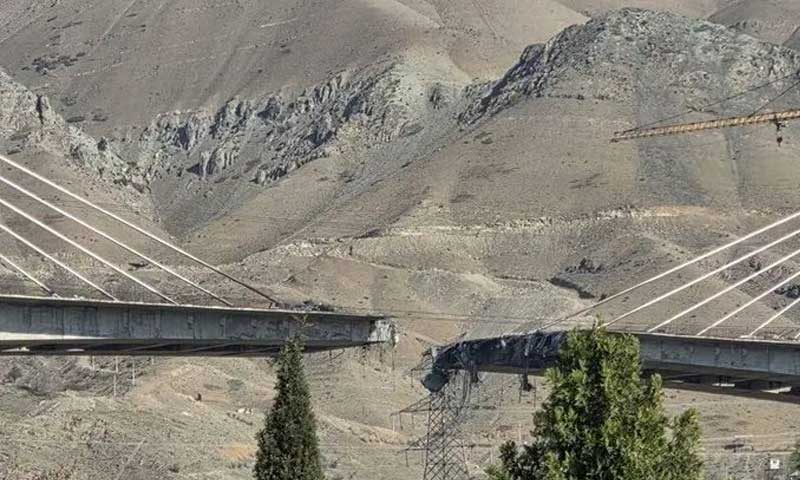
The death toll from a joint United States and Israeli strike on a key bridge in Iran has risen to eight, with at least 95 others injured, as Tehran issued a strong warning that attacks on civilian infrastructure would not force the country into submission.
Authorities in Alborz province said the casualties followed a second strike on Thursday that destroyed the central span of the B-1 bridge in Karaj, a major transport artery west of Tehran. The structure, described by officials as one of the highest in the Middle East, was partially reduced to rubble after the twin attacks.
Videos circulating on social media showed large sections of the nearly one-kilometre-long bridge collapsing, severing a vital link designed to ease congestion between Tehran and Karaj and improve connectivity to northern provinces.
Iran condemns ‘civilian targeting’
Iranian Foreign Minister Abbas Araghchi condemned the strikes, describing them as evidence of “moral collapse” rather than military strength.
In a statement posted on X, he said targeting civilian structures, including unfinished infrastructure, “will not compel Iranians to surrender,” adding that such actions only reflected “the defeat and disarray of the enemy.”
Araghchi also warned of long-term consequences, asserting that while damaged infrastructure could be rebuilt, the reputational cost to Washington would endure. “Every bridge and building will be built back stronger,” he said, cautioning that the damage to America’s global standing “will never recover.”
Trump rhetoric fuels tensions
The remarks came in response to statements by former US president Donald Trump, who had praised the destruction of the bridge and warned that further strikes could follow if Tehran did not agree to US demands.
Trump had earlier threatened to “bring Iran back to the Stone Age,” a remark that drew a sharp response from Tehran. Araghchi pointedly noted that such a comparison ignored the modern geopolitical reality of the Middle East, particularly its central role in global energy markets.
“There is one striking difference between the present and the Stone Age,” he said. “There was no oil or gas being pumped in the region back then,” he added, questioning whether Americans fully understood the implications of escalating the conflict.
Widening conflict and regional fallout
The strike on the B-1 bridge comes amid a broader escalation that began with a US-Israeli air offensive launched on February 28, which has so far killed more than 1,300 people, according to Iranian reports. Among the casualties was Iran’s Supreme Leader, Ayatollah Ali Khamenei, marking a significant turning point in the conflict.
Iran has since retaliated with drone and missile strikes targeting Israel as well as locations in Jordan, Iraq and Gulf states hosting US military assets. The ongoing exchanges have caused casualties, damaged infrastructure and disrupted global markets, particularly energy supplies and aviation routes.
With tensions continuing to rise, analysts warn that attacks on civilian infrastructure risk further inflaming the situation, reducing prospects for de-escalation and increasing the likelihood of a prolonged regional conflict.
You May Also Like