- WEB DESK
- October 27, 2026
‘Devolution of power is inevitable’: Kamal backs new administrative units in Sindh
-

- WEB DESK
- September 5, 2026
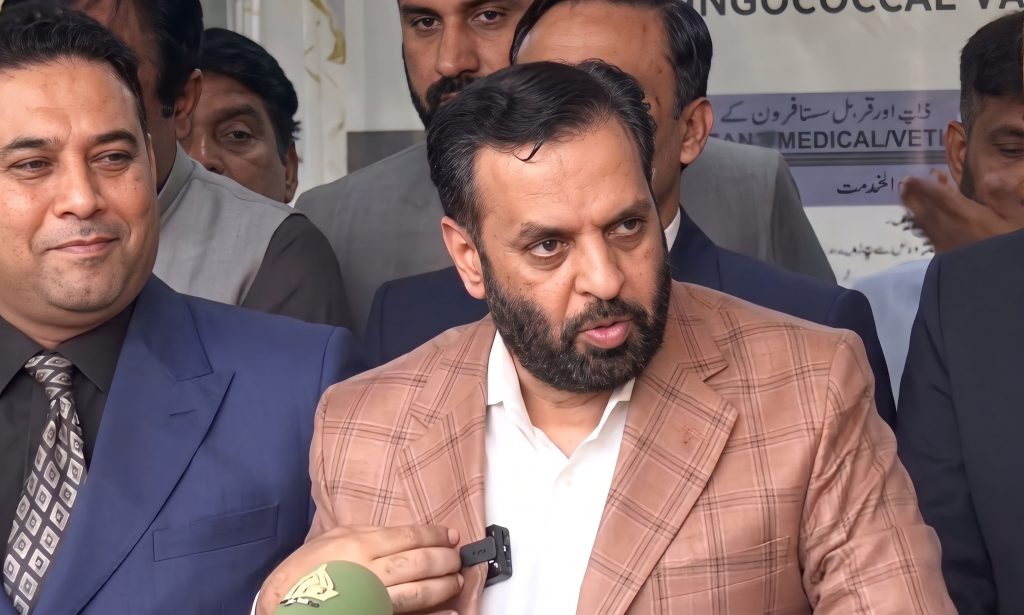
Federal Minister for Health Syed Mustafa Kamal said on Saturday that the Muttahida Qaumi Movement-Pakistan (MQM-P) had not backed down from its position on creating new administrative provinces, arguing that Sindh could be divided into three parts to improve governance.
Speaking at a press conference in Karachi after inaugurating Pakistan’s first International Travellers Vaccination Centre, Kamal questioned why Sindh could not be divided into three administrative units.
“Make Sindh 1, Sindh 2 and Sindh 3. What is the problem with that?” he said.
Kamal said the issue was not linguistic division but the distribution of resources and powers, arguing that people at the grassroots needed greater control over administrative matters.
“We are against division on a linguistic basis,” he said, adding that the MQM-P remained committed to the creation of more provinces.
The new provinces’ debate
His remarks came days after the Sindh Assembly passed a resolution opposing the creation of new provinces and administrative units in the province.
PPP leader Nisar Ahmed Khuhro had presented the resolution, which said the assembly “categorically and unequivocally rejects” any proposal to divide Sindh or create a new province.
The resolution declared that “Sindh is one and will remain one” and said every district and division of the province was an indivisible part of Sindh.
It also said the assembly would not accept any plan to separate any part of Sindh or place any area under federal control.
During the debate, PPP leader Saeed Ghani said his party would support a decision by another provincial assembly to create a new province within its own territory, but opposed any such move in Sindh.
“If the Punjab Assembly decides to create a new province, we will stand with it,” Ghani said, adding that the same principle would apply if the Khyber Pakhtunkhwa Assembly supported the creation of a new province.
Sindh Senior Minister Sharjeel Inam Memon also said decisions on new provinces should be taken by the relevant provincial assemblies in accordance with the Constitution.
Kamal, meanwhile, cited Karachi’s seven districts as an example, asking whether their creation had broken up the city. “Seven districts were made. Did Karachi break?” he said.
He also criticised the existing health and sanitation systems, saying they had become a business, and said residents from Karachi to Kashmore faced a lack of clean drinking water.
“On one front, we are working to prevent a third world war, while on the other, children are dying from dog bites,” he said.
Kamal also defended his record as Karachi’s mayor, saying he had worked on projects including Abbasi Shaheed Hospital and water supply schemes during his tenure.
Responding to questions about his anger over the death of newborns in a fire at PIMS, he said he was a human being who became angry over wrongdoing.
“If I do not get angry at something wrong, I am a hypocrite,” he said.
Kamal also challenged critics to produce evidence of corruption against him, saying no corruption case had been brought against him in 20 years.
The federal minister was speaking after opening the vaccination centre at the Federal Government Dispensary at the airport.
He said the centre would provide vaccination facilities for international travellers, including those requiring meningitis and flu vaccines.
He said vaccination records would be entered into the National Database and Registration Authority (NADRA) database, while travellers would receive computerised certificates.
Kamal said the system was cashless and digitised and would help address the issue of fake vaccination certificates, which he said had previously been issued for Rs4,000 to Rs5,000.
He said a meningitis vaccination certificate was required for people travelling for Hajj and Umrah.
He added that the system would also retain data on passengers deported from flights for medical reasons.
The debate over new federating units has continued in political circles for the past couple of months, although no official proposal has been confirmed.
Defence Minister Khawaja Asif earlier accused the Pakistan Peoples Party (PPP) of adopting a “dual policy” on the creation of new provinces and administrative units.
Asif said the PPP had shown flexibility towards creating a Saraiki province in Punjab but raised the issue of “Sindhudesh” when proposals for multiple provinces or administrative units were discussed.
“The devolution of powers is inevitable,” Asif said, arguing that the principle established through the 18th Amendment had not been implemented in its true spirit.
He suggested that Pakistan’s 36 divisions could be used as administrative units or that another arrangement could be devised.
Media reports have suggested proposals ranging from eight to as many as 30 provinces, but no official plan has been announced.
You May Also Like