- Reuters
- October 1, 2026
‘Superman’ Pakistan soldier claimed to be killed by India appears at ISPR conference
-

- WEB DESK
- October 1, 2026
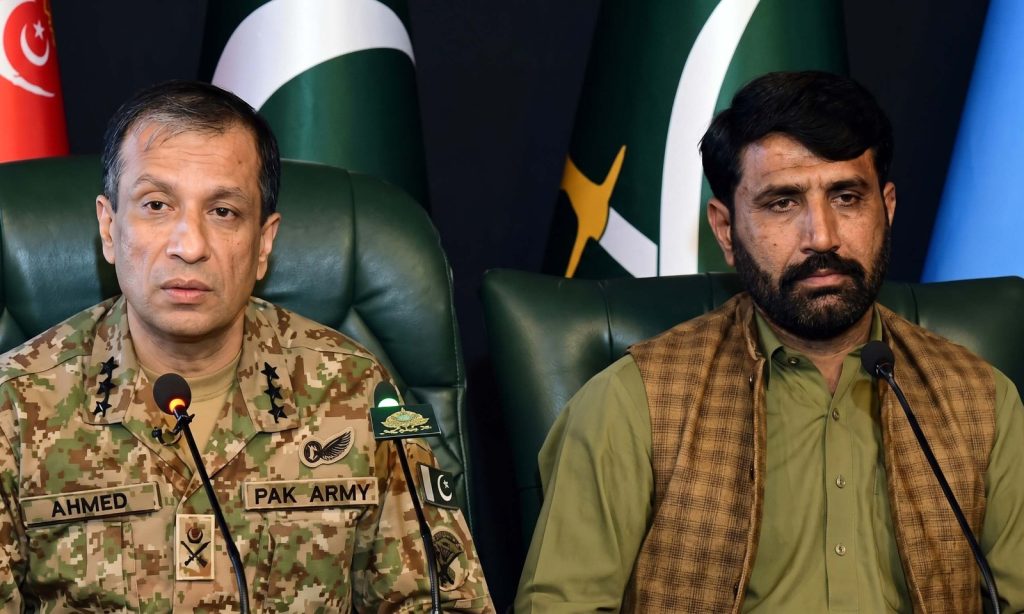
ISLAMABAD: Inter-Services Public Relations (ISPR) Director General Lt-Gen Ahmed Sharif Chaudhry on Thursday presented Havaldar Muhammad Asif at a press briefing, challenging an Indian account that a Lashkar-e-Taiba (LeT) commander identified as Musa alias Asif Fauji killed in an encounter in Indian Illegally Occupied Jammu and Kashmir (IIOJK) was an ex-Pakistan Army soldier.
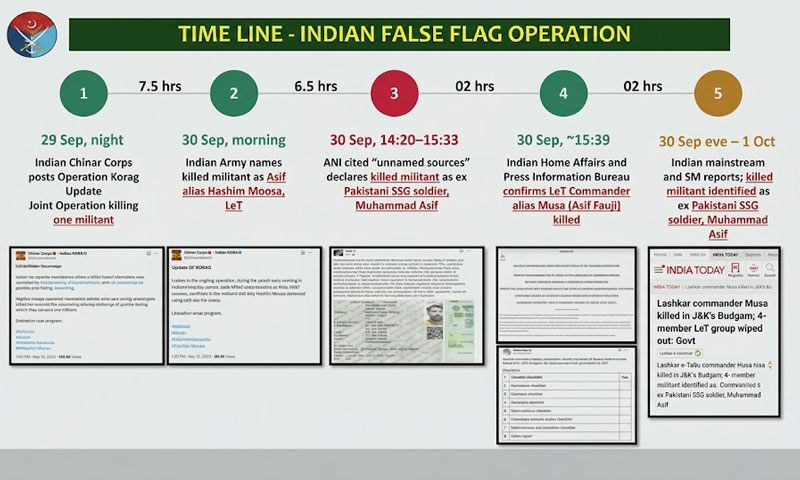
Addressing a press conference, Chaudhry said the sequence began on the night of September 29 when the Indian Army’s formation responsible for IIOJK posted on X that it had launched a joint search operation in the general area of Korag, Yousmarg, on the basis of “specific intelligence inputs”.
According to the Indian Army’s account, troops from the army, Jammu and Kashmir Police and Central Reserve Police Force (CRPF) observed suspicious activity and, after challenging the suspected militants, came under fire. An exchange of fire followed in which one militant was “neutralised”, the DG ISPR said while reading out the Indian Army’s account.
The Indian Army issued another update on the morning of September 30, saying that during an early-morning search in the general area of Palmaidan, troops recovered the body of a Pakistan-based LeT militant identified as Mohammad Asif alias Hashim Musa. The Army said the body was recovered along with “war-like stores”.
Chaudhry said the Indian side subsequently provided further details through news agency ANI, identifying Asif as a former Pakistan Army soldier.
According to ANI reports cited by Chaudhry, Asif was born on March 7, 1980, joined the Pakistan Army in 2000 and retired with the rank of havaldar. Indian reports also claimed that he had served with the Special Services Group (SSG) and performed VIP security duties.
Chaudhry said Indian authorities later changed the description of the slain militant, identifying him as LeT commander Musa alias Asif Fauji.
“Two hours later they said, ‘No, we will come and tell you what happened,’” Chaudhry said, referring to the subsequent Indian account.
He said Indian authorities described the operation as an intelligence-led mission and claimed that Musa had been operating in IIOJK since 2022.
The Indian Ministry of Home Affairs said earlier Musa was killed in an intelligence-led joint operation at Gurwatkalan in Budgam and described his death as a serious blow to the LeT network in IIOJK. It said Musa was one of four senior LeT commanders operating in the region since 2022 and that the operation was part of the long-running “Operation Sheruwali”, launched in May 2026.
Chaudhry said Indian authorities attributed several attacks to Musa, including the Halan attack in August 2023, DKG attack in December 2023, Kandi attack in May 2023, Shah Sitar attack in May 2024, Shiv Khori attack in June 2024, Gagan Geer attack in October 2024, Boota Pahari attack in October 2024 and Basira attack in April 2025.
He said India also claimed that three other members of the group had been killed in separate encounters, identifying them as Junaid Bhatt, Suleman and Yasir. The Indian government has made similar claims in its official account of the operation.
Chaudhry questioned the Indian account and described the episode as another “false flag operation” by India.
“An interesting story is now getting cooked,” he said, referring to what he described as a pattern similar to previous incidents that Pakistan has termed “false flag” operations.
He said Indian media outlets subsequently picked up the claims, naming News18, The Statesman, India Today, Hindustan Times, ABP Live and The Indian Express.
He also referred to social media posts that linked Musa’s photograph to various incidents, including the April 2025 Pahalgam attack, and attributed different militant activities to him.
Indian media have reported that Musa was wanted in connection with the Pahalgam attack and other attacks in Jammu and Kashmir. The Indian Express reported that he was the last surviving member of a four-man LeT group that Indian authorities linked to several attacks in the region.
Chaudhry said that since Indian authorities had claimed Musa was an ex-Havaldar of the SSG, Pakistan decided to establish where he actually was.
Where is Musa? Asif Fauji?
“Where is Musa? Asif Fauji? Yes, please come,” he said before inviting Havaldar Muhammad Asif to appear before the media.
“So here is that Superman, gentlemen. You can see this Superman,” Chaudhry said.
He identified the man as Havaldar Muhammad Asif of the SSG and displayed an Indian Army graphic identifying “Muhammad Asif alias Hashim Musa” as the militant whose body, according to the Indian Army’s Chinar Corps, had been recovered on September 30.
Addressing the press conference, Asif said he was from Pindi Gheb tehsil of Attock district.
He said some friends had called him after seeing social media reports claiming that he had been killed by the Indian Army in Kashmir.
“They asked me, ‘Where are you?’ I said, ‘I am speaking to you, I am in front of you, and I am alive, Alhamdulillah,’” Asif said.
He said he subsequently began receiving calls from Indian numbers, with callers asking for his personal information, including where he lived and who he was related to.
“I kept blocking those numbers,” he said.
Asif said he later learned through social media that Indian media outlets had used his personal information to report that he had been killed in a “fake operation” in Kashmir.
“I was myself very surprised. What is happening? I am sitting at home, and they have killed me somewhere,” he said.
He said he informed his unit about the reports and was advised to block the numbers and wait for ISPR to contact him.
Asif said ISPR officials later contacted him and asked whether he was the person reported to have been killed.
“I said, ‘I am alive.’ They said, ‘Then you should come and tell the details and make it clear that you are alive,’” he said.
Asif said he joined the Pakistan Army in 2000 in the artillery and joined the SSG in 2005.
“I served for 18 years with great courage and retired from the SSG in 2023,” he said.
After retiring, he said he worked for three years with a private security company and had been living with his family at his home in Rawalpindi for the past three to four months.
Asif rejected the allegations against him, describing the reports by Indian media as “false” and “baseless”.
“I condemn this. Alhamdulillah, I am alive and standing before you,” he said, adding that he could produce his identity card to establish that he was Havaldar Muhammad Asif.
“I am a soldier of the SSG, the Special Services Group. We have always fought from the front; we are not those who attack from behind,” he said.
“I have always fought bravely for my country and homeland, and I am still ready to fight. My life is also at the service of this country,” he added.
Chaudhry then described the episode as another attempt that he wanted to bring to the media’s attention.
He said he would also try to answer why such an episode had taken place and why, in his view, there was a need for what he called “this drama”.
“The first thing is to cover their own track of terrorism,” he said.
Chaudhry alleged that India was a major sponsor of terrorism and accused it of direct and indirect involvement in terrorism in the region going back decades.
He cited Mukti Bahini, the LTTE, the TTP and the BLA, alleging Indian sponsorship, funding and planning.
He further alleged that terrorism had acquired an internal dimension in India and accused Indian authorities of seeking to address problems through terrorism.
Chaudhry’s allegations about Indian involvement in terrorism and the characterisation of the Kashmir operation as a “false flag” were not independently verified.
Indian claim
The Indian Army has said the slain man was an LeT militant and has linked him to militant activity in the region. Indian authorities have also previously accused Pakistan-based militants of involvement in the April 2025 Pahalgam attack, allegations Islamabad has rejected.
Chaudhry called the latest episode another “false flag operation” planned by India.
“If these shameful characters have at least some shame, I think they will delete this.”
He said this was Musa alias Asif Fauji, the “Superman” who had allegedly been able to carry out all these activities, and whom Indian forces claimed to have neutralised.
They said Musa was one of four senior Lashkar-e-Taiba commanders operating in Jammu and Kashmir since 2022. They also claimed that he was a former Havaldar of the SSG.
The Indian Press Information Bureau issued the statement at 4:51pm the previous day, he said.
“Once they had done that, the usual suspects came in — the so-called credible Indian media,” he said, naming News18, The Statesman, India Today, Hindustan Times, ABP Live and The Indian Express.
He said social media was also flooded with tweets linking Musa’s photograph to various incidents, including the Pahalgam attack, and attributing different attacks and activities to him.
“Interesting! What a great success they have had,” he said.
Chaudhry then described the episode as “another” attempt that he wanted to bring to the media’s attention.
He said he would also try to answer a question about why such an episode had taken place and why there was a need for what he called “this drama”.
He said there were six reasons that were important to understand, both in Pakistan and, more importantly, in India and the rest of the world, for what he described as repeated such incidents by India.
“The first thing is to cover their own track of terrorism,” he said.
Chaudhry said that India was a major sponsor of terrorism and accused it of direct and indirect involvement in terrorism in the region going back decades.
He cited the Mukti Bahini, LTTE, TTP and BLA, saying that India had sponsored, funded and planned their activities.
He said terrorism had also acquired an internal dimension in India and alleged that Indian authorities believed problems could be addressed through terrorism.
He said that for Indian authorities, producing such a concocted story was “a very normal thing”, which was why he had questioned the need for what he called “this drama”.
Kashmir
Lt-Gen Chaudhry said the second reason was Kashmir, arguing that developments in IIOJK played a major role in what he described as the Indian public’s “psyche and cognitive domain”.
He alleged that the level of oppression in Kashmir was severe, claiming that there were nearly one million military, security, intelligence, CRPF and law-enforcement personnel deployed in the valley.
He said Kashmiris faced restrictions on movement between villages and alleged that homes could be demolished and people taken away at night on various pretexts.
“If you are doing this oppression on a daily basis, day and night, and you cannot subdue them, you cannot take away their desire to be counted, then you have to come out with these dramas — that ‘we are winning, we are killing’,” he said.
He said India was unable to suppress what he described as the Kashmiris’ demand for self-determination and therefore sought to portray the unrest as being driven by Pakistan.
He said this was why, in his view, a Pakistani soldier such as Havaldar Muhammad Asif was being presented as having gone from Pindi Gheb to fight in Kashmir.
“Havaldar Asif does not need to go there,” Chaudhry said.
He alleged that incidents of torture and other abuses in Kashmir were taking place and said the issue could not be dismissed as a matter of history.
He then played video clips which, he said, showed alleged incidents of torture and human rights abuses in Kashmir.
The clips included remarks alleging that Kashmiri civilians had been subjected to torture, women had been raped by security personnel and homes had been destroyed following an incident.
“Torture is not a historical issue; it is happening right now in Kashmir,” Chaudhry said.
He said India could not blame Pakistan for its internal problems.
“You have an internal problem, a great internal problem of oppression, of torture. You don’t want to address it; you want to externalise it,” he said.
“You cannot externalise your internal issues. You cannot put this blame on Muhammad Asif from Pindi Gheb.”
Chaudhry said Pakistan knew how to respond to India and challenged it to confront Pakistan directly, referring to what he called “Marka-e-Haq”.
“Come direct, fight with each other, like you did in Marka-e-Haq, and we will teach you a lesson that your generations will remember,” he said.
Pakistan obsession
Chaudhry said the third reason behind what he described as India’s repeated allegations was its “obsession with Pakistan”.
He said Pakistan had, over time, “got on their nerves” to such an extent that India sought to blame Pakistan whenever something happened.
He alleged that this had constrained the “imagination and faculties” of India’s political and military leadership.
“We keep on requesting them very politely: please grow up, please get out of this obsession with Pakistan,” he said.
He said India had its own internal problems and should address them instead of blaming Pakistan for every incident.
“Don’t try to link everything that’s happening in India to Pakistan,” he said.
Chaudhry said Pakistan had offered India an opportunity to provide evidence over its allegations concerning the Pahalgam attack.
“If you have proof, please come forward,” he said, adding that India could also provide evidence to a third party if it did not want to share it directly with Pakistan.
“But just don’t start every day, wake up and start harping everything on Pakistan, Pakistan, Pakistan. It doesn’t work that way,” he said.
‘Encounter-istan’
Chaudhry said the fourth reason was India’s alleged reliance on what he described as “theatre and drama”.
He referred to incidents including Uri, Chattisinghpora, Rajouri and the Mumbai attacks, saying India had gradually changed from “Hindustan” into what he called “Encounter-istan”.
“It is the encounters that pay. It is the story that is important. The facts are not important to Indians; the fiction is important,” he said.
He alleged that the Indian Army’s Chinar Corps, Press Information Bureau, Home Department and Indian media were all promoting the same narrative.
“The story should be clear, the story should be spicy. There should be action in it. It should be entertaining. There should be a story. There should be encounters. Put a Pakistani in it,” Chaudhry said.
Pakistan ready for ‘everything’ India may do
Lt Gen Ahmed Sharif Chaudhry said Pakistan is prepared for “everything” India may do, describing the country’s own strength as the “biggest guarantee of peace” in the region.
Responding to a question about India and the international response to its actions, the DG ISPR said the country’s “facade” had been exposed to the world.
“You are hearing the leadership of the world. You are hearing the US secretary of state, you are hearing the Canadian prime minister, you are hearing from the Australian leaders,” he said.
Chaudhry said Pakistan’s diplomats and the Foreign Office would be better placed to give a detailed response on the international community’s reaction to India.
He also dismissed questions about how the “spirit” of Havaldar Muhammad Asif had supposedly returned after Indian authorities claimed to have killed him in an encounter in Indian-administered Jammu and Kashmir.
“How did Asif’s spirit come back? Only Asif can tell you,” he said, before adding that Asif’s “spirit” had never gone anywhere.
“Alhamdulillah, it was never gone anywhere. It was right here. It has gone into their dreams and imagination,” the DG ISPR said, referring to Indian authorities’ claims.
Pakistan to decide ‘what, when and how’ to act in Afghanistan
Asked about an increase in strikes in Afghanistan and whether Pakistani ground forces could be involved in future operations, Chaudhry said Pakistan would decide “what we will do and when we will do” with the Afghan Taliban regime.
“That’s our prerogative,” he said.
He accused the Afghan Taliban regime of “abetting and sponsoring terrorism” and said the international media should ask where Bashir Zeb and Noor Wali, whom he described as leaders of internationally recognised militant organisations, were.
He also questioned the presence of Afghan nationals in militant formations allegedly entering Pakistan to carry out attacks.
“What is Afghanistan doing about it? That’s the relevant question,” he said.
Earlier on Thursday, Pakistan said it had carried out “well-planned and calibrated” aerial strikes against alleged terrorist hideouts at two locations in Afghanistan, with initial reports suggesting that 22 militants were killed. The Information Ministry said the strikes were conducted as part of Operation Ghazab Lil Haq and targeted hideouts and safe havens of militant organisations and their affiliates.
Chaudhry said Pakistan would take whatever measures were necessary to safeguard its citizens, particularly in Khyber Pakhtunkhwa and Balochistan, at a time, place and through a method it considered feasible.
He stressed, however, that Pakistan had “nothing against the Afghan people”.
“Absolutely nothing. We have got nothing against Afghanistan. The problem is with this Afghan Taliban regime,” he said.
The DG ISPR described the regime as non-inclusive, non-representative and unelected, and alleged that it was providing a security environment for militant organisations.
He claimed that groups including Al-Qaeda in the Indian Subcontinent (AQIS), Islamic State Khorasan (ISKP), the East Turkestan Islamic Movement (ETIM) and Islamic Movement of Uzbekistan (IMU), among others, were operating from Afghanistan.
“This is the reason that Pakistan, the frontline state, is fighting against” these groups, he said.
Militant coordination in Kandahar
Chaudhry also referred to what he described as an August 26 meeting in Kandahar, allegedly chaired by Mullah Shirin, the Taliban-appointed governor of Kandahar.
He alleged that representatives of Al-Qaeda, Bashir Zeb, Gul Bahadur and the Afghan Taliban had attended the meeting to coordinate their activities.
He further alleged that the Balochistan Liberation Army (BLA) had raised recruitment problems and that Gul Bahadur was being asked to provide manpower, which would then be put into BLA uniforms.
The DG ISPR questioned what he described as common ground between the BLA and Fitna al-Khawarij, saying: “Money.”
He alleged that the Afghan Taliban were sheltering the groups.
Pakistan prepared for any Indian action
Responding to the second part of the question about the possibility of tensions on the eastern border while Pakistan faces challenges on the western front, Chaudhry said the country was prepared for any action India might take.
“As far as India is concerned, we are prepared for everything that they are ready to do,” he said.
He described India as an “unreliable” country that, according to him, believed in deceit, terrorism and regional hegemony.
“The only guarantee of peace against such a country is our own strength,” he said.
Chaudhry said Pakistan’s political and military leadership, as well as its armed forces, had “complete confidence” in the country’s strength and its cause.
“That is the biggest guarantee of peace in this region. We are the biggest guarantee of peace in this region,” he said.
DG ISPR says Army has nothing to do with politics
The Army has “nothing to do with politics” and will not comment on political matters, Director General Inter-Services Public Relations (ISPR) Lt Gen Ahmed Sharif Chaudhry said during a press conference.
Responding to a question about reports of meetings between senior military officials and PTI founder Imran Khan at Adiala jail, the DG ISPR said politics was the domain of political parties.
“I have made it repeatedly clear: politics is for the political parties. Governments are made by politicians. It is for the government and political parties,” he said, urging journalists not to involve the Army in political matters.
DG ISPR says government, law ministry can explain Jadhav case status
When asked about the legal status of Indian national Kulbhushan Jadhav and why no action had been taken regarding his sentence, Chaudhry said the government and Ministry of Law and Justice were best placed to provide the details.
He said Jadhav remained a “big stigma” on India, whether alive or dead.
“What was your serving naval commander doing, carrying bags of money and himself saying that he was distributing money to terrorists?” he asked, referring to Pakistan’s allegations against Jadhav.
‘India sees stable Pakistan as a threat’
Responding to a question about whether India could further activate what the DG ISPR described as its proxies, particularly Fitna al-Khawarij and Fitna al-Hindustan, Chaudhry said India’s internal dynamics also played a major role in fluctuations in terrorism.
“Because a stable, prosperous and a rising Pakistan, they somehow consider as a great threat to India,” he said.
He said India would continue to use direct and indirect means to undermine Pakistan and that Islamabad needed to understand the threat and develop the technical, political, military and social capabilities required to counter it.
“This is an enduring fight and this has to be won. There is no other choice, there is no other way,” he said.
DG ISPR urges political consensus on counterterrorism
On the question of political figures adopting different approaches towards dealing with terrorism, Chaudhry said people could have different views on how to tackle the threat, but there should be no disagreement over confronting it.
Pakistan had been fighting terrorism for more than two decades and had suffered more than 100,000 deaths and hundreds of billions of dollars in economic losses, he said.
He added that terrorism had also caused major damage to the country’s socio-political fabric.
Chaudhry said the National Action Plan, revised National Action Plan and Azm-e-Istehkam vision had been developed through political consensus and should be followed.
“If someone … creates confusion in the narrative against terrorism, does not build competence or capacity, the question comes: is this behaviour only incompetence, lack of understanding, indifference or willful collusion?” he said.
He said such questions would arise because “the state is there, then there is politics; the state is there, then there is democracy; the state is there, then there are you and I”.
‘Fight against terrorism cannot be compromised’
Chaudhry described terrorism, which he attributed to Indian sponsorship, as an existential threat to Pakistan.
“Our boys, our girls, our police, our intelligence, our soldiers, our officers are fighting it on a daily basis,” he said.
He questioned why other stakeholders were not doing enough to counter the threat.
“Why are you not fighting it? Why are you not standing?” he asked, adding that it was for the people and government of Pakistan to assess the situation.
“But this fight against terrorism is paramount. This cannot stop, this cannot be compromised, this cannot be sacrificed at the altar of anyone’s politics,” the DG ISPR said.
Pakistan has ‘multiple options’ to respond to India’s claims’
Pakistan has “multiple options” to respond to Indian institutions and individuals who declared a serving Pakistani soldier dead and labelled him a terrorist, Director General Inter-Services Public Relations (ISPR) Lt Gen Ahmed Sharif Chaudhry said.
Responding to a question about possible legal action against those involved in the episode, the DG ISPR said the Pakistani state had several tools at its disposal.
“The first step you have seen is to expose them. We have done that. We have come and the gentleman is here,” he said, referring to Havaldar Muhammad Asif, whom Indian authorities had claimed was killed in an encounter in Indian-administered Jammu and Kashmir.
He said the purpose of presenting Asif before the media was to show the world, Pakistanis and Indians “what kind of people” India had in positions of authority and “what work they are getting done from them”.
“I don’t expect that they will feel ashamed, as I said earlier, but it is still important to know so that when you look in the mirror, at least you see your own face,” Chaudhry said.
Asked whether Pakistan was considering further options in response to repeated terrorist attacks and other actions, he said the state had several avenues available.
“There are multiple options which the state of Pakistan, the Foreign Office, which is very competent, will look at,” he said.
‘Pakistan has no problem with Afghan people’
Turning to Afghanistan, Chaudhry reiterated that Pakistan had no problem with Afghanistan or the Afghan people.
“Pakistan has no problem with Afghanistan. We have no problem with our Afghan brothers and sisters,” he said.
He said those “sitting above” in Afghanistan needed to realise that their actions had no connection with Islam, Afghan identity, Pashtun identity or Pashtunwali.
He alleged that such actors had placed themselves in a position of dependence on various agencies for money.
“They need to realise that what they are doing has nothing to do with Islam, nothing to do with Afghanism, nothing to do with Pashtunism and nothing to do with Pashtunwali,” he said.
‘We are standing on the side of truth’
Chaudhry said Pakistan, its citizens and armed forces believed they were standing on the side of truth.
“We are standing on the side of truth; we are travellers on the path of truth — Pakistan, the citizens of Pakistan and the Pakistan Army,” he said.
He added that Pakistan had no reason to be concerned, saying “truth ultimately prevails”.