- Web
- Mar 02, 2026
Early results show tight contest in Bangladesh election after strong turnout
-

- Web Desk
- Feb 12, 2026
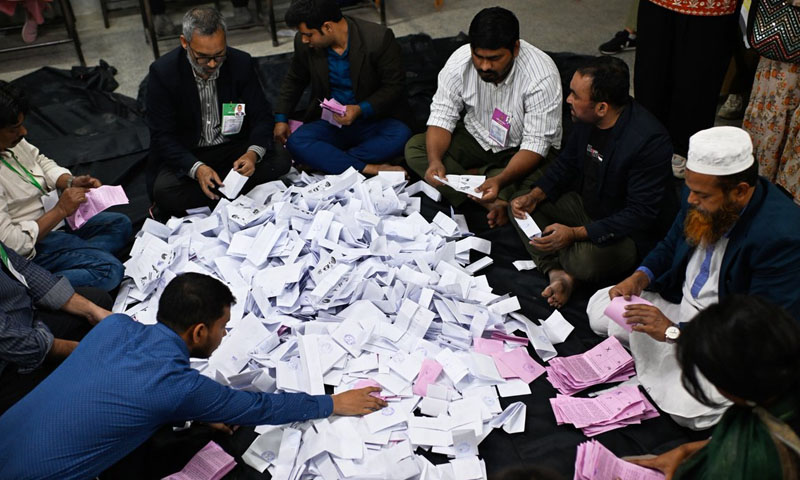
DHAKA: Early counting in Bangladesh’s general election showed a close contest on Thursday between the Bangladesh Nationalist Party (BNP) and the Jamaat-e-Islami, following what officials described as a strong voter turnout across the country.
The vote is being seen as pivotal for the South Asian nation of 175 million people. It is the first national election since the 2024 Gen Z-led uprising that forced long-time Prime Minister Sheikh Hasina from office.
Election Commission officials said counting began at around 4:30 pm local time after polling ended. Clearer trends were expected by midnight, with final results likely by Friday morning.
According to early trends reported by local television channels, the BNP was leading in 10 seats while Jamaat-e-Islami was ahead in seven of nearly 20 constituencies where initial results were available. Bangladesh’s parliament, the 300-member Jatiya Sangsad, requires 151 seats for a simple majority.
Opinion polls had given the BNP a slight edge going into the vote.
Turnout appeared set to exceed the 42 per cent recorded in the 2024 election, with local media estimating that more than 60 per cent of registered voters cast ballots.
Both prime ministerial hopefuls expressed confidence. BNP leader Tarique Rahman told reporters he was certain of victory, citing “enthusiasm among the people”. Jamaat chief Shafiqur Rahman described the election as a “turning point” for Bangladesh and said voters were eager for change.
Sheikh Hasina’s Awami League party is currently banned, and she remains in self-imposed exile in India. In a statement shared with journalists, Hasina called the election a “carefully planned farce” conducted without her party’s participation and demanded its cancellation. She called for a fresh vote under a neutral caretaker government.
Alongside the parliamentary election, voters also took part in a referendum on constitutional reforms. The proposals include establishing a neutral interim government during election periods, introducing a bicameral legislature, increasing women’s representation, strengthening judicial independence and limiting the prime minister to two terms.
More than 2,000 candidates, including a large number of independents, contested the election, with at least 50 political parties participating — a national record. Voting in one constituency was postponed after the death of a candidate.
Authorities deployed around 958,000 police, army and paramilitary personnel nationwide to ensure security. No major incidents of violence were reported.
Voters reported a more open atmosphere compared to previous elections.
“I am feeling excited because we are voting in a free manner after 17 years,” said Mohammed Jobair Hossain, 39, while waiting in line. “Our votes will matter and have meaning.”
In Dhaka and other cities, long queues formed outside polling stations, with heavy security visible, including mounted police outside key booths.
You May Also Like