
- Web
- 5 Hours ago
Ethiopian volcano eruption directs ash towards India as Pakistan’s skies clear up
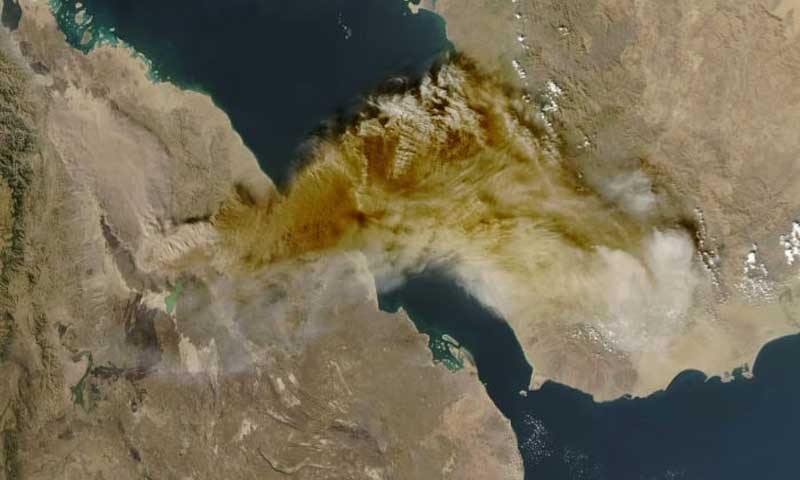
WEB DESK: The Pakistan Meteorological Department (PMD) has confirmed that the country’s airspace and atmosphere remain unaffected by ash from Ethiopia’s Hayli Gubbi volcano, which erupted after thousands of years and sent a massive ash plume drifting across the region.
The volcano, located in Ethiopia’s Afar region, emitted ash up to 14 kilometres high on Sunday, its first known eruption in nearly 12,000 years. The plume travelled over the Arabian Peninsula before passing south of Gwadar early Tuesday at an altitude of 45,000 feet.
While talking to Geo News, PMD spokesperson Anjum Nazir said the ash cloud moved across the Arabian Sea and briefly passed over Sindh’s air corridor without causing any impact on land. “Pakistan’s skies are clear and there is no danger to our atmosphere, northern areas, or air quality,” he said, adding that Oman, Yemen and Pakistan are now fully clear of volcanic residue.
Nazir explained that ash at such high altitudes cannot be detected on standard satellite images and poses no risk to the general public. He said the cloud has since drifted towards India, particularly Rajasthan, and is expected to continue moving northeast.
The India Meteorological Department reported that traces of the ash were observed as far as Delhi, Punjab, Haryana, Gujarat and Rajasthan. It said the cloud is now shifting towards China and is likely to leave Indian airspace by Tuesday evening.
Indian carriers, including Air India and Akasa, cancelled several flights as a precaution to inspect aircraft that had flown near the affected zones.
PMD reiterated that Pakistan remains outside the ash cloud’s impact zone and that no deterioration in air quality or visibility is expected.
You May Also Like