

- WEB DESK
- October 24, 2026
FCC chief justice stresses constitutional supremacy for societal stability
-

- WEB DESK | Javed Soomro
- September 15, 2026
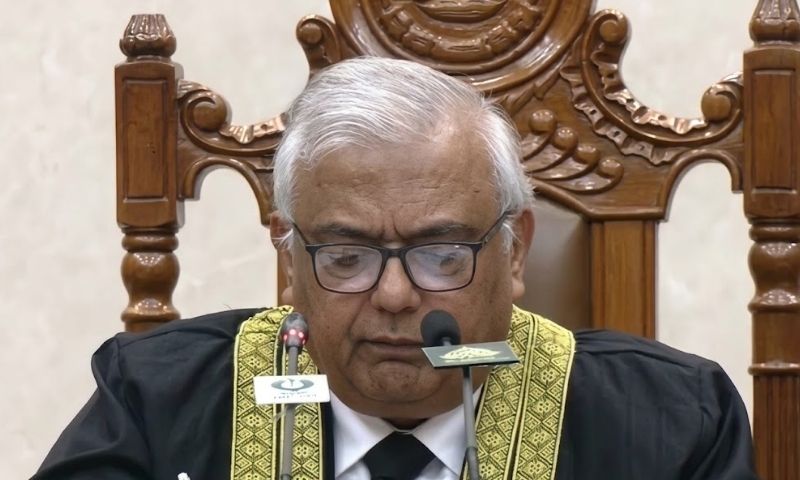
Chief Justice of the Federal Constitutional Court Justice Aminuddin Khan has called for strict adherence to the Constitution, saying the exercise of state powers must remain within constitutional limits to ensure stability in society.
Addressing a ceremony marking the start of the court’s new judicial year on Tuesday, Justice Aminuddin said the occasion was a chance for the judiciary to renew its commitment to providing justice. “Access to justice is the right of every citizen,” he said, stressing that constitutional provisions defining the powers and limits of state institutions must be respected.
“Constitutional supremacy and the rule of law are the judiciary’s foremost priorities,” the chief justice said, adding that constitutional accountability should be applied without discrimination.
Justice Aminuddin said the Federal Constitutional Court had delivered several important judgments since it began functioning and was fulfilling its role in dealing with constitutional matters. He said the judiciary’s primary responsibility was to provide affordable and speedy justice while maintaining its independence.
The chief justice also credited the establishment of the Federal Constitutional Court with helping reduce the backlog of pending cases and said the institution remained committed to strengthening constitutional supremacy.
He called for greater use of technology in judicial proceedings, saying it could improve institutional capacity and transparency. He said appointments for hearing cases were being made transparently and on merit.
Justice Aminuddin also highlighted efforts to strengthen cooperation between the bench and bar, including through visits by bar associations and other delegations, as well as international engagements aimed at improving judicial cooperation.
Pakistan Bar Council Vice Chairman Masood Chishti, speaking at the ceremony, praised Justice Aminuddin’s performance and said the Federal Constitutional Court could eventually provide guiding principles for the country’s constitutional and legal system.
Chishti also called for the court to introduce video-link facilities to make access to justice easier for litigants.
Awan says constitutional court must build credibility through its own record
Attorney General Mansoor Usman Awan has said FCC t will have to establish its credibility through its own judgments and institutional record as it enters its second judicial year. Awan noted that the court began functioning on November 13, 2025, following its creation under the 27th Constitutional Amendment.
Unlike older courts, which can draw on decades of precedents and institutional traditions, the Federal Constitutional Court has no established history of its own, he said. “How the Federal Constitutional Court’s beginning is remembered will be determined by its own work in the years ahead,” Awan said.
The 27th Amendment created the court specifically to deal with constitutional questions and transferred some powers previously exercised by the Supreme Court. These include disputes between the federation and provinces, matters concerning the enforcement of fundamental rights and authoritative interpretation of constitutional provisions.
Awan said there was little point in reopening the debate over whether the court should have been created through the amendment. “The Federal Constitutional Court exists,” he said, adding that it had already begun deciding cases involving constitutional interpretation and the protection of fundamental rights.
He said the court’s credibility would ultimately depend on its decisions and its ability to earn the confidence of litigants on a case-by-case basis.
The attorney general also cautioned the court against allowing political disputes to be presented as constitutional questions. Political controversies framed in constitutional language could consume the court’s time and divert attention from genuine constitutional issues, he said.
At the same time, Awan stressed that the court should not shy away from difficult constitutional questions simply because they were challenging. Distinguishing between a genuine constitutional issue and a political dispute dressed in constitutional language would be crucial to the court’s credibility, he said.
Awan pointed to the court’s recent decision in the long-running super tax cases as an example of its constitutional role. The court upheld the tax and ruled that Sections 4B and 4C of the Income Tax Ordinance, 2001, were neither discriminatory nor inconsistent with fundamental rights.
He said questions reaching the constitutional court were significant because its rulings could shape the balance of powers between the federation and provinces, as well as the interpretation and protection of constitutional rights.