
- Zafar Ali
- August 11, 2025
FCC clarifies status and role of high courts in landmark ruling
-

- Ahsan Wahid
- June 4, 2026
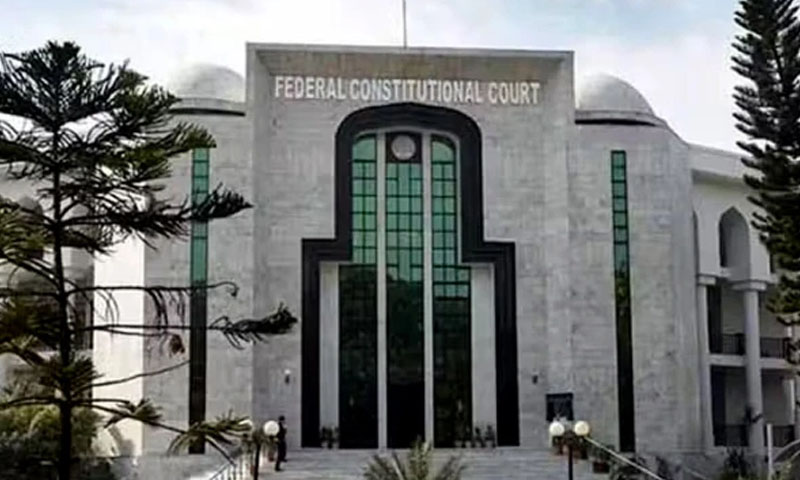
ISLAMABAD: The Federal Constitutional Court (FCC) ruled that Pakistan’s high courts are independent constitutional courts and are not subordinate to either the Supreme Court or the FCC, clarifying the constitutional relationship between the country’s superior courts and reinforcing the judicial and administrative autonomy of high courts.
In a detailed judgment authored by Justice Aamer Farooq and concurred by Justice Syed Arshad Hussain Shah, the FCC observed that requests seeking directions from superior courts for the expeditious disposal of cases pending before high courts are frequently made but should be approached with caution to preserve the judicial and administrative independence of the high courts.
The ruling came on an appeal filed by the Gujranwala Electric Power Company (GEPCO) against an order of the Islamabad High Court in a dispute involving Master Tiles & Ceramics Industries Ltd.
The court first addressed the petitioner’s contention that an Assistant Attorney General had given consent before the Islamabad High Court on behalf of GEPCO despite lacking authority to do so.
Agreeing with the petitioner’s position, the constitutional court held that, in the circumstances of the case, the Assistant Attorney General was not competent to provide consent on behalf of GEPCO, which as an independent entity was entitled to be represented through counsel of its own choice.
The court subsequently converted the petition into an appeal, allowed it and set aside the Islamabad High Court’s impugned order.
It directed that the petition filed by Master Tiles & Ceramics Industries be deemed pending before the Islamabad High Court once again.
During the proceedings, counsel for the respondent requested that if the matter were remanded to the Islamabad High Court, the constitutional court should direct it to decide the case expeditiously.
Addressing the request, the FCC issued extensive observations on the constitutional status of high courts.
The judgment noted that under Part VII, Chapter 3 of the Constitution, Pakistan currently has five high courts, each established as an independent constitutional court.
“The High Court, so created, is an independent Constitutional Court and is not subordinate to either the Supreme Court or the Federal Constitutional Court,” the judgment stated.
The court explained that while district courts and certain other courts established under Article 203 of the Constitution are subordinate to their respective high courts, the constitutional framework does not place high courts under the authority of either the Supreme Court or the FCC.
It further observed that the fact that high court judgments may be challenged before the Supreme Court or the FCC through appellate proceedings does not render the high courts subordinate institutions.
“All decisions of the High Court are challengeable before the Supreme Court and/or the Federal Constitutional Court, which does not make the referred court subordinate in any manner,” the judgment said.
The court also cautioned against the routine issuance of directions (by superior judiciary) to high courts regarding the scheduling and disposal of cases.
It noted that each high court maintains its own roster, case-management system and policies governing the fixation of cases for hearing.
“Any direction that overrides those mechanisms could amount to interference in the court’s institutional independence,” the FCC said.
“The orders issuing directions to the High Courts should be made sparingly and must be couched in appropriate words,” the court said.
The judgment added that any order which effectively supersedes a high court’s case-fixation policy or hearing schedule could constitute an intrusion into its judicial and administrative autonomy.
The constitutional court acknowledged that certain cases may involve urgency or exceptional circumstances requiring early hearings after a matter is remanded. However, it stressed that observations by superior courts should be framed carefully to avoid undermining the independence of the high courts.
The court further observed that directions issued by superior courts for priority hearings are generally administrative rather than judicial in nature and are recommendatory rather than mandatory.
In support of that proposition, it cited the Supreme Court’s judgment in Talat Ishaq vs National Accountability Bureau (PLD 2019 SC 112).
Concluding the matter, the constitutional court expressed the expectation that the Islamabad High Court would take up the GEPCO case at the earliest, keeping in view the urgency involved, while leaving the scheduling of proceedings to the high court’s own discretion.
Legal experts said the ruling provides significant guidance on the constitutional status of high courts and delineates the limits of supervisory directions that may be issued by superior appellate courts, reinforcing the principle of judicial independence within Pakistan’s constitutional framework.
You May Also Like


- Zahid Gishkori
- February 16, 2025
CDA plots scandal: Billions in fraud under investigation


- Zahid Gishkori
- September 20, 2024