
- WEB DESK
- October 17, 2026
FCC delivers major ruling safeguarding women’s inheritance rights
-

- Ahsan Wahid
- June 17, 2026
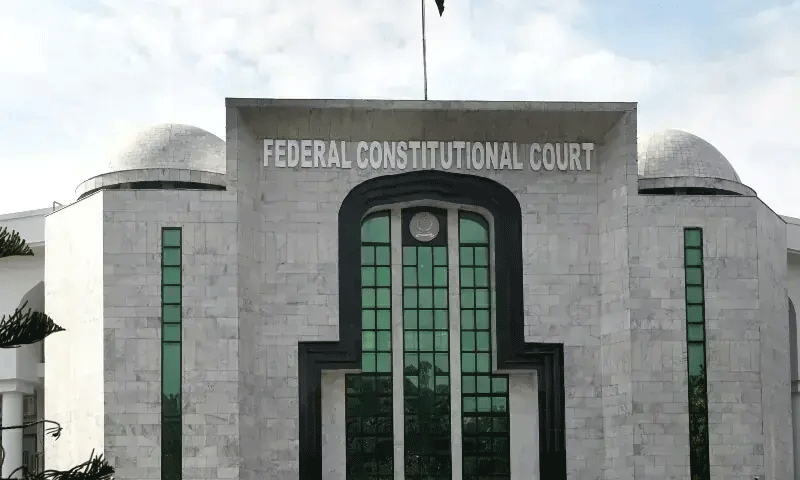
ISLAMABAD: The Federal Constitutional Court has overturned a provincial high court judgement that stripped several sisters of their parental inheritance, ruling that vague contractual language cannot be used to circumvent divinely ordained Islamic property rights or constitutional protections for women.
FCC Chief Justice Amin-ud-Din Khan and Justice Ali Baqar Najafi set aside a June 2025 decision by the Balochistan High Court. The top court reinstated a trial court order to re-examine allegations of familial fraud, marking an aggressive judicial stance against local customs that historically dispossess female heirs.
The case was originally filed as an appeal before the Supreme Court of Pakistan by a petitioner identified as Bibi Amina and her sisters.
Following the passage of the 27th Constitution Amendment Act, 2025, which structurally reconfigured the state’s apex judiciary, the transitional framework transferred the matter to the newly established Federal Constitutional Court for final adjudication.
The litigation began when Amina and her sisters sued their brothers, including a respondent named Shamsullah, to claim their legal shares from the estate of their late parents, Abdul Rehman and Bibi Sabza.
During the initial trial, the brothers produced a three-page out-of-court compromise deed, prompting the trial court to issue a consent decree in June 2021 ending the suit.
Fourteen months later, the sisters invoked curative civil jurisdiction to challenge the decree, asserting that their brothers had deployed fraud, misrepresentation, and concealment to secure their signatures.
They testified that their consent was neither free nor informed, and that the text was deliberately engineered to strip them of assets.
The legal battle turned specifically on Clause 2 of the settlement deed.
The clause stated that all properties left by the parents, including those explicitly labeled as “Ghair Mutadawia” — an Arabic legal term meaning properties not forming part of the active lawsuit or currently in dispute — would be registered solely in the names of the male heirs.
The case moved through multiple rounds of lower-court litigation.
A Quetta trial court initially threw out the compromise decree and restored the sisters’ lawsuit. After a series of appeals and remand orders, the Balochistan High Court intervened in June 2025, validating the brothers’ claims and declaring the out-of-court settlement fully revived.
The Federal Constitutional Court directly criticised the high court’s reasoning, declaring the settlement instrument legally void due to patent uncertainty and severe procedural flaws.
FCC Chief Justice Khan pointed out that the first two pages of the compromise deed did not contain signatures, thumbprints, or witness endorsements from any of the parties involved.
The court noted that if the unsigned pages were physically detached from the final signed sheet, the document lost all independent meaning and context.
Furthermore, the court ruled that an agreement intended to extinguish valuable inheritance rights cannot rely on nebulous terminology.
The deed failed to outline any locations, survey numbers, boundaries, or revenue records for the properties the sisters were allegedly surrendering.
Under Section 29 of the Contract Act, 1872, agreements characterized by such extreme uncertainty are void from their inception.
Divine Mandates and Constitutional Safeguards
The court emphasised the heightened protective standard required for vulnerable or illiterate women under the long-standing “parda nasheen” doctrine.
The record revealed that no trusted independent advisor, lawyer, or close relative had explained the legal ramifications of the text to the sisters before they signed away their rights.
Under Pakistani law, the beneficiary of a contract bears the entire burden of proof to demonstrate that a vulnerable signee gave fully informed, uncoerced consent.
The judgment contextualised the ruling within global human rights and domestic constitutional architecture, pointing out that female inheritance is tightly protected.
The court cited explicit injunctions from Surah An-Nisa of the Holy Quran, which serves as the supreme legislative source under Article 227 of the state’s constitution, stating that women are entitled to a mandatory, legally fixed share of parental estates.
The bench synchronised these religious protections with the fundamental rights chapter of Pakistan’s 1973 Constitution. Chief Justice Khan affirmed that Articles 4, 9, 23, 24, and 25 explicitly guarantee gender equality, economic security, and absolute protection against the unlawful deprivation of private property.
The high court’s validation of the settlement was formally annulled by the apex court.
The apex court remanded the case back to the civil court with instructions to aggressively assess all ancestral land assets, mathematically determine the sisters’ correct legal shares, and proceed with an entirely fresh trial.