- Reuters
- October 8, 2026
FCC fixes plea challenging Sohail Afridi’s appointment as KP chief minister
-

- WEB DESK
- October 8, 2026
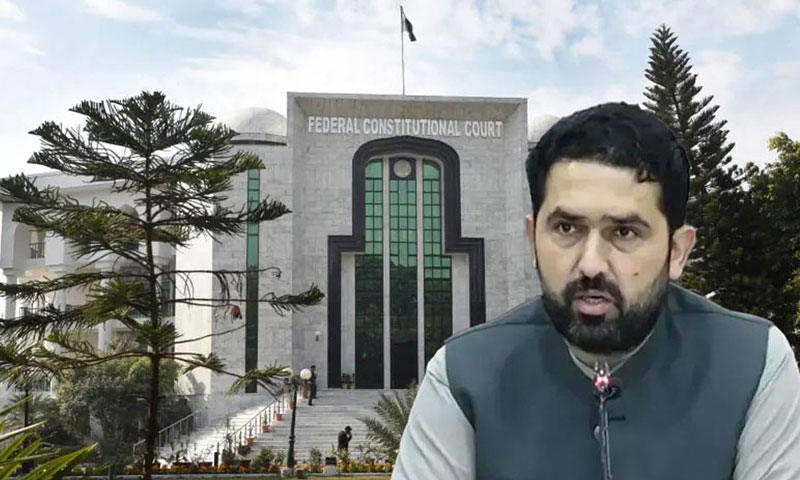
ISLAMABAD: The Federal Constitutional Court (FCC) has fixed for October 15 a petition challenging the appointment of Khyber Pakhtunkhwa Chief Minister Sohail Afridi, seeking to declare his election unconstitutional and restore his predecessor, Ali Amin Gandapur, to the office.
A three-member bench headed by Chief Justice Aminuddin Khan and comprising Justice Aamer Farooq and Justice Ali Baqar Najafi will hear the petition filed by Member of the National Assembly and lawyer Sher Afzal Marwat.
The petition challenges the circumstances surrounding Gandapur’s resignation and Afridi’s subsequent election as chief minister, arguing that the process was initiated on the directions of Pakistan Tehreek-e-Insaf (PTI) founder and former prime minister Imran Khan, whom the petitioner describes as convicted and constitutionally disqualified.
The FCC had taken up the petition on September 14 and issued notices to Afridi, the Khyber Pakhtunkhwa government and Attorney General for Pakistan Mansoor Usman Awan, seeking their responses.
The court subsequently fixed the matter for hearing in the second week of October.
Marwat appeared before the court in person during the earlier proceedings and argued that Gandapur had not resigned voluntarily but had submitted his resignation on the instructions of Imran Khan.
He maintained that the Constitution envisages that a public office-holder should resign voluntarily and argued that a resignation tendered under external pressure or dictation could not be treated as legally valid.
According to the petition, Gandapur submitted resignation letters on October 8 and 11, 2025, under what Marwat described as the unconstitutional direction of a convicted and disqualified individual.
He has sought a declaration that the letters lacked free will and were therefore legally ineffective.
Marwat also questioned whether the governor had formally accepted Gandapur’s resignation, arguing that the resignation and the subsequent de-notification were essential to the legal process of replacing the chief minister.
During the September 14 hearing, Justice Ali Baqar Najafi observed that another resignation had been submitted two days after the first, while Justice Aamer Farooq asked what constitutional question arose in the case.
Referring to the Supreme Court’s ruling in the Nawaz Sharif party presidency case, Marwat argued that a disqualified individual could not exercise control over the state through a proxy or issue binding directions concerning public office-holders.
The petition further contends that allowing a person disqualified under Articles 62 and 63 of the Constitution to influence the provincial executive would undermine constitutional governance and the independence of public offices. These are the petitioner’s arguments and have yet to be adjudicated by the court.
Marwat has asked the FCC to set aside all consequential actions arising from Gandapur’s resignation, including the October 15, 2025 notification concerning Afridi’s appointment and continuation as chief minister.
He has also sought Gandapur’s restoration to the office, arguing that if the resignation is declared invalid, the subsequent process that led to Afridi’s election would have no legal foundation.
The petition raises questions about the constitutional validity of a chief minister’s resignation, the role of a disqualified political leader in provincial decision-making and the legal consequences of the process through which a successor is elected.
The FCC’s upcoming hearing will take up the challenge to Afridi’s appointment. The court has yet to rule on the merits of the petition.
You May Also Like