

- AFP
- October 17, 2026
FCC issues detailed verdict striking down Income Tax Ordinance
-

- Ahsan Wahid
- June 16, 2026
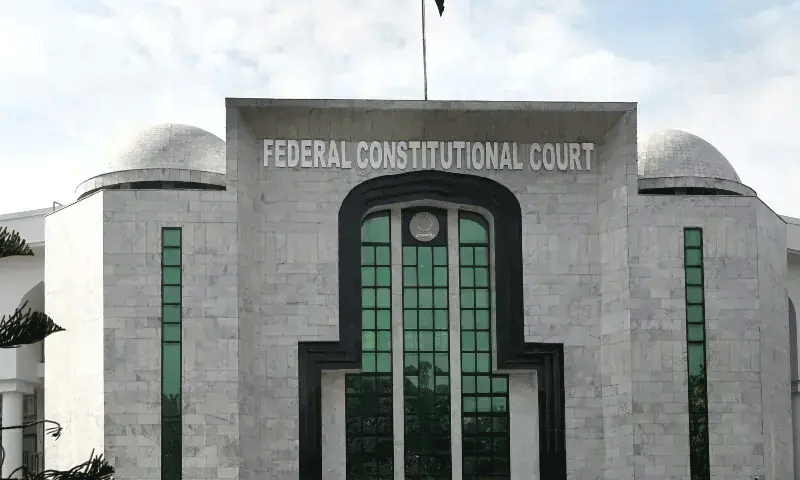
ISLAMABAD: The Federal Constitutional Court issued a detailed 92-page judgement on Tuesday declaring Section 7E of the Income Tax Ordinance unconstitutional, ruling that parliament cannot levy taxes on immovable property or construct taxes based on hypothetical earnings.
The landmark judgment, authored by FCC Chief Justice Aminuddin Khan, provides the detailed legal reasoning behind the court’s earlier May 7 short order that struck down the controversial tax provision.
“A tax can be levied for any public purpose, and the burden of such taxation is borne collectively by the public,” the court observed, clarifying that the validity of a tax does not depend on a direct benefit returning to the taxpayer.
“The role of the court is strictly to evaluate the constitutional legitimacy of a tax levy, not its underlying objectives. A law is struck down only when it violates fundamental rights or falls outside the legislative competence of the enacting body.”
The constitutional court ruled that Section 7E, which imposed a 5 per cent tax on the value of immovable property regardless of whether it generated actual income, was essentially a tax on property ownership rather than wealth generation.
The court noted that under the Constitution of Pakistan, the federal parliament is only authorized to legislate on matters within the federal domain.
“Parliament and the federal government only possess the authority to tax the value of movable assets under the constitution,” the judgment stated.
“The authority to impose taxes on immovable property falls strictly within the legislative jurisdiction of the provincial assemblies. Levying direct or indirect taxes on immovable property is completely beyond the jurisdiction of parliament.”
The bench further held that the constitution guarantees every citizen the right to acquire and hold property in accordance with the law. Forcing a citizen to pay a 5 per cent tax on a property that yields no actual revenue violates fundamental constitutional rights. “Taxation can only be imposed on actual income earned, not on fictional or presumed income,” the court ruled.
To highlight the disparity in the law, the court pointed out that while an individual renting out a house for 250,000 rupees is taxed on actual rent received, Section 7E unfairly forced the owner of an empty plot valued at 4.5 million rupees to pay taxes based entirely on its total asset valuation. The court added that while parliament can generally give retrospective effect to laws, monetary and fiscal laws cannot be applied retroactively.
Disputed Exemptions Struck Down
The court also struck down sub-clause (2) of Section 7E, which granted tax exemptions to a specific class of citizens, declaring it a violation of the constitutional right to equal treatment.
The clause had exempted the plots of military martyrs (shuhada), wounded war veterans, individuals who died during active service, ex-servicemen, and serving government officials from the tax asset pool.
The court noted that the state had failed to provide any solid or justifiable reason for granting these exclusive exemptions to a specific segment of society.
Addressing corporate tax structures, the judgment noted that a provision like Section 7E, aimed primarily at discouraging real estate hoarding rather than generating genuine revenue, could not be introduced through a Finance Bill. It added that courts are bound to interpret laws as written and cannot rewrite them to fix legislative ambiguities or errors.
The detailed verdict also addressed internal judicial procedures, confirming that the formation of benches remains the absolute discretion of the Chief Justice. It clarified that in the absence of any legal impediment, a two-member bench of the constitutional court is fully competent to hear all matters brought before it.