- Web Desk
- Mar 24, 2026
G-B govt withdraws wheat price hike; AAC sit-in continues
-

- Web Desk Tanveer Abbas
- Jan 29, 2024
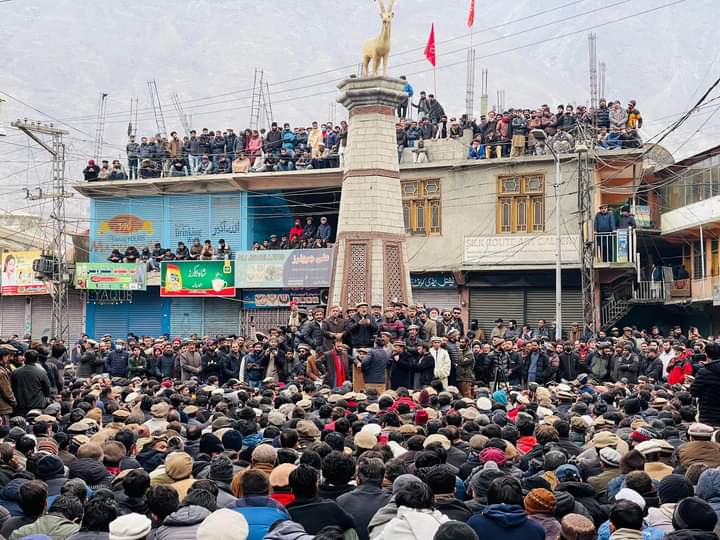
GILGIT: After weeks of demonstrations, sit-ins, and long marches, the Gilgit-Baltistan government has finally withdrawn its earlier notification to increase wheat prices.
The Chief Minister Secretariat issued a notification stating that the decision was made after consulting with and receiving unanimous approval from the members of the Gilgit-Baltistan Cabinet, considering the purchasing power of the local population and the broader public interest.
The Nagar Supreme Council, which led a significant march from Nagar, concluded its long march in Gilgit upon receiving the government’s notification regarding the continuation of wheat subsidies. Sheikh Mirza Ali clarified that their protest focused solely on the wheat subsidy issue, deferring other demands as impractical for the time being. He mentioned that additional demands would be raised by the people of Nagar once the new government in Islamabad takes office.

Similarly, a sit-in at Yadgar-i-Shuhada Skardu led by the Coordination Committee was postponed after continuous protests for 35 days on Monday. Terming the notification a victory and the first step towards meeting the 15-point agenda, the Coordination Committee leader Najaf Ali clarified that they were postponing not ending the protests due to harsh weather conditions.
“Revision of wheat price hike was our first demand while the remaining 14 demands are yet to be fulfilled. We fully support the Charter of Demands of the Awami Action Committee of Gilgit-Baltistan, he added.
However, the Awami Action Committee (ACC) which was leading the protests across the region in coordination with local bodies rejected the notification and announced the continuation of the sit-in until the fulfilment of the 15-point demands. They alleged that the government negotiated with its own planted facilitators, excluding actual stakeholders from the process. Meanwhile, hundreds of protestors from Ghizer joined the sit-in in Gilgit.

Gilgit-Baltistan witnessed disruptions in routine life for the fourth consecutive day on Monday, with a partial shutter-down and wheel-jam strike observed across the region. The strike garnered support from various political and religious parties in the area. Residents have been protesting for over a month against the increase in subsidised wheat prices and other grievances, with demonstrations held in multiple districts.
15-point Charter of Demands
The protestors demand that the wheat subsidy in Gilgit-Baltistan be frozen at 2022 rates, ensuring each person receives 9 kilograms of wheat per month. They call for the cancellation of the Gilgit-Baltistan Finance Act 2023 and the abolition of all taxes imposed in the region.
Additionally, they urge an end to the ‘artificially created power crisis’ and an increase in electricity production to address the region’s energy needs. The protestors advocate for an agreement with the federal government akin to the National Finance Commission to secure financial resources for Gilgit-Baltistan.
They emphasize the importance of recognizing locals’ ownership over all uncultivated and barren land through the Gilgit-Baltistan Reforms Bill. Furthermore, they propose replacing the GB Assembly with a constituent assembly to address governance issues effectively.
The demand includes providing free electricity from the Diamer-Bhasha Dam to Gilgit-Baltistan and allocating 80% royalty to the region in exchange for Water User Rights and Net hydrogen profits.
The protestors call for the cancellation of all mining leases granted to non-locals and the allocation of leases to locals of Gilgit-Baltistan.
They highlight the need to declare Tourism and Transportation as Industries in GB to promote economic growth.
Additionally, they seek the construction of the Shounter Tunnel to boost tourism in Gilgit-Baltistan. The protestors demand the establishment of medical and engineering colleges in Gilgit-Baltistan to enhance educational opportunities.
They call for the establishment of a university for women in GB to address gender disparities in higher education. The restoration of all ancient trade routes and roads is advocated to facilitate connectivity and economic development.
Local contractors in Gilgit-Baltistan are urged to be awarded PSPD contracts to stimulate economic growth in the region. The protestors recommend making NATCO profitable by granting it the transportation contract for wheat supply, ensuring sustainable operations.
You May Also Like