- Web Desk
- Mar 18, 2026
Gaza 2025: The ceasefire was never the goal
The timeline of Gaza in 2025 reads like a record of interruptions.
Not peace. Not resolution. Pauses.
People celebrated a ceasefire in January. It didn’t happen.
They gathered, they hoped, and the war returned. This conflict has trained people to expect a break in violence, not an end to it.
By late January, crossings opened and thousands began moving north. Not because it was safe. Not because there was peace. But because staying still was no longer an option. Movement has become the condition of survival.
Displacement dressed as return
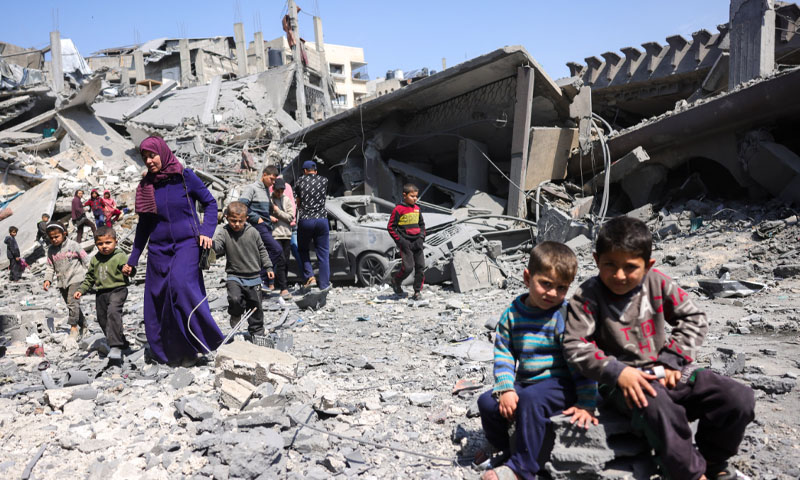
When people walk through rubble carrying what remains of their lives, it is often described as “return.” It isn’t. It is displacement in another direction. Homes no longer exist. Neighbourhoods are erased. What people return to is absence — of shelter, water, electricity, and certainty.
The ceasefire did not restore life. It only rearranged it.
Rebranding control
In February, the United States spoke about “taking over” Gaza, not militarily, but economically. Reconstruction was offered as language. Administration as solution.
This framing is not new. It replaces political responsibility with managerial terms.
Occupation becomes development. Control becomes stability. Nothing changes, except the wording.
When hunger becomes policy
By March, the ceasefire had collapsed. Airstrikes resumed. Hospitals overflowed. Aid slowed. Food became scarce. Water unreliable. People queued behind barbed wire for supplies that may or may not arrive.
In May, crowds broke into a UN warehouse. Not out of lawlessness, out of hunger. This was not a humanitarian failure alone. It was a political one.
The erasure of protected spaces
Hospitals are meant to be untouchable.
In Gaza, they were not. Medical facilities were struck. Journalists documenting the war were killed.
When those meant to heal and bear witness are no longer protected, the conflict shifts into something else entirely. The war stops distinguishing between targets and truths.
A regional ripple
By September, Gaza was no longer contained.
Violence spread to Jerusalem, the West Bank, and beyond. Strikes reached Qatar. The war became regional — not because it expanded suddenly, but because it was never isolated to begin with. Conflicts like this do not stay where they start.
Ceasefire is not peace
October brought a ceasefire that held. Hostages were released. Families moved back. There was relief — and it was real. But a ceasefire is not peace. It is a pause in violence, not a resolution of its causes. A moment of quiet before the next reckoning.
The unresolved question
The central issue remains untouched.
Gaza is treated as a crisis to manage, not a society to restore. Its people are negotiated over, moved around, spoken for — but rarely centred.
Until the conditions that make war inevitable are addressed, no ceasefire will hold. The timeline will simply reset.
And the pauses will continue.
You May Also Like