- WEB DESK
- October 8, 2026
Ghizer flood: shepherd saves hundreds as early warning system fails
-

- Zafar Ali
- August 22, 2025
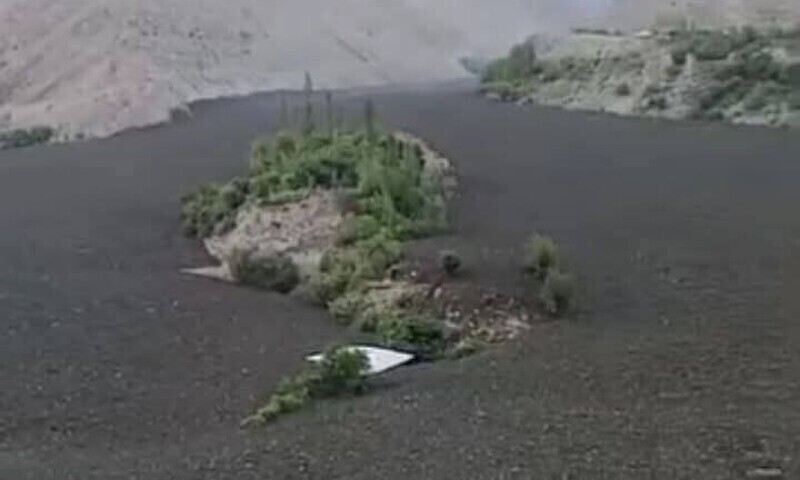
ISLAMABAD: It was not the millions of dollars worth of early warning systems installed in Gilgit-Baltistan’s climate-vulnerable valleys under the GLOF-II project, but a local shepherd who saved hundreds of lives as he alerted residents of Tali Das village in Ghizer district to the incoming flood after a glacier burst late at night on Thursday-Friday.
The glacial outburst blocked the Ghizer River for nearly 10 hours, threatening downstream areas. According to Rescue 1122, at least 200 people were evacuated to safety before floodwaters submerged most of the village and inundated hundreds of houses.
A Glacial Lake Outburst Flood (GLOF) occurs when water suddenly escapes from a glacial lake, leading to severe flooding that can block or overwhelm rivers. Pakistan is home to more than 13,032 glaciers, the largest reserve outside the polar regions. Experts warn that nearly 10,000 glaciers in Chitral and Gilgit-Baltistan are rapidly melting due to rising temperatures caused by climate change.
Pakistan floods kill 17,000, cause $70bn losses in 75 years
G-B Rescue 1122 said the displaced were moved to Yangal and Sumal, with medical aid provided on site. Gilgit-Baltistan Secretary Fida Hussain confirmed there were no casualties, though the floods swept away most of Tali Das and Roshan. Local volunteers were first on the scene, while officials said about 80 per cent of Tali Das was destroyed.
A resident, Abdul Waheed, said a shepherd living near the glacier had alerted downstream residents by mobile phone, urging them to evacuate before the flood struck.
Gilgit-Baltistan govt to relocate Ghizer flood victims
GB government spokesperson Faizullah Faraq said rescue operations were ongoing to reach stranded people. Law and Tourism Minister Ghulam Muhammad said 70 houses were completely destroyed. He warned that if the river’s natural flow was not restored, hundreds more homes could be submerged.
Special Assistant to the Chief Minister for Information, Eman Shah, said initial relief and rescue efforts had begun, with residents of downstream areas being shifted to safer ground amid fears of another lake burst.
Earlier this month, a GLOF from the Shisper Glacier swept away part of the Karakoram Highway in Hassanabad, destroying homes and infrastructure. On August 1, a glacier burst in Bagrote Valley killed one person and injured his father.
Locals have long complained that early warning systems installed under GLOF-I and UNDP-funded GLOF-II project are not fully functional across G-B.
Sources said that faulty equipment and maintenance issues of the early warning system have left communities vulnerable. Earlier, after an inquiry, GLOF-II Project G-B Coordinator Abdul Basit, was removed from service over corruption charges.
Locals also said the early warning system installed above Tali Das and Roshan failed to alert them. Instead, it was the shepherd named, Wasiyat Tanha, who warned villagers of the approaching flood via mobile phone.
“Had he (shepherd) not been there in the mountains, hundreds of people would have died under the debris and flood,” said Kamil, a resident of Roshan. He urged the government to install new early warning systems across Ghizer district and ensure their regular maintenance and monitoring so that they function properly.
According to the UNDP, due to rising temperatures, glaciers in Pakistan’s northern mountain ranges, including the Hindu Kush, Himalayas, and Karakorum, are melting rapidly. The rapid ice melting has led to the formation of 3,044 glacial lakes in Gilgit-Baltistan (GB) and Khyber Pakhtunkhwa (KP). Of these, 33 glacial lakes have been assessed as prone to hazardous glacial lake outburst flooding (GLOF).
GLOFs are sudden events that can release millions of cubic meters of water and debris, causing the loss of lives, property, and livelihoods among remote and impoverished mountain communities. Over 7.1 million people in GB and KP are vulnerable to these events, with 26.7 per cent and 22 per cent of the population in these areas, respectively, living below the poverty line.
You May Also Like