- Reuters
- November 16, 2026
‘Give me justice before it is too late’: Imran Khan pens open letter to three superior courts
-

- Javed Soomro
- November 16, 2026
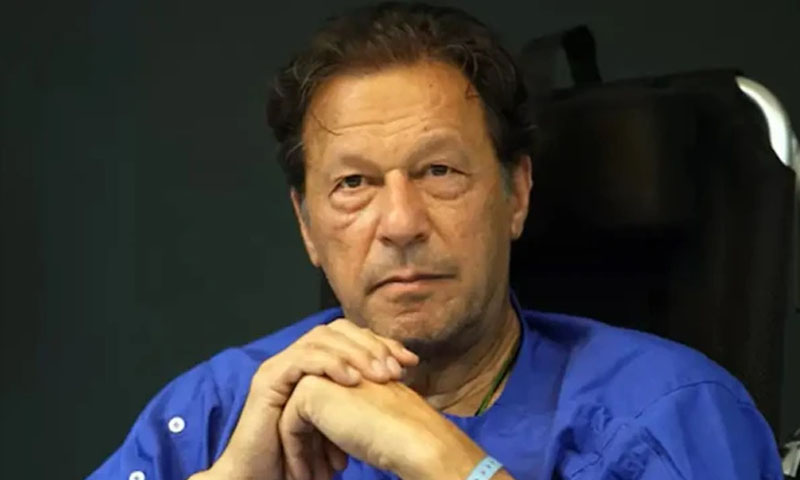
ISLAMABAD: Former prime minister and Pakistan Tehreek-e-Insaf (PTI) Imran Khan has written an open letter to the chief justices of Pakistan’s three superior courts, seeking urgent medical treatment for himself and his wife, Bushra Bibi, and the implementation of judicial orders concerning their healthcare and prison conditions.
Conveyed through his lawyer Salman Safdar, the PTI founder expressed concern from Adiala Jail over his deteriorating health, claiming his blood pressure had risen to 193 and that doctors had warned him of the risk of a brain haemorrhage and cardiac arrest. The letter has been addressed to the three superiors courts namely Supreme Court’s Chief Justice of Pakistan Yahya Afridi, Federal Constitutional Court (FCC)’s Chief Justice Justice Amin-ud-Din Khan and Islamabad High Court (IHC)’s Chief Justice Sardar Muhammad Sarfraz Dogar.
“At seventy-four, this unrelenting state is taking me to a place from which I may not return alive,” Khan wrote, urging the judiciary to intervene before his health deteriorated further.
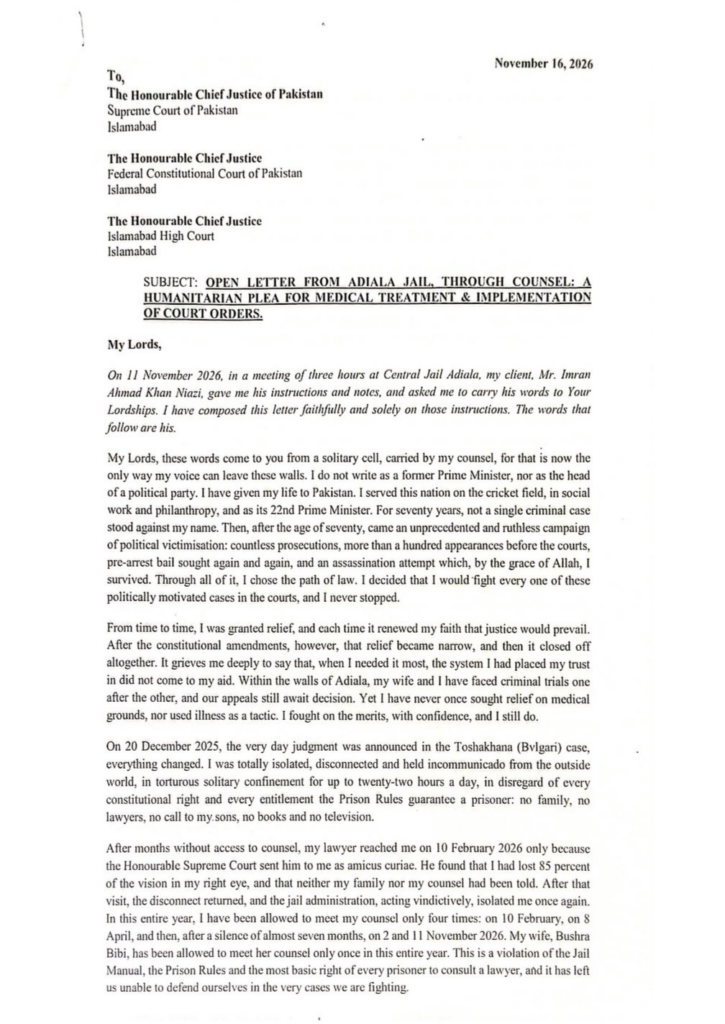
“I do not ask Your Lordships for any favour. All I request as justice is the implementation of the orders of the Honourable Supreme Court and proper treatment for our medical conditions,” he said.
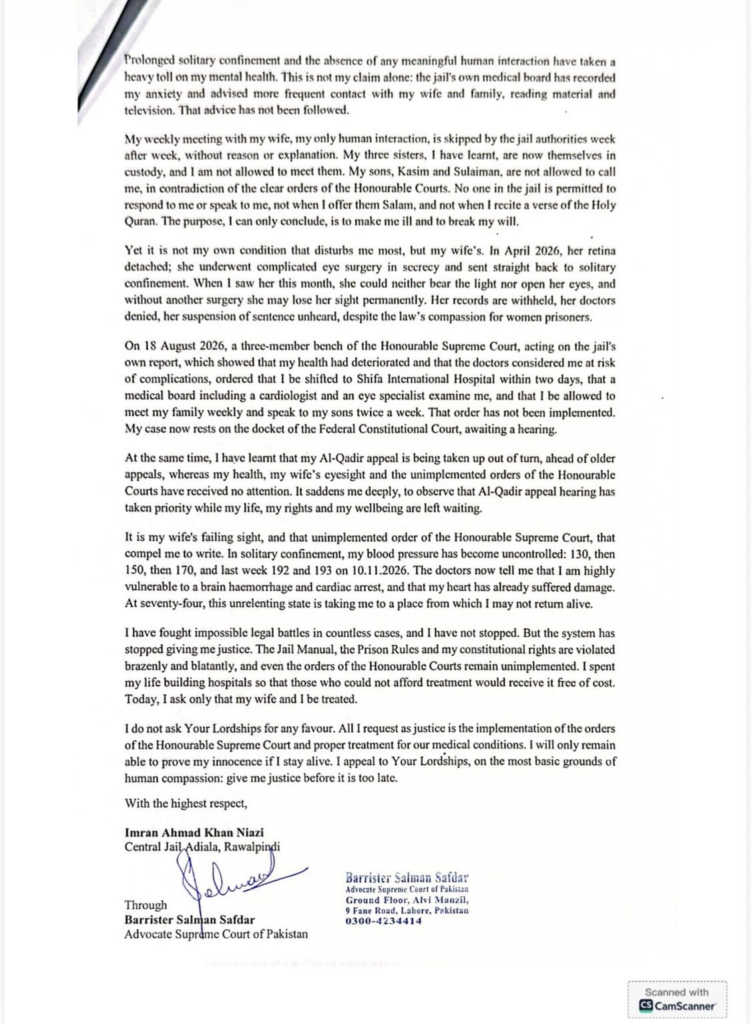
Addressed to the chief justices of the Supreme Court, Federal Constitutional Court (FCC) and Islamabad High Court (IHC), the letter was prepared by Khan’s counsel following a three-hour meeting at Adiala Jail on November 11.
His lawyer stated that the letter had been composed faithfully on Khan’s instructions and that the words reflected the former prime minister’s own account.
Imran claims blood pressure reached 193, warns of serious health risks
Khan said prolonged isolation and inadequate access to medical care had taken a toll on his physical and mental health.
He claimed that his blood pressure had progressively increased from 130 to 150, then 170, before reaching readings of 192 and 193 on November 10.
According to the letter, doctors had warned him that his condition could result in a brain haemorrhage or cardiac arrest and that his heart had already suffered damage.
Khan also alleged that he had lost 85 per cent of the vision in his right eye earlier this year, a development he claimed was not initially disclosed to his family or lawyers.
His account follows earlier medical assessments identifying a blockage in a vein of his right eye, which required specialist treatment.
However, Khan has continued receiving medical treatment while in custody. During the intervening night of November 10 and 11, he was taken to the Pakistan Institute of Medical Sciences (PIMS) for an examination and an injection in his affected eye.
Hospital authorities said he remained medically stable before, during and after the procedure and was subsequently returned to Adiala Jail.
The latest letter does not include medical documents independently confirming his reported blood pressure readings or the alleged cardiac complications.
Supreme Court’s August 18 order remains central to plea
A major concern raised by Khan is the alleged failure to implement a Supreme Court order directing his transfer to Shifa International Hospital.
On August 18, a three-member bench of the Supreme Court ordered his transfer to the Islamabad hospital within two days for a comprehensive medical examination.
The court also directed the formation of a multidisciplinary medical board, including a cardiologist and an ophthalmologist, and ordered access to his medical records and regular family meetings.
Khan maintained in his letter that these directions had not been implemented.
“That order has not been implemented. My case now rests on the docket of the Federal Constitutional Court, awaiting a hearing,” he wrote.
The implementation of the order has been the subject of further litigation. The federal government filed a review petition, challenging the direction to transfer him to a private hospital, while PTI sought contempt proceedings over alleged non-compliance.
Khan questioned why his medical treatment and the implementation of court orders remained unresolved while proceedings in his Al-Qadir Trust case continued.
‘No family, no lawyers, no call to my sons’
The former prime minister also alleged that he had been subjected to prolonged solitary confinement since December 20, 2025, when judgment was announced in the Toshakhana case.
He claimed he was being confined for up to 22 hours a day and denied regular access to family members, lawyers, books, television and telephone calls.
Khan said his lawyer had been permitted to meet him only four times this year, identifying meetings on February 10, April 8, November 2 and November 11.
He further alleged that jail staff were prohibited from speaking to him, even when he greeted them or recited verses from the Holy Quran.
“No one in the jail is permitted to respond to me or speak to me, not when I offer them Salam, and not when I recite a verse of the Holy Quran,” he wrote.
Khan claimed that the isolation had affected his mental health and that a prison medical board had recommended more frequent contact with his family, reading material and television.
He also complained that his weekly meetings with Bushra Bibi were frequently cancelled and that his sons, Kasim and Sulaiman, were not permitted regular telephone calls despite court directions.
The IHC had previously directed prison authorities to facilitate meetings between Khan and Bushra Bibi, along with family contact and access to reading materials under prison rules.
Imran expresses concern over Bushra Bibi’s eyesight
Khan said his wife’s medical condition was causing him even greater concern than his own health.
“Yet it is not my own condition that disturbs me most, but my wife’s,” he wrote, referring to her eye surgery in April and subsequent difficulties with her vision.
According to the letter, Bushra Bibi had been unable to tolerate light or open her eyes properly when he met her earlier this month.
Khan claimed that further surgery was necessary and that her eyesight could be permanently affected if she did not receive appropriate treatment.
He also alleged that her medical records had been withheld and that she had been denied access to doctors of her choosing.
His appeal comes as Bushra Bibi’s lawyers have filed a separate application before the IHC seeking her urgent transfer to a specialised hospital.
The application raises concerns about her deteriorating eyesight and requests access to her complete medical records.
During earlier court proceedings, Islamabad Advocate General Naveed Malik maintained that Bushra Bibi was receiving appropriate medical care in prison and informed the court that a medical board had examined her on November 8.
‘I will only remain able to prove my innocence if I stay alive’
In the closing part of his letter, Khan reflected on his legal battles and criticised what he described as the failure of the justice system to protect his constitutional rights.
He maintained that he had consistently contested the cases against him through legal proceedings rather than seeking relief on medical grounds.
“I spent my life building hospitals so that those who could not afford treatment would receive it free of cost. Today, I ask only that my wife and I be treated,” he wrote.
Khan also questioned the scheduling of his appeal in the £190 million Al-Qadir Trust case, arguing that it was being taken up ahead of older appeals while his medical concerns remained unresolved.
The IHC has fixed November 18 for hearing appeals filed by Khan and Bushra Bibi against their convictions in the case.
Concluding his letter, Khan appealed to the judiciary to ensure the implementation of existing court orders and provide medical care to both him and his wife.
“I will only remain able to prove my innocence if I stay alive,” he wrote, adding: “I appeal to Your Lordships, on the most basic grounds of human compassion: give me justice before it is too late.”