- Aasiya Niaz
- 14 Minutes ago
Global nuclear safety at risk: last US-Russia atomic pact officially expires
-

- Web Desk
- Feb 05, 2026
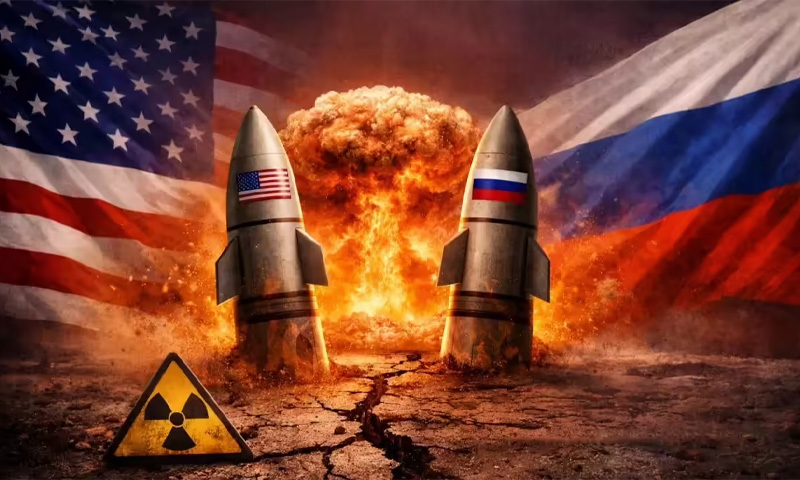
WEB DESK: A historic era of nuclear restraint has come to an end. On February 5, the New START (Strategic Arms Reduction Treaty) has officially expired, leaving the world’s two largest nuclear powers the United States and Russia without any legally binding limits on their atomic arsenals for the first time in over half a century according to AFP.
The collapse of the 2010 landmark agreement marks a “grave moment” for international security, according to United Nations Secretary-General António Guterres, as the “guardrails” that prevented a global catastrophe since the Cold War have been removed.
Russia Vows “Responsible” Path Amid Uncertainty
Despite the legal lapse, the Kremlin has signaled it will not immediately trigger a new arms race. Russian officials, including aide Yuri Ushakov, confirmed that President Vladimir Putin conveyed to Chinese President Xi Jinping that Moscow intends to act in a “measured and responsible manner.”
The Russian Foreign Ministry stated that while they are no longer bound by treaty obligations, they will continue to monitor U.S. military policy and the global strategic balance before making any major moves.
“Russia remains open to seeking politico-diplomatic ways to stabilise the situation, provided the appropriate conditions are created,” the Ministry added.
The Path to Expiration: Why the Deal Failed
The New START treaty, long regarded as the last surviving pillar of decades-long efforts to curb the risk of nuclear war, has unraveled amid steadily worsening relations between Washington and Moscow. Although the agreement was extended in 2021, Russia suspended its participation in 2023 after the outbreak of the Ukraine conflict, bringing an end to the mutual on-site inspections that had served as the treaty’s critical “eyes and ears.”
In late 2025, President Vladimir Putin proposed that both sides continue to observe the treaty’s numerical limits for at least another year, but Moscow maintains that it received no formal response from Washington through official diplomatic channels.
Complicating matters further is the China factor: the Trump administration has shown little appetite for renewing a purely bilateral arrangement, with Secretary of State Marco Rubio insisting that any 21st-century arms control framework must also include China, whose nuclear arsenal is expanding at a rapid pace.
A World Without Guardrails: What Changes Now?
The expiration of New START removes the legal cap of 1,550 deployed strategic warheads and 700 deployed missiles and bombers for each side, ushering in a far more uncertain nuclear landscape. Experts caution that the absence of inspections and data exchanges creates a dangerous transparency vacuum, forcing both Washington and Moscow to rely largely on satellite intelligence and inference conditions that sharply raise the risk of misunderstanding and potentially devastating miscalculation.
At the same time, organizations such as the Nuclear Threat Initiative warn of a rapid breakout risk, noting that both countries possess the technical ability to “upload” hundreds of additional warheads onto existing delivery systems within a matter of months.
Beyond the bilateral dimension, the removal of constraints is also likely to fuel broader global instability, as other nuclear-armed states, particularly China, may feel compelled to accelerate their own arsenal expansions to preserve strategic balance.
What Lies Ahead?
While President Trump has stated, “If it expires, it expires we’ll do a better agreement,” critics argue that negotiating a new treaty in the current geopolitical climate could take years of technical work and diplomatic trust that currently do not exist.
As the “Doomsday Clock” remains at its most dangerous setting in history, the world now waits to see if Washington and Moscow will translate their vows of “responsibility” into a new, verifiable framework or if a new era of unchecked nuclear competition has truly begun.
You May Also Like