- Web Desk
- Mar 24, 2026
Govt to stop buying power under major energy sector reforms
-

- Web Desk
- Nov 03, 2025
ISLAMABAD: Energy Minister Awais Leghari has said that the government inherited an expensive power system with multiple challenges, yet managed to cut electricity prices by Rs10.5 per unit over the past 18 months.
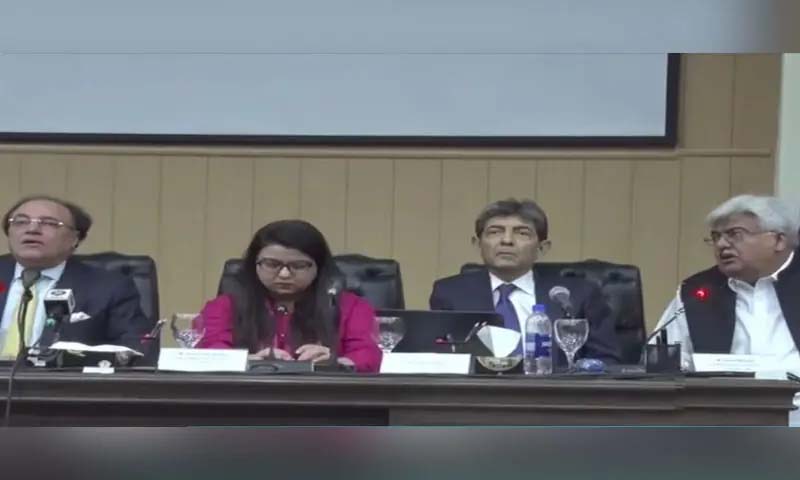
Addressing a press conference along with Finance Minister Muhammad Aurangzeb, FBR Chairman Rashid Mahmood Langrial and Minister for IT Shaza Fatima in Islamabad and others, Leghari said that surplus power was used efficiently by offering industries electricity at Rs26 per unit under a three-month package. The tariff for electric vehicles was reduced from Rs71 to Rs39 per unit, and industrial rates were cut by Rs16 per unit.
“We are modernizing the energy sector, resolving technical issues and saving billions of rupees. By auctioning loss-making generation units, the government saved Rs48 billion,” Leghari said.
He said that the finance ministry supported the energy ministry in finalising the IMF agreement. “We had 7,000 megawatts of surplus electricity that we couldn’t just keep idle. We got approval to sell it at cost, reducing the burden on consumers.”
“For the first time in 20 years, the government is exiting the power-purchasing business. Now, consumers will buy and sell electricity directly, ensuring better prices,” he said, calling it the biggest reform in Pakistan’s energy sector history.
The minister said that maintaining idle plants was costing Rs7 billion annually in salaries. “We auctioned 17 such units, raising Rs48 billion from a government entity and Rs9 billion from the private sector.”
He also announced a comprehensive plan to eliminate the Rs1.2 trillion circular debt within six years — without burdening consumers — through improved governance and automation.
“Within three years, the entire power system will be on automated metering with prepaid options,” he added.
“We reduced circular debt by Rs700 billion in one year, not just through lower interest rates or negotiations but by cutting losses in distribution companies,” Leghari said.
He revealed that annual losses of Rs193 billion were reduced, including Rs80 billion from tube wells in Quetta Electric Supply Company where 27,000 users consumed power without paying bills.
“Through federal and provincial investment of around Rs54 billion, we will recover Rs40 billion this year — meaning our investment in solarization will pay off within one year,” he said.
Addressing the joint press conference with the government’s economic team, Finance Minister Muhammad Aurangzeb described the recent agreement with the IMF as an endorsement of Pakistan’s economic stability.
He said that the government is pursuing a comprehensive reform agenda as structural reforms are essential for sustainable economic stability. He also said that the reduction in interest rates has had a positive impact on the economy.
Aurangzeb said that the economy has stabilised and significant progress has been made toward macroeconomic stability. “Our goal is to ensure sustainable economic stability, and for that, reforms are unavoidable,” he said.
He said that the government is implementing fundamental economic reforms, and that global rating agencies have acknowledged Pakistan’s improved stability.
“The IMF staff-level agreement also validates the country’s economic progress,” he said.
Aurangzeb said Pakistan’s economic direction is now on the right track. “The reduction in policy rates has had a positive effect on the economy. Reforms are being introduced in the tax system, energy, and other sectors, while pension reforms and right-sizing are also part of the broader reform agenda.”
‘FBR does not need to impose new taxes’
FBR Chairman Rashid Langrial said that income tax return filings have increased by 18 per cent this year, with the number of taxpayers reaching 5.9 million. “FBR does not need to impose new taxes,” he asserted.
He said the rate of individual tax return filing has increased, and effective measures have led to higher revenue collection, with support from all relevant institutions.
“For the first time, the tax-to-GDP ratio has risen by 1.5 per cent,” he noted, adding that the FBR is implementing all tax-related measures approved in the budget. The prime minister, he said, chairs weekly meetings on tax reforms.
Langrial explained that tax reforms take time but the target is to raise the tax-to-GDP ratio to 18 per cent within the next three to four years — with 15 per cent coming from the federation and 3 per cent from provinces.
He said that the federal government must increase its contribution by 3.52 per cent in three years, while provinces have to raise theirs by 2.15 per cent — a difficult task given their smaller base.
Referring to inter-agency cooperation, Langrial revealed that FBR officers previously faced serious threats while dealing with tax evasion in the narcotics sector — two officials were even martyred in Kohat Tunnel.
“Our job is not to fight; we are trained to ensure tax compliance,” he said, adding that with the support of Rangers and other institutions, such enforcement has now become possible.
‘Govt ensuring transparency in privatisation’
Prime Minister’s Adviser on Privatisation Muhammad Ali said that lack of commitment from top leadership had stalled privatisation for two decades, but the prime minister is personally focused on it.
He said right-sizing efforts are ongoing in consultation with ministries, and all final approvals are given by the cabinet.
“We are enhancing the capacity of the Privatisation Commission and ensuring full transparency so no monopolies emerge after privatisation,” he added.
Ali cited the sale of First Women Bank for Rs5 billion, clarifying that criticism over the price was misplaced since another small bank, SME Bank, could not even be sold and had to be shut down.
“The government is determined to meet its privatisation targets and is engaging financial experts for the process,” he said, adding that privatisation will now accelerate.
He confirmed that four groups — Fauji Foundation, Airblue, Lucky Cement and Arif Habib Group — are bidding to purchase PIA, while distribution companies’ privatisation will begin with IESCO, LESCO and FESCO.
‘54,000 vacant posts abolished’
Prime Minister’s Coordinator for Right-Sizing Salman Ahmad said that 20 ministries have already undergone right-sizing, resulting in the abolition of 54,000 vacant posts. He added that PASSCO, a heavily loss-making entity, will be shut down.
‘National Digital Exchange being established’
Minister for Information Technology Shaza Fatima said that Pakistan is targeting a $10 billion digital impact over the next four years.
“We are moving toward a cashless economy,” she said, noting that the *Digital Nation Pakistan Act* was passed in January, providing a roadmap for digital society, economy, and governance.
The prime minister has formed three committees on the cashless economy — one chaired by the State Bank Governor, another by Shaza Fatima herself, and a third overseeing transactions between the public and government — under the overall supervision of the finance minister.
She said a “National Digital Exchange” is being established to link all institutions, including the FBR, allowing integrated operations across government departments.
“We are introducing a comprehensive, integrated system for a cashless economy,” she said. “Digitization will expand the tax net, improve revenue collection, enhance transparency, and save time.”
Citing a World Bank report, she added, “A 10 per cent increase in digital payment adoption can boost GDP growth by nearly 1 per cent — meaning that for every 10 per cent rise, Pakistan’s GDP could grow by Rs40 billion.”
You May Also Like