
- Reuters
- October 27, 2026
Govt urged to criminalise forced conversions, ensure equal rights for minorities
-

- WEB DESK
- August 12, 2026
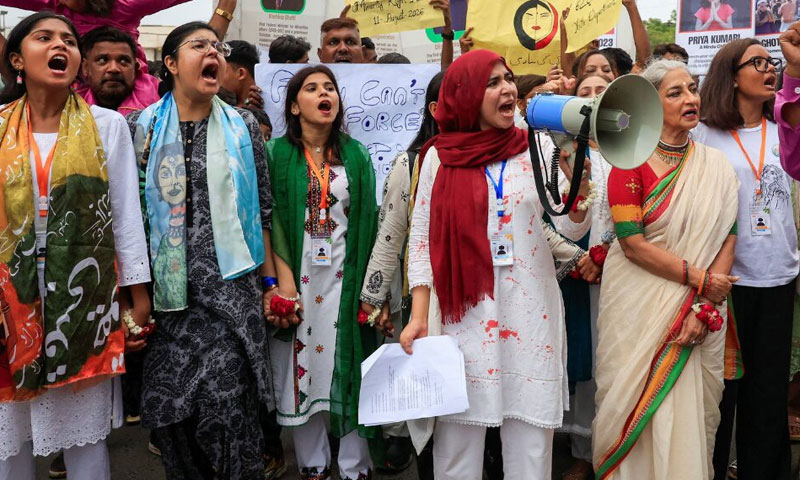
KARACHI: Civil society activists and representatives of religious minority communities held a “Minority Rights March” outside Quaid-e-Azam’s mausoleum in Karachi, calling for an end to forced conversions and demanding constitutional and legal reforms to ensure equal rights for all citizens.
The march was organised in connection with “National Minorities Day” and sought to draw attention to the principles outlined by Quaid-e-Azam Muhammad Ali Jinnah in his historic August 11, 1947 address.
Participants gathered outside the mausoleum to recall Jinnah’s vision of a Pakistan where all citizens would enjoy equal rights irrespective of their religion or faith.
Human rights activists and prominent political and social figures were among those attended the march.
Speakers said that the prevailing situation in the country was contrary to the principles outlined by Muhammad Ali Jinnah in his August 11 address.
They stressed that remembering Jinnah’s vision through speeches alone was not enough and called for his principles to be reflected in legislation, government policies and the everyday lives of citizens.
11-point charter of demands
Participants expressed concern over what they described as increasing violence, inequality and incidents of forced conversion targeting religious minorities.
An 11-point charter of demands was presented during the march, calling on the government to introduce immediate constitutional and legal reforms to protect minority rights.
The demands included a 10 per cent quota for minorities in educational institutions and employment, the removal of hate material from the national curriculum and amendments to Articles 41 and 91 of the Constitution.
The activists also called for forced conversion to be made a punishable offence and urged the government to take effective measures to prevent such incidents.
Another key demand focused on the education system, with participants calling for the introduction of separate religious curricula for minority communities.
The organisers said the demands were aimed at creating a Pakistan where every citizen was treated equally and where religion or belief did not determine a person’s rights.
The organisers said that the march was intended to demand a country where every citizen could practise their religion and live their life without fear or discrimination.
They called for equal rights, dignity and freedom of religious belief and urged the government to take concrete measures to protect vulnerable communities.
Speakers said the state had a responsibility to ensure that constitutional guarantees of equality were translated into practical protections for religious minorities.
The participants also emphasised the need to address discrimination and violence through institutional, legal and educational reforms.
‘Struggle continues’
In a post on the official X account of the Minority Rights March, organisers said Karachi residents had participated in large numbers and raised their voices for equality, dignity and justice.
The post said the march had concluded but the struggle would continue, adding that the voices demanding equality, justice and dignity for all would not be silenced.
The organisers said they would continue advocating for the rights of religious minorities and pushing for reforms to ensure that all citizens were treated equally under the law.
You May Also Like


- WEB DESK
- October 27, 2026
Punjab govt moves to provide life insurance cover to employees
- AFP
- October 27, 2026