- Web Desk
- Feb 24, 2026
Gul Plaza fire: ruling coalition clashes in National Assembly
-

- Web Desk
- Jan 20, 2026
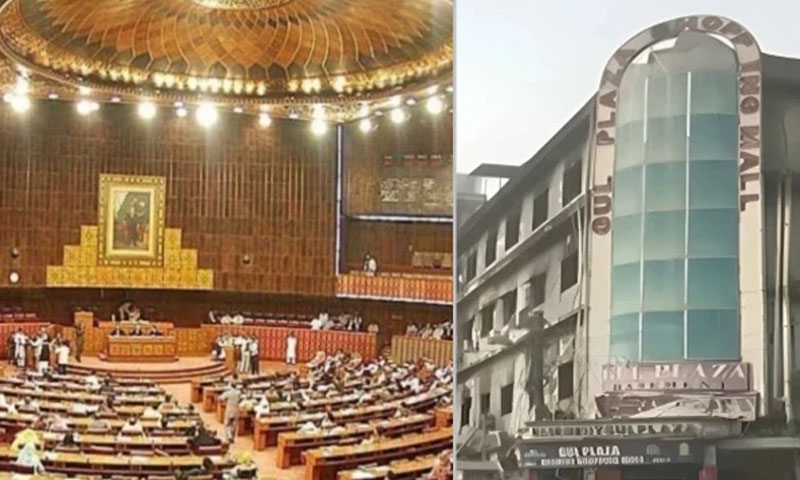
ISLAMABAD: The ruling coalition faced internal divisions in the National Assembly over the Gul Plaza tragedy as the Muttahida Qaumi Movement-Pakistan (MQM-P) and the Pakistan People’s Party (PPP) exchanged allegations over the incident and emergency response failures.
Deputy Speaker Ghulam Mustafa Shah chaired the session. At the request of MQM, the session’s agenda was suspended to discuss the Gul Plaza tragedy.
The MQM-P and the PPP criticized each other, while Defence Minister Khawaja Asif called for reforms in local government syatem.
MQM-P member Farooq Sattar described the fire as a national tragedy and said the provincial government had been slow to respond to the tragedy.
He said that the Sindh chief minister reached the site 22 hours after the incident while a representative of the Jamaat-e-Islami arrived 20 hours later. Sattar praised firefighter Furqan Shahid, who died attempting to control the blaze, and said around 80 people still remain missing.
Farooq Sattar said that Karachi is a city of 40 million people. He noted that President Asif Ali Zardari had acknowledged this in his speech, but officially the city’s population is often shown as 20 million.
He said that there are only 100 fire brigades for the entire population, of which 50 are non-functional, and just 25 fire stations serve the entire city.
He criticized the removal of parks and green spaces and said that while the National Assembly has taken steps to address Karachi’s problems, more action is needed. Over 50 percent of commercial centers in the city lack fire or emergency equipment, he said, and suggested importing anti-fire balloons from China.
Sattar remarked that the fire at Gul Plaza has ignited a fire in the hearts of every citizen of Karachi. He called for cooperation with the provincial government and urged collective efforts to transform Karachi into a city akin to New York under Zehran Mamdani or London under Sadiq Khan. He emphasized that Article 140A should become part of the 28th amendment and not be politicized, as it concerns citizens’ rights.
PPP lawmaker Shehla Raza on Gul Plaza fire
PPP National Assembly member Shehla Raza said that when a fire occurred in New Zealand, 40 people died, and in Lahore’s Hafeez Centre, fires occurred three times but no political controversy happened. She said: “It’s a fire. These things happen.”
Raza criticized MQM-P for politicizing the Gul Plaza incident, saying it was strange that one event was used to question issues ranging from provincial autonomy under the 18th Amendment to basic education.
She highlighted Sindh’s long history and its welcoming of migrants, saying the province should be viewed as an ancient region.
She noted that the fire at Gul Plaza broke out at multiple points and questioned what chemicals were used that prevented it from being extinguished despite water being applied.
She also asked why 24 entry and exit routes to the plaza were blocked.
Raza said that traffic delays hindered the fire brigade’s response. While she agreed that a local government system is necessary, she warned against using it as a pretext for political point-scoring, urging lawmakers to express grievances responsibly.
Defense Minister Khawaja Asif told the National Assembly that to prevent fires and accidents in Karachi and to empower the country’s 250 million citizens, it is essential to establish authoritative and functional local governments in major cities including Lahore, Karachi, Peshawar, and Quetta. He noted that even during periods of military rule, local governments functioned, and that China’s presidents also rose to power through local governance experience.
Asif said human lives are being lost daily in Karachi due to fires like the Gul Plaza incident and routine accidents involving dumpers. He emphasized that Karachi has grown so large that managing it is a challenging task, and empowering citizens requires a robust local government system.
He noted that the 28th Amendment had proposed an effective system to empower local governments, and there had been a consensus to implement the system outlined in the 18th Amendment. However, the amendment had to be rolled back.
Asif added that the aim was to instill a sense of national and provincial identity in the new generation across the country, from Gwadar to Gilgit, through a unified curriculum, but this effort was also halted.
He stressed that the Gul Plaza fire and other incidents highlight the need for active local governance nationwide, allowing powers to be delegated down to district, tehsil, and union council levels.
He said that until there is representation at the neighborhood level, neither fire brigades nor other emergency services can function effectively, and even federal departments such as defense, navy, and aviation cannot substitute for local authorities in firefighting.
Asif noted that during the regimes of Ayub Khan, Zia-ul-Haq, and Pervez Musharraf, empowered local governments existed and regular elections were held. He added that today elections are often postponed, and provincial governments resist transferring powers to lower levels.
He cited China and Turkey as examples where developed countries have functional local government systems and proposed amending the constitution to introduce a uniform curriculum and active local governance nationwide.
Abdul Qadir Patel on Karachi’s governance history
PPP National Assembly member Abdul Qadir Patel said that for 35 years, Jamaat-e-Islami and MQM dominated Karachi, leaving the city in its current condition.
He claimed the PPP is the only party that provided full financial support to victims of Karachi’s disasters.
Speaking in the National Assembly, Patel said that despite opposition claims, the PPP has consistently called for collaboration to manage the city. He described the Gul Plaza fire as a tragedy in which precious lives were lost and criticized past municipal mismanagement.
Patel said that during the 35 years of rule by these two parties, structures like the Timber Market fire occurred, and in Gul Plaza, officials and politicians allowed unsafe construction practices. He also highlighted past mismanagement related to parks, playgrounds, and illegal plotting.
MQM lawmaker Wasim Hussain responds
MQM National Assembly member Wasim Hussain strongly rejected Patel’s allegations, saying that those criticizing Altaf Hussain in parliament had previously served him loyally, including presenting him with Sindhi Ajraks and caps.
He saidthat during Gul Plaza’s construction, all relevant agencies and political figures were aware, and that today, the focus should be on identifying the real responsible parties, rather than placing blame politically.
Earlier, Khalid Maqbool Siddiqui held a press conference at Parliament House, sharply criticizing the provincial government.
He said that merely a telephone call to the chief minister is insufficient and the prime minister should directly talk to Karachi representatives. He said that the incident was the result of 17 years of mismanagement and warned that over 100 lives could be at risk due to administrative failures.
You May Also Like