
- AFP
- October 27, 2026
Hague court tells India to uphold Indus Waters Treaty, limit Ratle project work
-

- WEB DESK
- August 31, 2026
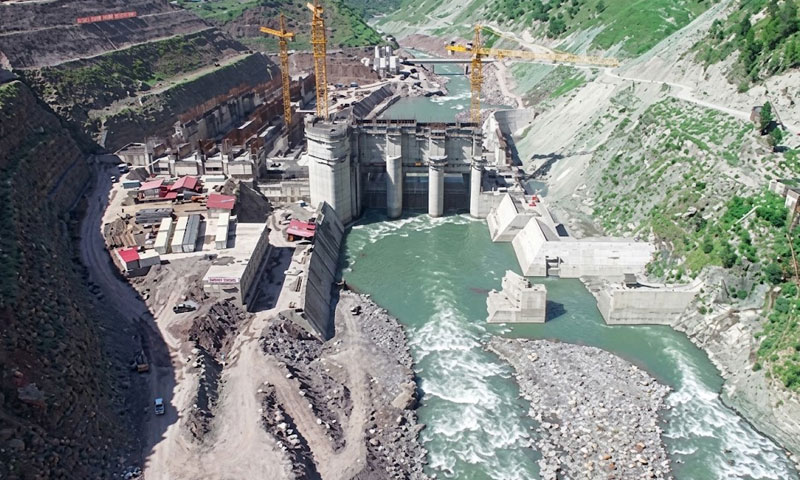
ISLAMABAD: The Permanent Court of Arbitration (PCA) in The Hague has ruled that the Indus Waters Treaty (IWT) between Pakistan and India remains fully in force, rejecting New Delhi’s position that it could unilaterally suspend the decades-old water-sharing agreement.
The tribunal also issued interim measures concerning India’s under-construction Ratle hydroelectric project in Indian Illegally Occupied Jammu and Kashmir (IIOJK), limiting work on the project pending further proceedings under the treaty.
The ruling marks another significant development in the long-running water dispute between the two nuclear-armed neighbours, which escalated sharply after India announced in April 2025 that it was placing the IWT “in abeyance”.
The PCA said India had no legal basis under the treaty to terminate or suspend it unilaterally. The court also said a neutral expert appointed under the treaty’s dispute-resolution mechanism would determine whether the design and construction of Indian hydroelectric projects comply with the IWT, with that process expected to continue into 2027.
The ruling comes after a series of proceedings before the PCA over Indian hydroelectric projects on the western rivers, which Pakistan says could give India excessive control over downstream water flows.
Pakistan welcomes arbitration court ruling
Pakistan on Monday welcomed a decision by the Permanent Court of Arbitration concerning the Indus Waters Treaty, saying the ruling would be reviewed in detail to assess how it could help facilitate renewed contacts with India.
The government said that the international arbitration court had directed India to adhere to the Indus Waters Treaty and halt work on hydroelectric projects covered by the dispute.
“Pakistan welcomes the decision of the international arbitration court,” the government said, adding that the details and implications of the ruling would be examined.
Pakistan has consistently maintained that the treaty remains a binding international agreement and cannot be unilaterally suspended. India, meanwhile, announced in April that it was putting the treaty in abeyance following a deadly attack in IIOJK, a move rejected by Islamabad.
The dispute has also centred on Indian hydropower projects on rivers allocated to Pakistan under the treaty, including the Ratle and Kishanganga projects.
Pakistan said it would carefully examine the arbitration court’s ruling and determine how the decision could contribute to restoring communication between the two countries.
“It will be seen how this decision can help in renewed contacts,” the government said.
The PCA proceedings were initiated under the dispute-resolution mechanism provided in the Indus Waters Treaty. The court has previously ruled that it had competence to consider Pakistan’s objections concerning India’s hydropower projects despite India’s opposition to the arbitration process.
India rejects ruling
India rejected the latest ruling, maintaining that the arbitration process has no jurisdiction over the matter.
The Indian Ministry of External Affairs said its decision to place the IWT in abeyance remained in force and rejected the PCA’s authority to issue orders concerning the treaty.
New Delhi has previously boycotted the PCA proceedings, arguing that the court was improperly constituted and that the dispute should instead be dealt with through the treaty’s separate neutral-expert mechanism.
The opposing positions mean that the latest ruling is unlikely to immediately resolve the dispute, but it reinforces Pakistan’s legal argument that the treaty continues to bind both countries.
What the court has ruled previously
The latest decision is part of a broader arbitration process initiated by Pakistan in 2016 over the design of India’s Ratle and Kishenganga hydroelectric projects.
In August 2025, the PCA issued an award on the general interpretation of the IWT, holding that the treaty’s provisions governing Indian hydroelectric projects on the western rivers must be interpreted according to the treaty itself.
The tribunal subsequently issued a supplemental award in May 2026 concerning the maximum pondage — the amount of water that can be stored at a run-of-the-river hydroelectric plant.
That ruling reinforced limits on India’s ability to use storage capacity at hydroelectric projects on the western rivers and affirmed Pakistan’s rights to obtain information needed to assess whether Indian projects comply with the treaty.
The PCA’s latest proceedings specifically considered Pakistan’s request for interim measures and the status of the treaty following India’s decision to place it in abeyance. The court had completed hearings on those issues in May 2026.
The Indus Waters Treaty
Signed in September 1960 after years of negotiations facilitated by the World Bank, the IWT governs the use of the Indus river system by India and Pakistan.
Under the treaty, the three eastern rivers — the Ravi, Beas and Sutlej — were allocated for India’s unrestricted use, while Pakistan received the three western rivers — the Indus, Jhelum and Chenab.
India is nevertheless permitted to use the western rivers for certain purposes, including limited irrigation and hydroelectric generation, subject to detailed restrictions set out in the treaty.
Indian hydroelectric projects on the western rivers are generally required to operate as run-of-the-river schemes. Such projects can generate electricity without permanently diverting the rivers, but their design, storage and operational characteristics are subject to treaty restrictions intended to protect Pakistan’s downstream rights.
The Ratle project, with a planned generation capacity of about 850 megawatts, is being built on the Chenab River in IIOJK. Pakistan has repeatedly objected to aspects of its design, arguing that the project could enable India to exercise greater control over flows reaching Pakistan.
The Kishenganga project, a 330MW facility on a tributary of the Jhelum, has also been the subject of a long-running dispute between the two countries.
Why the treaty matters to Pakistan
The Indus river system is the backbone of Pakistan’s irrigation network and agriculture. The country is heavily dependent on the western rivers for irrigation, food production and water supplies.
Any sustained reduction or manipulation of flows could therefore have consequences well beyond the immediate water dispute, potentially affecting agriculture, food security and the wider economy.
Pakistan has consequently treated the IWT as a core national-security issue, particularly because of its limited water-storage capacity and its dependence on river flows originating in or passing through India-administered territory.
Deputy Prime Minister and Foreign Minister Ishaq Dar said earlier that Pakistan would safeguard its legitimate rights and interests under the treaty and international law, warning that any attempt to deprive Pakistan of its treaty-allocated waters could have serious consequences for regional peace and security.
How the dispute escalated
The latest legal confrontation stems from a broader deterioration in Pakistan-India relations.
India announced on April 23, 2025 that it was placing the IWT in abeyance, a day after the April 22 attack in Pahalgam in IIOJK that killed 26 people.
New Delhi blamed Pakistan for the attack, a charge Islamabad vehemently rejected.
India subsequently took a series of measures against Pakistan, including suspending the treaty, closing the Wagah-Attari border crossing, reducing diplomatic representation and restricting visas.
Pakistan rejected India’s decision to suspend the IWT, arguing that the treaty contains no provision allowing either party to unilaterally place it in abeyance.
The dispute escalated further in May 2025, when India and Pakistan exchanged military strikes before agreeing to a ceasefire.
Two parallel dispute-resolution tracks
The water dispute has also become complicated by competing mechanisms under the IWT.
The treaty provides for different procedures depending on the nature of a dispute. These include the Permanent Indus Commission, a neutral expert and, for certain disputes, a Court of Arbitration.
Pakistan initiated the PCA proceedings in 2016 over the Kishenganga and Ratle projects.
India has opposed the PCA process and has instead backed the neutral-expert route for technical questions concerning the projects.
The World Bank appointed a neutral expert in separate proceedings, creating parallel processes that India has argued should take precedence over the PCA proceedings.
The PCA, however, has maintained that it has jurisdiction over the matters brought before it under the treaty.
The court has also held in earlier proceedings that awards of the Court of Arbitration are final and binding on the parties on matters within its jurisdiction.
What happens next
The latest ruling does not by itself resolve every technical dispute surrounding Indian hydroelectric projects on the western rivers.
Instead, it establishes that the treaty remains the governing legal framework while the technical questions concerning individual projects continue to be examined through the mechanisms provided under the IWT.
A neutral expert appointed under the World Bank-backed process is expected to assess whether the relevant Indian hydroelectric projects comply with treaty requirements, with the process extending into 2027.
For Pakistan, the latest PCA ruling provides another legal affirmation of the continued validity of the IWT and its protections for downstream water rights.
For India, however, the treaty remains in abeyance and New Delhi continues to reject the PCA’s jurisdiction.
The conflicting positions leave the 1960 agreement at the centre of one of the most consequential disputes in Pakistan-India relations, with the legal battle over water now running alongside the two countries’ broader diplomatic and security tensions.
You May Also Like



- WEB DESK
- October 27, 2026
