- Web Desk
- 28 Minutes ago
Heavy US-Israeli strikes reported in Tehran as war escalates
-

- Web Desk
- 11 Minutes ago
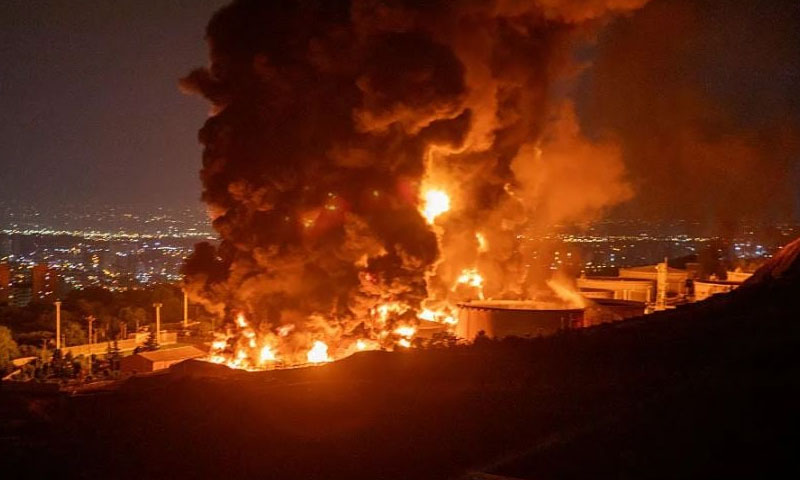
TEHRAN: Heavy US and Israeli bombardment was reported in Iran’s capital Tehran on Tuesday, with powerful explosions also heard in the nearby city of Karaj, as the conflict widened across the Middle East.
Arab media reported that dozens of people were feared killed in the strikes, described as among the most intense since the war began. Witnesses reported powerful blasts in Karaj that lit up the night sky.
Iran’s foreign minister, Abbas Araqchi, said negotiations with the United States were not on the agenda under the current circumstances.
“As long as necessary, Iran will continue missile attacks,” he said.
The Lebanese group Hezbollah said it fired missiles at a drone control base in the Israeli city of Safed and launched rockets toward the Yiftah Barracks.
Separately, a drone struck a hotel building in Bahrain, causing a fire, according to regional media reports.
Putin urges end to war
Russian President Vladimir Putin urged U.S. President Donald Trump to quickly end the war with Iran during an emergency phone call, Russian media reported.
The Kremlin said the two leaders discussed the conflict with Iran, as well as the situation in Ukraine, developments in Venezuela and the global oil market.
According to Kremlin foreign policy aide Yuri Ushakov, Putin also presented proposals aimed at ending the conflict.
Putin has previously warned that the U.S. and Israeli campaign against Iran could trigger a global energy crisis.
The Russian leader recently congratulated Iran’s new Supreme Leader Mojtaba Khamenei, saying the country needed strong leadership during the current crisis.
U.S. used $5.6 billion in weapons in first days: report
The United States used about $5.6 billion worth of weapons and ammunition in the first two days of the war against Iran, the The Washington Post reported, citing U.S. officials.
The report said the scale of the expenditure showed how rapidly the U.S. military was deploying advanced and costly weaponry.
Some members of the U.S. Congress have expressed concern that the military could be quickly consuming stocks of its most sophisticated weapons.
The U.S. military’s regional command, U.S. Central Command, said American forces had struck about 5,000 targets in Iran so far, damaging or destroying around 50 Iranian warplanes.
Tensions rise around Strait of Hormuz
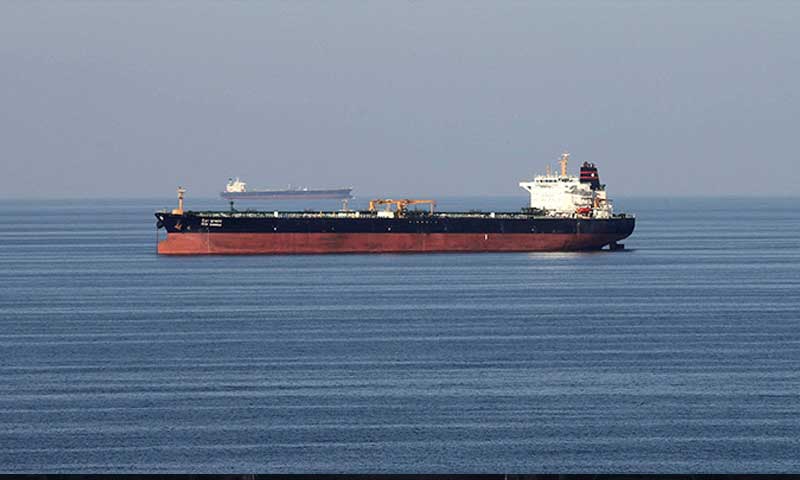
Iran’s Revolutionary Guards warned that only countries expelling U.S. and Israeli ambassadors would be allowed unrestricted passage through the strategic Strait of Hormuz.
A spokesman for the Islamic Revolutionary Guard Corps said Iran would decide when the war ends, dismissing comments by Trump.
“Security in the region will either be for everyone or for no one,” the spokesman said, warning that continued attacks on Iran could halt all oil exports from the region.
Trump said earlier that the U.S. Navy could be deployed to protect commercial shipping in the Strait of Hormuz if necessary.
Iran fires drones and missiles across region
Iran has launched about 2,000 drones and 500 missiles at targets in Arab countries since the conflict began, the The New York Times reported.
The figures suggest Iran’s missile capabilities remain intact despite speculation that its stockpiles were running low.
Iran’s Revolutionary Guards said they fired 10 Khyber Shekan missile missiles toward Tel Aviv and warned that air raid sirens in Israel would continue.
Iranian forces also claimed they had struck a U.S. naval vessel with the same missile, though the claim could not be independently verified.
Trump threatens Iran’s new leadership as Middle East conflict intensifies
U.S. President Donald Trump threatened Iran’s emerging leadership with assassination and said U.S. and Israeli forces were carrying out major military operations against the country, as tensions across the Middle East continued to escalate.
Speaking at a conference of Republican lawmakers, Trump adopted a sharply aggressive tone, saying any new leadership that emerged in Iran would also be targeted.
“Whoever comes forward as the new leadership will be eliminated as well,” he said.
Trump claimed that the United States and Israel had already inflicted heavy damage on Iran’s military capabilities. He said U.S. forces had struck 5,000 targets in Iran and destroyed 51 Iranian naval vessels.
“Iranian ships are now at the bottom of the sea,” he said, adding that Iran’s drone and missile capabilities had been largely destroyed.
Trump also said that if the United States had not carried out the military operation, Iran could have acquired a nuclear bomb within two weeks, posing what he described as a major threat to the world.
The U.S. president said the world was witnessing a large and complex military campaign called “Epic Fury,” which he said was proving even more effective than an earlier operation named “Midnight Hammer”.
Trump added that during his first presidential term he had focused on strengthening the U.S. military, while in his second term he was fully utilising that power.
“The U.S. military is the best and most powerful in the world, and now the entire world knows it,” he said.
Trump also criticised the U.S. withdrawal from Afghanistan during the presidency of Joe Biden, calling it a “shameful moment” in American history that damaged Washington’s credibility.
Trump criticises Iran’s new supreme leader
In an interview with NBC, Trump said Iran had made a “big mistake” by appointing Mojtaba Khamenei as the country’s new supreme leader after the death of his father, Ali Khamenei.
“I think Iran made a very big mistake,” Trump said when asked about the leadership change. When pressed about the possible consequences, he replied: “We’ll see.”
Trump had earlier described Mojtaba Khamenei as a weak figure not suited to lead Iran.
Asked about the possibility of the United States seizing Iran’s oil resources, Trump said it was too early to discuss but did not rule out the option.
He added that Washington was considering all possible options in dealing with Iran and its nuclear programme.
Iran’s leadership transition came after long-time supreme leader Ali Khamenei was killed in joint U.S.-Israeli strikes, after which the Iranian establishment appointed his son Mojtaba Khamenei as the new leader.
Analysts say the change in leadership has further intensified an already volatile conflict and complicated the political and military situation in the region, with broader implications for global politics and energy markets.
Syria backs Lebanon efforts to disarm Hezbollah
Syrian President Ahmed al-Sharaa said his country supported Lebanon’s efforts to disarm the Iran-backed group Hezbollah.
Speaking during a video conference with European leaders, Sharaa said Syria stood behind the position of Lebanese President Joseph Aoun and supported measures aimed at disarming the group.
He added that Syria had reinforced its defensive forces along the border with Lebanon amid rising regional tensions to prevent the conflict from spilling onto Syrian territory.
The deployment was aimed at stopping cross-border militant activity and ensuring Syrian territory was not used for military operations, he said.
Aoun had earlier warned that Hezbollah’s decision to fire rockets toward Israel risked dragging Lebanon into a major war with severe consequences for the country.
Hezbollah missile strike injures 16 in Israel
Hezbollah said it carried out a missile strike on an Israeli military headquarters from southern Lebanon, causing significant damage.
Israel confirmed that at least 16 people were wounded in the attack but did not disclose the exact location of the strike or the identities of the injured.
Hezbollah said it targeted the Israeli army’s Home Front Command headquarters located in Ramla, known as the Rehavam base.
The group also claimed to have struck a satellite communications station in Beit Shemesh.
Separately, Iran targeted central Israel with a cluster missile strike that killed one person and wounded four others.
Two UAE soldiers killed in helicopter crash
Two members of the armed forces of the United Arab Emirates were killed when a military helicopter crashed during a mission, the country’s defence ministry said.
According to Arab media reports, the crash occurred on Monday while the helicopter was carrying out a national duty.
The ministry did not immediately disclose the location of the crash but said a technical malfunction was believed to have caused the accident.
Authorities have launched an investigation into the incident and expressed condolences to the families of the deceased soldiers.
The accident comes as Gulf states maintain heightened military readiness amid rising tensions across the Middle East and ongoing military operations and surveillance activities in the region.
You May Also Like