
- WEB DESK
- August 25, 2026
Indian court rejects Muslim student’s plea to wear hijab in school
-

- WEB DESK
- August 25, 2026
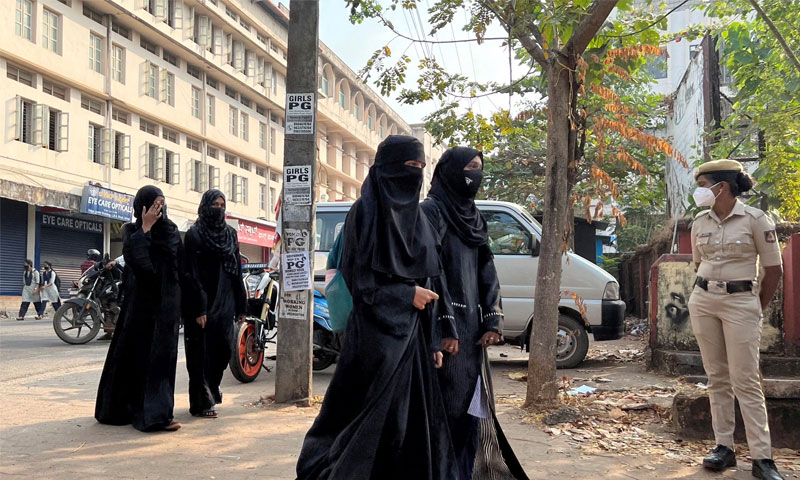
PRAYAGRAJ, India: The Allahabad High Court has dismissed a petition filed by a Muslim student seeking permission to wear a headscarf or hijab, along with the prescribed school uniform, holding that she failed to establish that wearing a headscarf was an essential religious practice protected under Article 25 of the Indian Constitution.
A two-judge division bench comprising Justices JJ Munir and Indrajeet Shukla ruled that an unaided private educational institution has the authority to prescribe and enforce a uniform dress code, provided the policy is bona fide, non-discriminatory and intended to maintain discipline and institutional identity.
The judgment, passed on August 21 and reported on Tuesday, concerns a minor student of Tagore Public School in Attarsuiya, Prayagraj, who had completed Class X at the institution and was seeking admission to Class XI.
The student, identified in court records as Sukaina Rizvi, approached the high court through her mother, asking it to direct the school to allow her to wear a headscarf in addition to the uniform prescribed for all students.
She argued that wearing the headscarf was an essential part of her religious practice and said she had worn it at the same school from Class VI through Class X without facing objections from the administration.
Court rejects claim of essential religious practice
The court found that the petition did not contain sufficient factual or legal material to establish that “wearing a headscarf was an essential religious practice in Islam,” such that its denial would jeopardise the petitioner’s faith.
The bench also examined photographs from the student’s previous classes and noted that she appeared to be the only girl wearing a headscarf.
The court said that no other female student, including those belonging to the same religious community, was seen wearing one.
The judges described the assertion in the petition that wearing a headscarf was an essential religious practice as a “bare assertion”, noting that the petitioner had not placed sufficient material before the court to substantiate the claim.
The bench further observed that high courts that had considered the issue had generally taken the view that wearing a headscarf could not be treated as an essential part of Islamic faith in the absence of which a woman’s religious identity would be jeopardised.
Private school’s right to enforce uniform
The court also rejected the argument that the student’s previous practice of wearing a scarf without objection created a continuing right to do so.
According to the judgment, the fact that the school had not objected when the student wore the headscarf in earlier classes could not, by itself, prevent the institution from subsequently enforcing its uniform policy.
The court observed that earlier non-enforcement could have resulted from several reasons, including inaction, lack of strict enforcement, courtesy or hesitation, but this did not create an enforceable right for the student to compel the school to modify its uniform policy.
The bench held that where a uniform is prescribed and applied in a bona fide and non-discriminatory manner, the decision regarding the institution’s dress code primarily falls within the school’s domain.
It said allowing individual students to alter a uniform according to personal or religious preferences, without establishing that the practice was essential to their faith, could undermine the very purpose of having a uniform and weaken the institution’s disciplinary authority.
School opposed the petition
The petition was opposed by the school administration, the Uttar Pradesh government and the Central Board of Secondary Education (CBSE).
The school described itself as a private, unaided and self-financed institution attended by students belonging to different religious communities. Its position was that allowing an individual student an exception to the prescribed dress code could affect uniformity, discipline and the institution’s identity.
The school maintained that the addition of a headscarf to the prescribed uniform would amount to a modification of the dress code applicable to all students.
The court accepted the broader principle that an unaided private educational institution can enforce its uniform policy, as long as the policy is applied equally and is not discriminatory.
It therefore declined to issue directions requiring the school to make an exception for the petitioner.
Karnataka hijab ruling also considered
The Allahabad High Court’s decision also referred to the earlier controversy over hijab restrictions in educational institutions in Karnataka.
The bench considered the Karnataka High Court’s judgment on the issue as persuasive authority and noted that the matter had subsequently reached the Supreme Court in the Aishat Shifa case.
The Supreme Court had delivered a split verdict in October 2022, with the two judges taking different positions on the issue.
One judge upheld the Karnataka government’s restrictions while the other took a different view and directed that the matter be placed before the Chief Justice of India for an appropriate bench.
The split meant that there was no final majority ruling settling the broader constitutional question.
Against that backdrop, the Allahabad High Court said there was no reason for it to take a different view from the Karnataka High Court in the case before it, particularly because the petitioner had failed to establish the religious-essentiality claim on the material placed before the court.
The ruling comes amid continuing legal and political debate in India over religious attire in educational institutions, particularly after the Karnataka hijab controversy that reached the Supreme Court.
Muslim body likely to challenge ruling
The All India Muslim Personal Law Board (AIMPLB) has indicated that it is likely to challenge the Allahabad High Court’s decision.
According to PTI, an AIMPLB representative said that the organisation was aware of the case and suggested that the matter should be taken to the Supreme Court, arguing that hijab has historically been regarded as an integral part of Islam.
You May Also Like

- WEB DESK
- August 24, 2026
Petrol, diesel prices surge as govt announces new rates

- WEB DESK
- August 24, 2026