- Aasiya Niaz
- 1 Hour ago
India’s piracy or policing? Iran-linked tankers seized in US trade quid pro quo
-

- Web Desk
- Feb 17, 2026
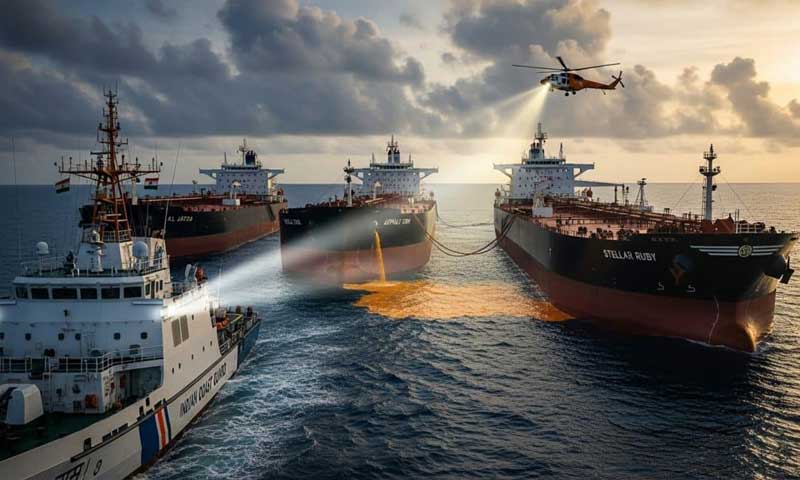
WEB DESK: In a development highlighting the shifting contours of South Asian geopolitics, the Indian Coast Guard has seized three oil tankers Stellar Ruby, Asphalt Star and Al Jafzia allegedly part of a “shadow fleet” used to circumvent international sanctions. While New Delhi frames the operation as a measure to uphold “maritime security” and a “rules-based order”, the timing has sparked questions across the region.
According to Reuters, the interception, which took place 100 nautical miles west of Mumbai, follows mounting pressure from Washington. Analysts note that the operation coincided with the United States’ decision to reduce import tariffs on Indian goods from 50% to 18%, a diplomatic gesture linked to New Delhi’s recent commitment to halt Russian crude oil imports.
The “Shadow Fleet” Crackdown
The seized vessels are reported to have employed so-called “dark fleet” tactics, frequently changing names and flags to evade scrutiny, switching off tracking transponders to conceal ship-to-ship transfers, and operating under complex overseas-based ownership structures to obscure the origin of their oil. “The syndicate exploited mid-sea transfers to move cheap oil from conflict-ridden regions, evading duties owed to coastal states,” the Indian Coast Guard stated in a post that was later deleted from its website.
Strained Ties and Strategic Realignments
The seizure adds tension to Indo-Iranian relations, already strained by India’s quiet withdrawal from the Chabahar Port agreement. Once a cornerstone of bilateral cooperation, the port received no allocation in India’s 2026 budget a move widely interpreted as acquiescence to US economic pressure and the threat of secondary sanctions.
In Tehran, officials have denied any connection to the seized vessels, though state media framed the detention as a hostile act influenced by external “guardianship”.
A New Maritime Reality
India’s assertive enforcement of Iranian-linked maritime assets marks a departure from its longstanding policy of strategic autonomy. Deploying 55 ships and 12 aircraft for round-the-clock surveillance, New Delhi is signalling its willingness to act as a primary enforcer of Western-led maritime norms in the Indian Ocean.
As India deepens its alignment with Washington, it faces a potential erosion of trust with long-standing regional partners such as Iran. Observers question whether the country’s role as a “net security provider” is beginning to blur into that of a Western-aligned maritime police force.
You May Also Like