
- WEB DESK
- 21 Minutes ago
India’s Skyroot launches Vikram-1 in historic private orbital mission
-

- Reuters
- 1 Hour ago
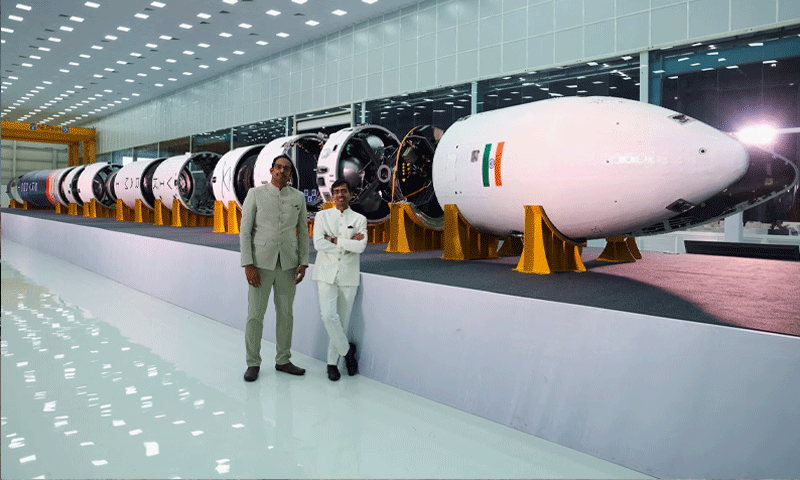
BENGALURU: Indian space startup Skyroot Aerospace on Saturday successfully launched the country’s first privately developed orbital rocket, marking a milestone in national efforts to secure a larger share of the global commercial launch market.
The maiden orbital flight, named “Mission Aagaman”, took off from the Satish Dhawan Space Centre in Sriharikota at 0635 GMT, following a brief temporary delay from its initial 0600 GMT schedule.
Approximately 15 minutes after liftoff, the vehicle successfully deployed multiple customer payloads and in-orbit experiments into a 450-kilometre orbit. With this mission, India has become the third country in the world to achieve orbital launch capability through a private enterprise.
Technical milestones and payload deployment
The Vikram-1 rocket stands at approximately 22 metres (72 feet) tall and is designed to transport payloads weighing up to 350 kilograms into low-Earth orbit. The vehicle operates on a multi-stage propulsion system consisting of three solid-fuel stages and a liquid-fuel orbital adjustment module.
According to Skyroot, the module is powered by a 3D-printed engine, marking the first time these specific technologies have been flown in India. The flight carried various technological demonstration satellites and experimental payloads from both domestic and international organisations.
The primary objective of the mission was to validate the rocket’s core systems under flight conditions, including its propulsion, avionics, telemetry, guidance, navigation, and control mechanisms. The startup confirmed that the collected data will be utilised to prepare for future commercial operations.
Expanding India’s space economy
“Mission Aagaman is a grand success,” Skyroot said in an official statement, noting that additional test flights will be conducted before transitioning to routine commercial operations.
Established in 2018, the Hyderabad-based firm has attracted substantial global investment following the liberalisation of India’s space sector. Earlier this year, Skyroot became the first domestic space-sector company to reach a 1 billion dollar valuation. The achievement follows the company’s 2022 Vikram-S mission, which was the first privately developed suborbital flight to reach space from Indian soil.
The government of India officially opened the space sector to private investment in 2020, ending decades of exclusive state control by the Indian Space Research Organisation (ISRO). New Delhi aims to expand its share of the global space economy from the current 8 billion dollars to 44 billion dollars by 2033, positioning private domestic firms to compete directly with established market players in the United States, Europe, and China.