
- Web
- Mar 18, 2026
Interstellar comet 3I/ATLAS reaches closest point to Sun
-

- Web Desk
- Oct 30, 2025
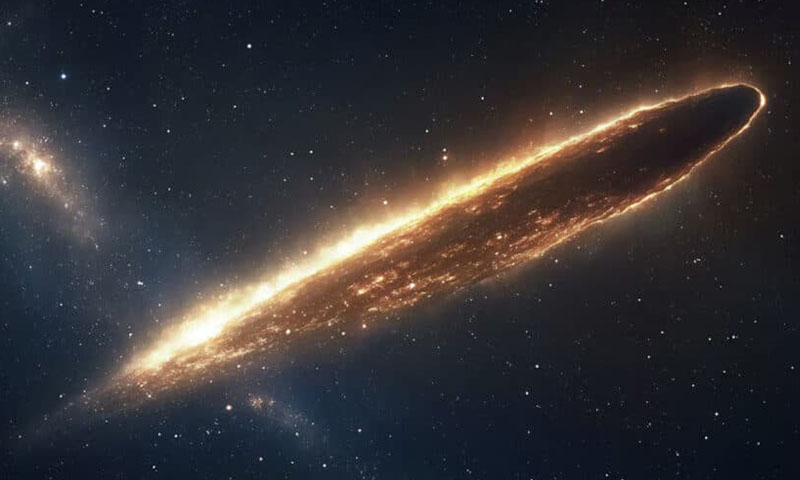
WEB DESK: Scientists around the world are turning their eyes to a rare visitor from beyond our solar system. Comet 3I/ATLAS, the third confirmed interstellar object ever observed, has reached perihelion, which is its closest approach to the Sun, and is expected to be most active today.
Currently, the comet is hidden from Earth’s view as it passes behind the Sun. However, several spacecraft, including NASA’s Psyche mission to the asteroid Psyche and the Lucy mission en route to Jupiter’s Trojan asteroids, continue to monitor its journey.
Perihelion is a key moment in a comet’s orbit, when solar heat causes dramatic changes in its activity. For comets like 3I/ATLAS, which travel on elongated paths, this can trigger the release of gases and dust, giving scientists a rare glimpse into the object’s composition. Observations so far indicate that 3I/ATLAS contains higher levels of carbon dioxide and nickel than typical solar system comets, offering clues about the molecular cloud where it formed more than seven billion years ago.
Astronomers are eager to capture data during this highly active phase. While the comet is faint—around magnitude 12—it is within reach of dedicated astrophotographers and smart telescopes. Both the Hubble and James Webb space telescopes are expected to provide detailed insights into its chemical makeup.
Despite recent online speculation about potential alien origins, experts emphasise that 3I/ATLAS is a natural object. Harvard astronomer Avi Loeb sparked viral interest by suggesting a small chance the comet could be artificial, but NASA scientists caution that there is no evidence to support such claims. “It is a comet, not a threat,” they say, though its unusual chemical patterns continue to intrigue researchers.
For those hoping to glimpse the comet from Earth, it may become briefly visible after it emerges from behind the Sun, potentially at the end of November. Early observations in regions with dark skies, such as Washington State, suggest that telescopes with at least an 8-inch aperture will be needed to see its faint tail and coma.
3I/ATLAS offers scientists a rare window into the chemistry of a distant star system and a chance to directly compare it with the comets of our own solar system. While its passage is brief, the data gathered may illuminate the mysteries of interstellar space for years to come.
You May Also Like