
- Reuters
- October 7, 2026
Iran insists on right to control Strait of Hormuz shipping after vessel hit near Oman
-

- WEB DESK
- June 26, 2026
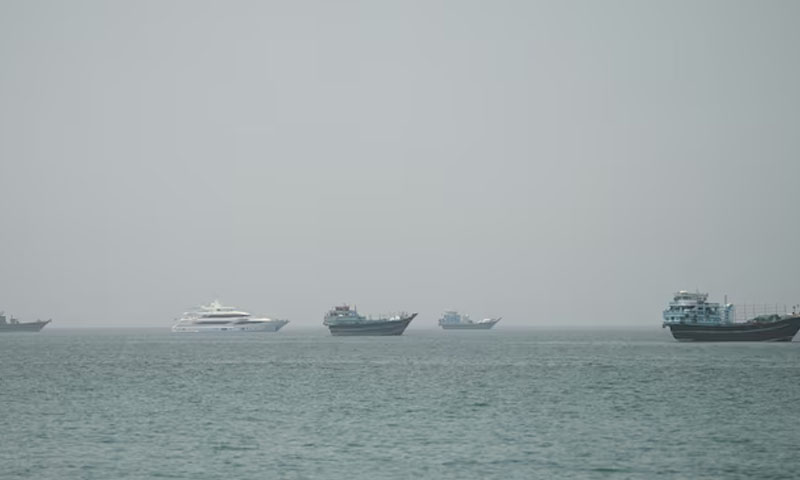
DUBAI/LONDON: Iran on Friday reaffirmed its right to regulate shipping through the Strait of Hormuz and warned Gulf states against aligning with the United States, a day after a commercial vessel was struck near Oman, underscoring the fragility of a preliminary agreement aimed at ending the recent conflict.
Tehran was responding to a joint statement issued by the United States and the six-member Gulf Cooperation Council (GCC), which rejected Iran’s insistence that it could impose transit tolls on vessels passing through the strategic waterway.
“Safe passage through the Strait of Hormuz cannot be guaranteed under ambiguous arrangements, parallel routes or decision-making that does not take Iran’s role as a coastal state into account,” Deputy Foreign Minister Kazem Gharibabadi said in a post on X.
Iran’s foreign ministry described the joint statement as “interventionist, irresponsible and provocative”, saying the US military presence in the Gulf was the main source of regional instability. It added that the strait should be managed by Iran and Oman in accordance with the interim agreement reached after the conflict.
“We warn against the continuation of hostile and interventionist policies in the region,” the ministry said.
The dispute comes despite an interim agreement between Tehran and Washington that halted hostilities following the conflict triggered by U.S.-Israeli strikes on Iran in February.
On Thursday, the Singapore-flagged container ship Ever Lovely, operated by Taiwan’s Evergreen Marine, was struck by what the company described as an “unknown object” near Oman while following a route recommended by the United Kingdom Maritime Trade Operations (UKMTO), Reuters reported.
No injuries were reported, and the vessel later resumed its voyage out of the Strait of Hormuz.
Two U.S. officials told Reuters that Iranian forces had fired on the vessel. Iran’s Persian Gulf Strait Authority, however, said ships using unauthorised routes would do so at the risk of their owners, operators and captains.
There was no immediate response from the US government to Iran’s latest remarks.
During a visit to Gulf states on Thursday, U.S. Secretary of State Marco Rubio warned that Washington would respond if Iran threatened or blocked shipping through the strait.
In a joint statement with GCC members, Rubio called for “free, unconditional, and unrestricted navigation” through the Strait of Hormuz without transit tolls or attempts by any country to assert control.
The statement also said any lasting agreement with Iran should address its ballistic missile programme, drones and support for proxy groups.
The International Maritime Organization (IMO) temporarily suspended its ship escort operations through the Strait of Hormuz following Thursday’s incident.
Earlier this week, the IMO and Oman announced a new southern shipping route through the strait to help vessels stranded during the conflict, a move that drew criticism from Tehran.
Despite continued tensions, Saudi Aramco resumed crude oil loadings at its Ras Tanura terminal on Friday after a nearly four-month suspension, according to shipping data cited by Reuters.
Oil prices edged lower on Friday even as uncertainty persisted over implementation of the interim agreement and shipping through one of the world’s most critical energy chokepoints.