- WEB DESK
- October 6, 2026
Iran, Oman near deal on temporary Strait of Hormuz shipping route: Araghchi
-

- WEB DESK
- August 9, 2026
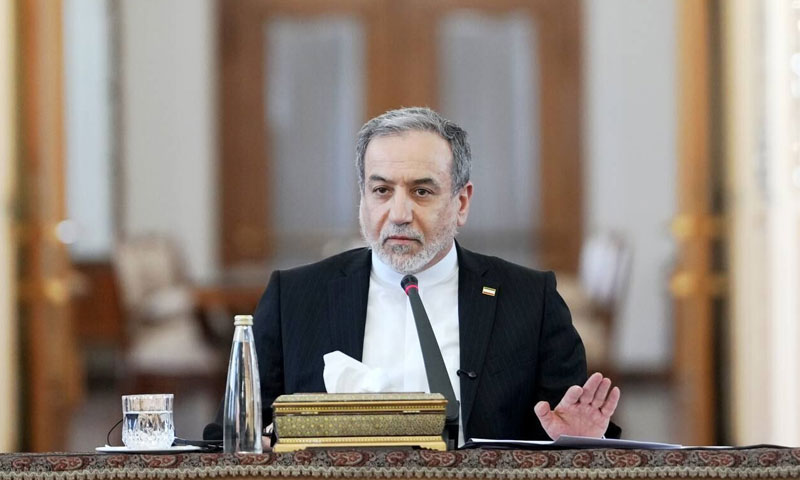
TEHRAN: Iran and Oman are close to reaching an agreement on a temporary shipping route through the Strait of Hormuz, Iranian Foreign Minister Abbas Araghchi said on Sunday, as Tehran made the full reopening of the strategic waterway conditional on a series of demands, including an end to US military pressure and the lifting of sanctions.
Araghchi said that negotiations between Iran and Oman over the legal mechanism and management of shipping through the Strait were continuing and had made significant progress, particularly on determining a new transit route.
“Negotiations with Oman on the legal mechanism and management of the Strait of Hormuz, including the designation of a shipping route, are under way and we are very close to an agreement,” Araghchi told reporters on the sidelines of a news conference by President Masoud Pezeshkian in Tehran.
He said that Iranian and Omani military and naval officials had held discussions using existing navigational maps and that a new shipping route would be finalised once those talks were completed.
However, Araghchi stressed that the proposed arrangement would initially be temporary and would later serve as the basis for a permanent shipping route.
The Iranian foreign minister said the traffic separation scheme (TSS) previously used in the Strait was no longer acceptable to Tehran and would have to be replaced.
He acknowledged that establishing a new system involved extensive technical and legal complexities, saying the immediate focus was on creating a temporary mechanism to facilitate maritime traffic.
Full reopening remains subject to conditions
While Tehran and Muscat appear close to an interim arrangement for shipping, Iran has made clear that reaching an agreement on a transit route would not automatically mean the complete reopening of the Strait.
According to an Iranian statement cited by local media, Iran’s top security body has set six conditions for the full reopening of the waterway.
The demands reportedly include an end to US threats against Iran, an end to the conflict in the region, the lifting of what Tehran describes as a naval blockade of Iranian ports and the withdrawal of US military forces from the region.
Iran has also demanded compensation from the United States for war-related damage, the lifting of sanctions and the unconditional return of Iranian assets frozen abroad.
There was no immediate response from US officials to the demands. Washington, however, has continued to insist that safe and secure navigation through the Strait of Hormuz must be guaranteed as part of any final arrangement.
The development highlights the difference between the immediate issue of restoring commercial shipping and the broader political and security dispute between Tehran and Washington.
Iran blames US for disruption
Araghchi also blamed the United States for violating the Islamabad Memorandum of Understanding, saying Iran had implemented its fifth clause and helped restore maritime traffic to around 60 per cent of normal levels within two weeks.
He said traffic was expected to return fully to normal within a month, but accused Washington of subsequently seeking to establish new shipping routes through the Strait despite Iranian warnings.
According to Araghchi, such moves undermined Iran’s management of the waterway and complicated efforts to establish a new navigation mechanism.
Oman, which has been playing a mediating role in the negotiations, has described the talks as positive and constructive and has condemned attacks on vessels in the Strait.
Iran seeks greater control over shipping
The negotiations also come amid a wider dispute over who should control and manage maritime traffic through the strategically vital waterway.
Iran has effectively tightened its control over the Strait during the current crisis and, according to the Iranian account, is seeking a greater role in regulating vessels passing through the waterway, including the possibility of charging transit fees.
The United States opposes such an arrangement and has pushed for unrestricted and secure international navigation through the Strait.
An interim agreement reached in June reportedly provided room for Iran and Oman to negotiate future arrangements for the management of the waterway.
The talks are now approaching the end of a 60-day period, although an extension of that period is reportedly being considered.
Vessel incidents add to tensions
The negotiations have also taken place against the backdrop of continuing maritime incidents in and around the Strait.
According to Emirati authorities, a vessel operated by the United Arab Emirates’ state-owned oil company ADNOC was struck while transiting the Strait of Hormuz. The attack was attributed to an Iranian missile.
ADNOC said there were no fatalities in the incident. The company has also said that more than a dozen of its vessels have been targeted by missile and drone attacks since the escalation began in February, resulting in one sailor being killed and 20 others injured.
Separately, the United Kingdom’s Maritime Trade Operations centre reported that a vessel near Khasab, Oman, was struck by a projectile, causing a fire that was subsequently extinguished. The crew was reported to be safe.
It was not immediately clear whether the incident reported near Khasab involved the same vessel targeted in the attack on the ADNOC ship or was a separate incident.
Caspian Sea issue
Araghchi also addressed Iran’s position on the legal status of the Caspian Sea, saying Iran’s precise share of the waterway had not been settled under the convention governing its legal status.
He said disputes concerning baselines and the division of the seabed had been left for bilateral and trilateral negotiations among the countries concerned.
According to Araghchi, the convention was submitted to the Iranian parliament in 2018 and 2019, but its ratification remains subject to parliamentary approval.
He stressed that the convention prohibits the presence of foreign military forces in the Caspian Sea.
The latest developments leave the Strait of Hormuz facing a potentially important but uncertain transition: Iran and Oman appear close to an interim mechanism that could facilitate shipping, but a broader reopening remains tied to unresolved political, military and economic demands between Tehran and Washington.
The Strait is one of the world’s most strategically important maritime chokepoints, meaning any prolonged disruption or restrictions on shipping could have wider implications for energy markets and global trade.