- WEB DESK
- 1 Hour ago
Iran renews attacks on Gulf states after another night of US strikes
-

- Reuters
- 1 Hour ago
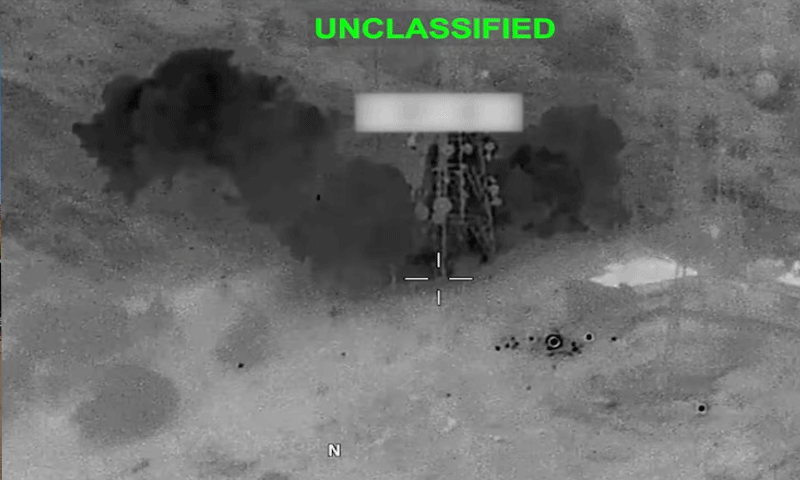
DUBAI: Iran launched renewed attacks on US Gulf allies on Saturday following a seventh consecutive night of American strikes targeting Iranian military sites, escalating the conflict just a week after a fragile ceasefire agreement collapsed.
The escalating hostilities have severely impacted shipping traffic in the region. The United States announced it was enforcing a naval blockade, while Tehran stated it had targeted vessels violating its navigation rules in the Strait of Hormuz, a vital maritime chokepoint through which one-fifth of the world’s oil supply passes.
The friction drove oil prices up by more than 4pc on Friday to their highest level in over a month, compounding political pressure on US President Donald Trump ahead of the upcoming November congressional elections.
According to the US military’s Central Command, the latest round of American attacks targeted Iranian surveillance sites, military logistics infrastructure, underground weapons storage, and maritime capabilities using fighter aircraft, aerial drones, and warships. More than 50,000 American service members remain deployed across the Middle East. Meanwhile, the US military reported it had redirected four commercial vessels, disabled one, and boarded another to enforce its blockade.
Infrastructure heavily hit
In response to the US offensive, Iranian local officials reported that missiles struck power facilities and desalination pumps in the southern city of Jask, cutting off drinking water to local villages. Further strikes were reported across coastal Hormozgan Province, resulting in three deaths and eight injuries, alongside damage to two bridges and a road tunnel.
Iranian state media added that previous attacks had destroyed five bridges in the south, killing seven people in the port of Bandar Khamir, while an airport in the eastern city of Iranshahr near the Pakistani border was also hit.
UN Secretary-General Antonio Guterres expressed deep concern over the escalation, particularly regarding the targeting of civilian infrastructure across the region. President Trump has threatened broader air strikes on Iranian infrastructure and has not ruled out a ground assault on Iran’s coast or islands, a move US officials say is designed to provide the administration with multiple strategic options.
Tehran has retaliated by striking Gulf countries that host US airbases, including Kuwait, Bahrain, Qatar, and Jordan. In Kuwait, an Iranian attack hit a power generation and water desalination station, causing a fire and disabling multiple electricity units, prompting a military response against incoming Iranian drones.
The Islamic Revolutionary Guard Corps (IRGC) also claimed to have destroyed Bahrain’s main artificial intelligence centre and a US drone depot using ballistic missiles and drones.
Shipping disrupted in vital waterways
The maritime standoff remains critical as the IRGC reported stopping four vessels from transiting the Strait of Hormuz using a combined missile and drone operation. Iranian media further claimed two oil tankers exploded after navigating a mined route south of the strait, though the US military dismissed the report as false.
Security concerns have also extended to the mouth of the Red Sea near Yemen, where armed men seized another vessel, threatening the region’s secondary oil chokepoint.
Iran’s state television quoted the IRGC warning that no chemical fertilizers or oil and gas exports would leave the region until US “aggression” ends. Additionally, Mohsen Rezaei, an adviser to Iran’s supreme leader, cautioned the US against further escalation or any attempts to seize Iranian territory.
In the northern Indian Ocean, the Iranian navy reportedly fired a shore-to-sea cruise missile at a US vessel, which Tehran claimed forced the ship to move out of range. Meanwhile, Saudi Arabia’s civil defence issued its first early warnings in several months across two locations, though no immediate damage was reported.
You May Also Like