- WEB DESK
- October 6, 2026
Iran says Pakistan-Saudi-Turkiye defence pact poses no threat
-

- WEB DESK
- August 10, 2026
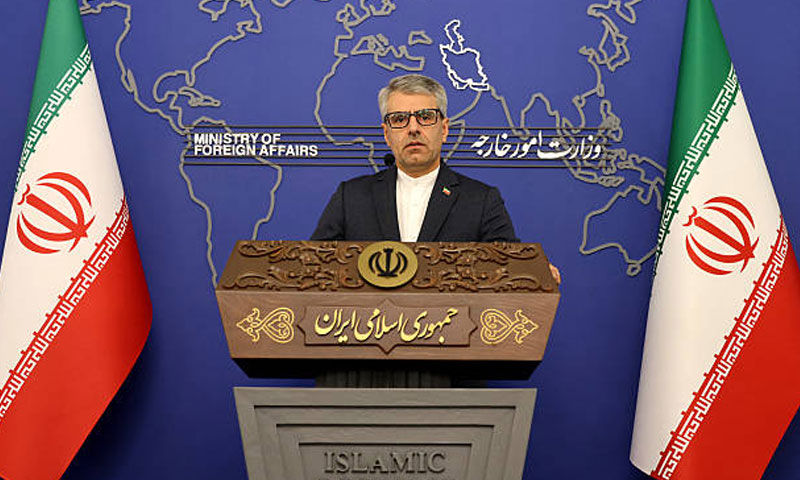
TEHRAN: Iran on Monday said it had no reason to be concerned about the joint defence agreement signed by Pakistan, Saudi Arabia and Turkiye, describing the pact as a sign that regional countries were seeking alternatives to security arrangements dominated by the United States.
Addressing a press conference, Iranian Foreign Ministry spokesman Esmaeil Baqaei said Tehran did not view the Makkah Joint Defence Agreement as a threat, stressing Iran’s longstanding religious, historical and civilisational ties with the three signatory countries.
“There is no reason to worry that this treaty will be against Iran,” Baqaei said during his weekly press briefing, according to Iranian state media.
The agreement was signed in Makkah last week by Pakistan, Saudi Arabia and Turkiye and seeks to strengthen collective deterrence among the three countries. Under the pact, an attack against any one of the signatories is to be treated as an attack against all three.
Baqaei said the agreement reflected a broader shift in the way countries in the region viewed their security needs, particularly following developments in the Middle East over the past two to three years.
He argued that regional states had increasingly concluded that their security could not depend on arrangements offered by powers outside the region.
“The countries of the region have realised that security is not a commodity that can be bought from false security brokers,” Baqaei said, referring to the United States.
He said countries were instead seeking to rely more heavily on their own capabilities and regional cooperation.
According to Baqaei, any regional security initiative would have a greater chance of success if it took into account the geopolitical and historical realities of the Middle East, was comprehensive and inclusive, and correctly identified the sources of threats and instability.
He said such an approach could help strengthen regional security and prevent what he described as instability and abuses by Israel and its allies.
Iran leaves door open to regional security cooperation
Asked whether Iran could potentially join the defence arrangement, Baqaei said Tehran had consistently advocated security mechanisms based on cooperation among regional countries and without what he called the “destructive intervention” of foreign powers.
He said those proposals remained on the table and could be updated in light of changing regional circumstances.
“We are in close contact with neighbouring countries and regional countries,” Baqaei said, adding that Tehran hoped countries would draw lessons from recent developments and choose the best course to strengthen collective regional security.
His comments came amid efforts by several Middle Eastern countries to reassess their security arrangements following heightened tensions involving Israel, Iran and the United States.
Pakistan has described the Makkah agreement as defensive in nature and said it is not directed against any particular country.
Earlier, Deputy Prime Minister and Foreign Minister Ishaq Dar said that the pact remained open to other countries in the region that were willing to uphold its principles.
Dar said the agreement was the culmination of years of discussions and coordination and was intended to strengthen efforts for peace, stability and prosperity in the wider region.
He also clarified that the agreement did not replace or invalidate existing bilateral or multilateral arrangements between the signatories and other countries or international organisations.
Iran-US talks remain conditional
Baqaei also reiterated Tehran’s position that negotiations with Washington would remain suspended as long as the United States continued to violate its commitments under an interim understanding.
“We have always talked about peace,” he said, adding that Iran would not engage with the United States while agreements continued to be violated.
Iranian Foreign Minister Abbas Araghchi had made a similar statement earlier, saying that Tehran would not resume talks with Washington until what Iran considers violations of the interim agreement were addressed.
The comments underscore the deep mistrust between Tehran and Washington, despite diplomatic efforts aimed at preventing further escalation in the region.
Iran has repeatedly accused the United States of contributing to instability in the Middle East through its support for Israel, while Washington has maintained pressure on Tehran over its regional policies and nuclear programme.
Tehran and Muscat discuss Strait of Hormuz
The Iranian spokesman also addressed developments surrounding the Strait of Hormuz, one of the world’s most strategically important maritime routes.
Baqaei said Iran and Oman had held positive discussions on the issue and suggested that the waterway could be reopened if outside powers refrained from interfering.
The comments came as Tehran and Muscat continued negotiations aimed at reaching an understanding over the situation in and around the strait.
Iranian Foreign Minister Araghchi said earlier that an agreement between Tehran and Muscat was approaching its final stages. However, he cautioned that even after an agreement was reached, the Strait of Hormuz would not immediately return to normal maritime traffic.
The strait connects the Persian Gulf with the Gulf of Oman and the Arabian Sea and is a critical route for global energy supplies. Any prolonged disruption to shipping through the waterway could have wider consequences for international oil markets and global trade.
Iran has maintained that the security of the waterway should primarily be addressed by regional states rather than external powers.
Baqaei said Tehran remained committed to regional cooperation and believed that neighbouring countries could develop mechanisms to safeguard their collective security without outside interference.
Iran blames US and Israel for regional instability
Baqaei also accused the United States of contributing to instability in the Middle East and criticised Israel over its military campaign in Gaza.
He said Israel had continued its attacks on Gaza despite international agreements and accused it of fuelling tensions across the region.
Iran has consistently backed the Palestinian cause and has condemned Israel’s military operations in Gaza, while Israel and its allies have accused Tehran of supporting armed groups across the region.
Baqaei reiterated that Iran would continue to support the Palestinian people.
He also paid tribute to journalists killed in Iran, Lebanon and Palestine, saying a number of journalists had been killed while carrying out their professional responsibilities over the past two years.
Pakistan-Iran ties
The Iranian foreign ministry spokesman also commented on the possibility of visits to Pakistan by Iranian officials.
Asked about invitations extended by Pakistan to Iranian Parliament Speaker Mohammad Bagher Ghalibaf and Foreign Minister Abbas Araghchi, Baqaei said the visits would take place when the timing was appropriate.
He stressed that bilateral relations would remain the main consideration.
“The relationship between Iran and Pakistan is a very important one,” Baqaei said, adding that the relationship had become even more significant over the previous seven or eight months for a number of reasons.
Pakistan and Iran have sought to strengthen bilateral ties in recent months, including cooperation on border security, trade, energy and regional diplomacy.
Baqaei’s remarks on the Makkah defence agreement therefore came against the backdrop of Tehran’s broader effort to maintain close relations with its neighbours while advocating a regional security framework that excludes the dominant role of external powers.
The Iranian position also indicates that Tehran is not immediately treating the Pakistan-Saudi-Turkiye pact as an adversarial arrangement, despite the agreement’s collective defence provisions and the broader realignment of security relationships in the region.
Instead, Tehran appears to be seeking to keep the door open for dialogue and potentially broader regional security cooperation, provided such arrangements are based on the participation of regional states and are not directed against Iran.