- WEB DESK
- November 26, 2026
Iran says Pakistan, Qatar continue relaying proposals in talks with US
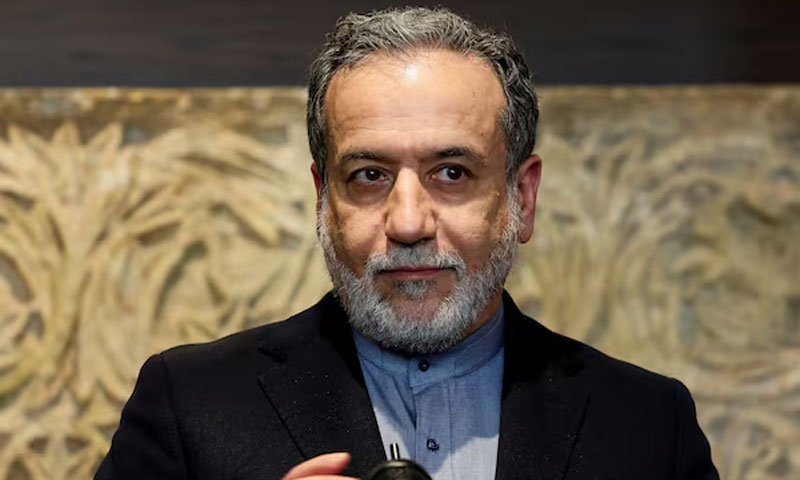
Qatari and Pakistani mediators are continuing to relay ideas and proposals between Iran and the United States, Iranian Foreign Minister Abbas Araqchi said on Thursday, indicating that diplomatic efforts remain active despite tensions between the two countries.
“Ideas have been put forward; I think paths can be opened; these ideas are being reviewed; however, our main position has not changed. We have certain requests that have to be met, and then the Strait of Hormuz can be opened,” Araqchi said in a video published on his Telegram channel.
The foreign minister’s remarks were also reported by CGTN Europe, which carried further comments in which he said negotiations had neither been forgotten nor abandoned, although Tehran was currently prioritising efforts to strengthen the country’s resilience against external pressure.
Araqchi said his colleagues, particularly those working in neighbouring countries, were making round-the-clock efforts to meet Iran’s needs, keep trade routes open and ensure the country could withstand pressure.
“The goal is to make our enemies understand that a blockade of Iran is impossible, and they cannot isolate our country,” he said.
He added that negotiations had their own mechanisms and were being pursued under the supervision of Iran’s Supreme National Security Council. The current priority, he said, was to discourage adversaries from imposing sanctions and exerting further pressure on the country.
Referring to the mediation efforts, Araqchi said Qatari and Pakistani representatives remained actively involved in conveying proposals and suggestions.
“If specific ideas or perspectives have been raised that could pave the way for a solution, they are being considered,” he said.
Iran FM: ‘Seyed Abbas Araghchi, Minister of Foreign Affairs:
🔹 Our main focus is on strengthening the country’s resilience and helping to increase its ability to withstand the pressures exerted by enemies through various means.
🔹 My colleagues, especially in neighboring countries, are working tirelessly around the clock to meet the country’s needs, keep trade routes open, and carry out any other actions that help to meet the country’s requirements. The goal is to make our enemies understand that a blockade of Iran is impossible, and they cannot isolate our country.
🔹 Negotiations are part of our work, and we have not forgotten or abandoned them; we are still pursuing them. However, in the current circumstances, there is a more important mission, which is to discourage the enemies from imposing sanctions and exerting pressure on our country. The negotiation process has its own specific mechanisms and is being followed under the supervision of the Supreme National Security Council.
🔹 The Qatari and Pakistani mediators are still actively engaged, putting forward and conveying ideas and proposals. This is a normal process. If specific ideas or perspectives have been raised that could pave the way for a solution, they are being considered.’
— CGTN Europe (@CGTNEurope) November 26, 2026
Iranian drone attack kills two Italians in Kuwait
Meanwhile, two Italians were killed in an Iranian drone attack in Kuwait on Thursday, Italian Foreign Minister Antonio Tajani said, adding that the victims were technicians working for the Italian unit of German defence group Rheinmetall.
The two technicians were working at an air-defence surveillance station in Kuwait when it was targeted by Iranian drones, Tajani told the Senate in Rome.
“Following a powerful explosion, both of our compatriots, according to information coming from Kuwait, have died. Two other people were injured: a Pakistani national and a captain in the Kuwaiti army,” he said.
Kuwait’s Defence Ministry confirmed that the two Italians had died of their injuries after initially reporting that four people had been wounded by falling debris when a “vital facility” was targeted in what it described as an Iranian attack.
The ministry confirmed that the other two injured people were a Kuwaiti national and a Pakistani national. It said the country’s military had detected and dealt with several drones within Kuwaiti airspace, adding that the attack had also caused material damage.
Tajani expressed sympathy with the families of the victims, while Iran’s Foreign Ministry did not immediately respond to a Reuters request for comment. Rheinmetall also declined to comment.
Thursday’s attack marked the second reported Iranian attack on the US-allied Gulf state this month. Earlier in November, Iran said it had targeted US drone and missile sites in Kuwait after the United States struck Qeshm Island in the Strait of Hormuz.
Pakistan, Qatar lead mediation efforts
Pakistan and Qatar have played a key role in facilitating diplomatic engagement between Washington and Tehran, with their earlier efforts culminating in the Islamabad Memorandum of Understanding (MoU) in June.
Prime Minister Shehbaz Sharif announced on June 18 that the MoU had been electronically signed by US President Donald Trump and Iranian President Masoud Pezeshkian, with Pakistan acting as mediator. The understanding was aimed at de-escalating the conflict and providing a framework for further negotiations.
The initial agreement provided for a 60-day ceasefire, the reopening of the Strait of Hormuz and a 60-day negotiating period to work towards a broader settlement, including issues relating to Iran’s nuclear programme and sanctions.
As part of the follow-up process, Pakistan and Qatar hosted the first high-level committee meeting under the MoU framework in Burgenstock, Switzerland, on June 21-22, with representatives from the United States and Iran also attending.
The meeting resulted in an agreement to establish a High-Level Committee to oversee the mediation process, while chief negotiators were tasked with leading working groups on nuclear issues, sanctions, monitoring and dispute resolution.
The parties also agreed on a roadmap towards reaching a final deal within 60 days and establishing a communication channel to prevent incidents and miscommunication, particularly concerning the safe passage of commercial vessels through the Strait of Hormuz.
On July 2, Pakistani and Qatari mediators held separate meetings with US and Iranian negotiators in Doha. Pakistan’s Foreign Office said “positive progress” had been made on various aspects of the Islamabad MoU, describing the discussions as a continuation of the momentum generated at the Burgenstock summit.
Both sides agreed to continue discussions, with the next meeting to be arranged after the funeral proceedings of Iran’s former Supreme Leader Ali Khamenei.
However, the initial understanding failed to produce a lasting settlement as differences between Washington and Tehran persisted and hostilities resumed.
More recently, an Iranian official said a Qatari delegation had held talks in Tehran on November 20, as diplomatic efforts continued to find a way to end the conflict.
Iranian Deputy Foreign Minister Kazem Gharibabadi said Tehran remained in contact with mediators, including Qatar, through in-person and virtual discussions, and was exploring whether diplomacy could be given another opportunity.
The latest remarks by Araqchi indicate that Pakistan and Qatar continue to serve as channels for conveying proposals between the two sides, even as Tehran maintains that its conditions must be addressed before a broader agreement can be reached.