- Web
- Now
Iran strikes Gulf targets as US-Israel attacks continue
-

- Web Desk
- Mar 05, 2026
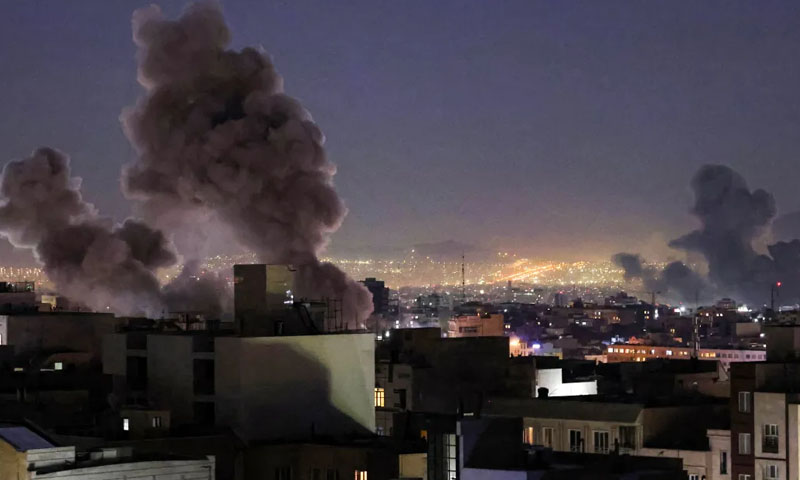
DUBAI/RIYADH/WASHINGTON/TEHRAN, March 5 (Reuters): Gulf states said on Thursday they intercepted Iranian missiles and drones as the conflict triggered by US and Israeli strikes on Iran continued to widen across the Middle East, raising fears of a prolonged regional war.
The United Arab Emirates said its air defence systems destroyed six ballistic missiles and 125 drones launched by Iran toward the country.
In a statement, the UAE Ministry of Defence said seven ballistic missiles were detected, with six intercepted in the air. One missile fell inside the country but caused no casualties or damage.
The ministry said 131 drones were also detected, with 125 successfully shot down while six fell inside UAE territory.
Authorities in Abu Dhabi said debris from intercepted drones fell in two locations in the capital, injuring six Pakistani nationals. Officials said the injured suffered minor to moderate wounds and were in stable condition.
The UAE urged residents to rely only on official sources of information and avoid spreading rumours or unverified reports.
The attacks are part of an escalating confrontation that began on February 28 when the United States and Israel launched large-scale strikes on Iranian targets.
Iranian officials and regional media say the attacks killed several senior Iranian figures including Supreme Leader Ali Khamenei, members of his family, the defence minister, the army chief, the national security adviser and the head of the Islamic Revolutionary Guard Corps.
Since then Iran has launched waves of retaliatory missile and drone attacks on US bases and allied facilities across the Gulf.
Saudi Arabia intercepts cruise missiles
Saudi Arabia also said its air defences intercepted three cruise missiles early on Thursday near the city of Al-Kharj outside Riyadh.
The Saudi Ministry of Defence said the missiles were destroyed in the air before reaching their targets.
US Secretary of State Marco Rubio later spoke by phone with Saudi Foreign Minister Faisal bin Farhan Al Saud, thanking Riyadh for its response after an earlier attack near the US embassy in the Saudi capital, according to US officials.
The two sides discussed the rapidly evolving regional situation and what Washington described as threats posed by Iran to regional stability.
White House rules out ground invasion
In Washington, the White House said the United States currently had no plans to deploy ground forces to Iran.
White House press secretary Karoline Leavitt told reporters the United States was not preparing to send land troops into Iran at this stage.
She said Iran had posed a threat to the United States and its allies for decades and that President Donald Trump believed he had public support for the military campaign.
Leavitt added that the administration was consulting advisers about the next steps and was also working on measures to secure the Strait of Hormuz, a critical global oil shipping route.
Iran warns US after naval clash
Meanwhile, Iran’s Foreign Minister Abbas Araghchi accused the United States of sinking the Iranian navy frigate IRIS Dena in international waters.
In a statement on social media, Araghchi said the vessel was attacked about 2,000 miles from Iran’s coast while hosting personnel from the Indian navy.
He said around 130 sailors were on board and warned the United States would “pay a heavy price” for the attack, calling it a dangerous escalation at sea.
Israel launches fresh strikes
Israel said it carried out new air strikes overnight on Iranian targets in the cities of Qom and Isfahan.
The Israeli military said it destroyed a ballistic missile launcher in Qom that was preparing to fire toward Israel and also targeted Iranian air defence systems in Isfahan to prevent further missile launches.
Israel also reopened its main international gateway, Ben Gurion Airport, five days after closing it following the start of hostilities.
The first flight since the closure arrived from Athens carrying Israeli citizens stranded abroad, Israeli authorities said.
Iranians cope under bombardment
Inside Iran, residents were struggling to cope with the continuing US and Israeli bombing campaign while internet access remained heavily restricted, according to reports.
People in several cities said they were relying on cash transactions and local networks to obtain food and fuel as communications disruptions complicated daily life.
The conflict has already caused heavy casualties across the region, with hundreds reported killed in Iran and dozens more in Gulf states targeted by retaliatory strikes.
Analysts warn that the war could escalate further if attacks on US bases and regional infrastructure continue or if additional countries become directly involved in the conflict.
You May Also Like