

- Muhammad Zareef
- October 19, 2026
Iran’s Araqchi blames US for Strait of Hormuz tensions, calls for diplomacy
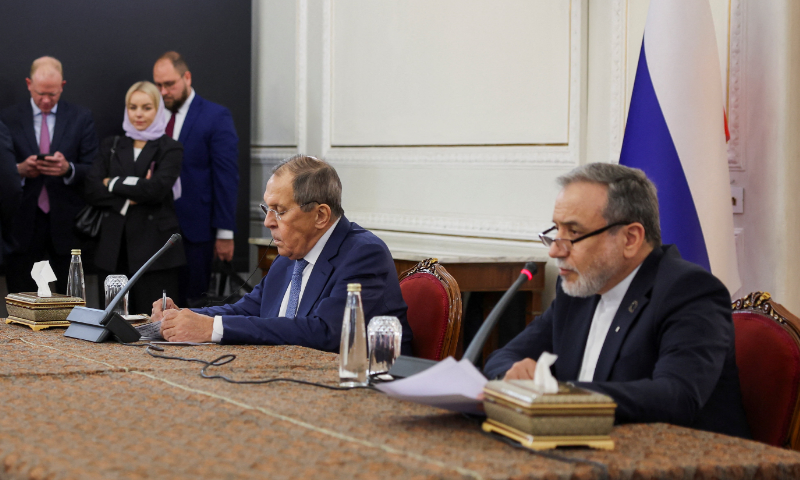
Iranian Foreign Minister Abbas Araqchi said regional issues should be resolved through diplomacy and blamed the United States for insecurity and tensions in the Strait of Hormuz.
Araqchi made the remarks after a joint news conference with Russian Foreign Minister Sergei Lavrov, whose visit was expected to focus on “regional and international developments”.
Araqchi also called on regional countries to work towards a joint security arrangement.
“We welcome any initiative that leads to security from within without the presence of foreign forces, and consider it the right move,” Araqchi said.
His visit comes after Russian President Vladimir Putin told Iranian President Masoud Pezeshkian in early October that Moscow was prepared to contribute to mediation efforts.
Russia and Iran are among the most heavily sanctioned countries in the world by the United States, and their military and economic cooperation has increased since Russia’s invasion of Ukraine in 2022.
Iran claims control over the strategic waterway, through which one-fifth of the world’s hydrocarbons pass in normal times, and regularly targets vessels that cross without its authorisation.
In response, Washington has maintained a naval counter-blockade on Iranian ports, according to AFP.
The Russian Foreign Ministry said discussions during Lavrov’s visit were expected to focus on “ways to resolve the acute international crisis triggered by the unlawful aggression of the US and Israel against Iran”.
The ministry said the war had dealt a blow to stability and security “not only in the near and Middle East, but also on a global scale”.
Separately, Araqchi told Iranian media outlet IRNA in an interview on Sunday that Iran’s offer to the United States to reopen the Strait of Hormuz within seven days remained on the table. Hemade the remarks while attending the 52nd session of the Organisation of Islamic Cooperation Council of Foreign Ministers in Baghdad.
Iran presented its proposal to US President Donald Trump in mid-September after an interim ceasefire collapsed, and Tehran later acknowledged receiving a US response. However, Iran’s security chief, Mohsen Rezaei, said last week that negotiations had stalled because Washington had failed to address all seven conditions for reopening the strait.
“Our situation is clear and based on the seven-days proposal presented to the US. They shared comments which we are reviewing, but our proposal is still on the table and if there is any honesty on the US part, which there isn’t, the way to reopening the Strait of Hormuz is obvious,” Araqchi told IRNA.
Iran’s conditions included lifting the US blockade on its ports and sanctions on its oil exports, as well as ending hostilities on all regional fronts.
If Washington accepted Tehran’s conditions, the strait could reopen within six days, with talks resuming the following day, Araqchi said.
You May Also Like

- Muhammad Faizan Khan
- October 19, 2026
Power-sector circular debt hits Rs1.675 trillion

- AFP
- October 19, 2026
