- WEB DESK
- November 24, 2026
‘Is Mohsin Naqvi Quaid-e-Azam?’ Rana Sanaullah hits back at interior minister
-

- WEB DESK
- November 23, 2026
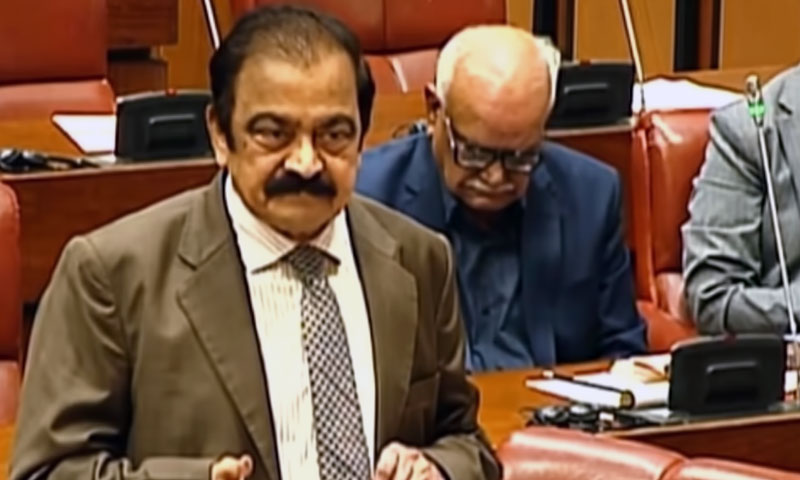
ISLAMABAD: Prime Minister’s Adviser on Political Affairs Rana Sanaullah has hit back at Interior Minister Mohsin Naqvi over his veiled warning, saying he has never needed to hide his face and challenging cabinet member to worry about his own ability to do so.
“We have always kept our face and chest uncovered. You should worry about your own ability to hide your face,” Sanaullah said in an interview with Geo News programme “Aaj Shahzeb Khanzada Kay Sath”.
The exchange follows Naqvi’s warning to Sanaullah, without naming him, that he had patiently listened to his remarks for two-and-a-half years but would respond in a way that would leave him unable to show his face.
Speaking informally to journalists in Lahore on Sunday, Naqvi accused the adviser of making comments about him to gain television exposure. The remarks came amid a growing disagreement within the ruling coalition over the proposed creation of new provinces and the way the debate had been initiated.
Sanaullah said he had never commented on Naqvi’s personal life and had no intention of doing so, but maintained that he had the right to question his performance as interior minister and as a political colleague.
“Is Mohsin Naqvi Quaid-e-Azam that I have been commenting on his personality for three years?” he said, adding that he had always addressed him as the interior minister and never as the chairman of the Pakistan Cricket Board.
Responding to Naqvi’s warning that he would leave him unable to show his face, Sanaullah said he would never find himself in such a position and advised the interior minister to be concerned about his own reputation.
The adviser said he had objected to Naqvi making what he described as irrelevant remarks about Prime Minister Shehbaz Sharif during a speech, arguing that the issue of new provinces needed to be discussed in parliament and could not move forward without consensus.
He said Naqvi’s comments had complicated the matter and turned it into a controversial issue before it could be taken up by parliament.
Sanaullah questioned why Naqvi had failed to consult key political leaders during the four months in which the issue had been under discussion, pointing out that President Asif Ali Zardari and Pakistan Peoples Party (PPP) Chairman Bilawal Bhutto-Zardari had publicly said they had not been consulted.
“If President Zardari and Bilawal Bhutto are saying that nobody spoke to them, then what have you been doing for four months?” he asked.
He said Naqvi had failed to take even those close to him into confidence, adding that the interior minister should accept responsibility for the way the proposal had been handled.
Sanaullah said he had heard Zardari describe Naqvi as his son on more than one occasion and noted that the interior minister was often present during visits to the presidency. However, he said Naqvi’s statements would not affect him but had complicated the political debate.
The adviser also rejected the assertion that the system had collapsed, saying it had been deliberately weakened through the actions of politicians and others. He described Shehbaz Sharif becoming prime minister as a positive development and said political leaders should accept responsibility for failures at their own level rather than respond defensively.
On Naqvi’s remarks about businessmen who provide billions of rupees in funding to political parties, Sanaullah said he had been referring to a small group of business figures, not the entire business community.
He alleged that some businessmen contributed large sums to political parties because they expected to benefit from those relationships later. He challenged Naqvi to identify anyone who had given millions or even Rs100 to the Pakistan Muslim League-Nawaz (PML-N).
Sanaullah said the creation of new provinces could only proceed through parliamentary debate and consensus, adding that Naqvi should have consulted the political leadership before taking the proposal forward.
He said the issue had been mishandled and should have been brought to parliament from the outset. Sanaullah recalled that he had called for parliament to be the appropriate forum on July 30, when Naqvi first raised the proposal.
The adviser said the PPP’s opposition to a referendum had further complicated the debate, but believed a way forward could be found through discussions with the party in parliament.
He suggested that the PPP could be reassured that the process would follow the Constitution, adding that public opinion could still be sought if political parties reached agreement on the matter.
Sanaullah said Naqvi could not bypass the prime minister’s position on the issue and that Shehbaz Sharif’s stance offered a possible way forward. If the matter was brought before parliament, he said, the PML-N and the prime minister would play an active role, with consensus remaining the objective.
“Threats will not silence people like me,” Sanaullah said, urging Naqvi to present arguments rather than respond with warnings.