
- Reuters
- September 15, 2026
ISPR chief says India’s “Pahalgam drama” is buried forever
-

- Zafar Ali
- May 7, 2026
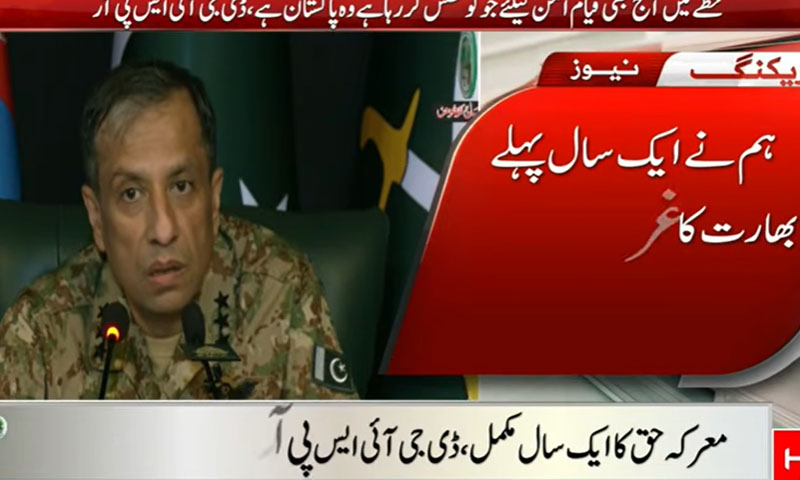
RAWALPINDI: Pakistan’s military spokesperson on Thursday said the armed forces had defeated an adversary “five times larger” during “Marka-i-Haq (Battle of Truth) while accusing India of fabricating terrorism allegations against Pakistan and pursuing aggressive nationalist policies in the region.
Addressing a press conference along with Rear Admiral Shifaat Ali Khan and Air Vice Marshal Tariq Ghazi, marking one year since the conflict with India, Inter-Services Public Relations (ISPR) Director-General Lt-Gen Ahmed Sharif Chaudhry said Pakistan had successfully fought a “multi-domain war” and shattered what he described as India’s long-standing narrative linking Pakistan to terrorism.
“We buried India’s arrogance a year ago,” Chaudhry said, adding that Pakistan’s armed forces had fulfilled the nation’s expectations during the conflict.
He accused India of staging the Pahalgam incident as a “false flag operation” and said New Delhi blamed Pakistan within minutes without conducting an investigation.
“An FIR was registered within 10 minutes of the incident, yet even after a year India has failed to present evidence,” he said.
Chaudhry questioned India’s repeated claims of targeting militant infrastructure, asking New Delhi to specify which alleged militant camps had been struck.
Calling Pakistan “the biggest ambassador of peace” in the region, the military spokesperson said Islamabad continued to work for regional stability despite tensions with India.
He also criticised Indian political leadership, saying Indian politicians appeared “more like warmongers than politicians,” while accusing them of promoting Hindutva ideology and rhetoric linked to “Akhand Bharat,” or a greater unified India.
The ISPR chief further alleged that India’s professional military had been undermined by political interference and accused New Delhi of committing abuses against Kashmiri Muslims and minorities, including residents of Manipur.
He reiterated Pakistan’s position that Kashmir was not India’s internal matter and said the dispute should be resolved in line with United Nations resolutions.
Relations between the nuclear-armed neighbours remain strained amid recurring diplomatic disputes, cross-border accusations and tensions over Kashmir.
He urged India to “learn to speak the truth,” accusing New Delhi of deflecting attention from its domestic and external challenges by blaming others, while warning that Pakistan remained prepared to respond to any aggression.
Ahmed Sharif said that Pakistan had transformed the nature of warfare during what Islamabad calls the “Battle of Truth,” describing it as a conflict fought across land, air, sea, cyberspace and the information domain.
“This was not just a conflict along the Line of Control. It was a multidimensional war,” Chaudhry said.
He said Pakistan had responded effectively to aggression “within hours” and stressed that the country remained fully prepared for future threats.
“We were ready then, and we are ready today,” he said, adding that “no one can harm Pakistan.”
The military spokesperson described war between two nuclear-armed states as “madness” and accused India of continuing to use proxy groups after what he called its defeat in the conflict.
“They are angry over defeat, which is why they keep using terms like Fitna al-Khawarij and Fitna al-Hindustan,” he said, referring to militant labels used by Pakistani authorities.
Chaudhry also mocked sections of the Indian media, saying they provided Pakistan with “daily entertainment,” while accusing Indian politicians of failing to resolve the country’s internal and external problems.
He said Pakistan’s state institutions, armed forces and leadership remained united.
“The country, military and leadership are all on the same page,” he said.
You May Also Like

- WEB DESK
- September 15, 2026
Petrol price rises by Rs4.10, diesel by Rs6.41 per litre
- Reuters
- September 15, 2026
Samson, Reddy lead India to series-clinching win over Afghanistan

- WEB DESK
- September 15, 2026