- Web Desk
- 5 Hours ago
January 31 attack: family of Nushki’s mosque cleric recounts night of terror
-

- Web Desk
- Feb 12, 2026
WEB DESK: The family of a mosque cleric killed in an attack in Nushki has described the events of January 31 as an act of brutality, alleging that militants tried to force him to issue a statement in support of what officials termed Fitna al-Hindustan before killing him and his family.
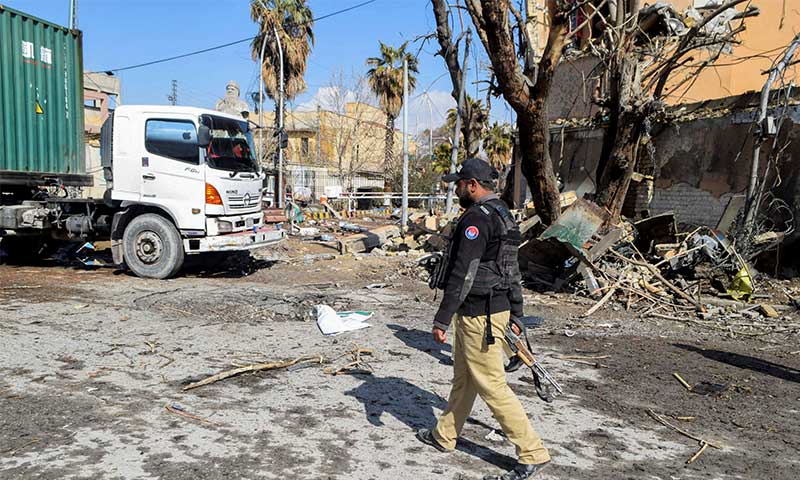
According to relatives, armed assailants stormed the home of mosque preacher Amshed Ali Khan in Nushki on January 31. Khan, his wife and their three children were killed in the attack.
Khan, 40, originally from Khyber Pakhtunkhwa’s Karak district, had been serving as a khateeb (prayer leader) at a local mosque. Family members say he was pressured by the attackers to publicly endorse their narrative but refused.
“They demanded that he give a statement in their favour,” a relative said. “He chose to sacrifice his life, along with his family, but did not bow to falsehood.”
His brother said the family was proud of his stance. “We are proud of Amshed Ali. He sacrificed himself, his wife and his children for Pakistan,” he said, describing him as a martyr who stood by his principles until the end.
The killings have sparked outrage locally, with relatives vowing that such acts would not weaken their resolve. “These cruel actions will not lower our morale. They will only make us stronger,” a family member said.
Security analysts condemned the attack, saying the targeting of a religious cleric and his family demonstrated that the perpetrators had no connection to Islamic teachings. “The martyrdom of the mosque’s khateeb proves that these terrorists have nothing to do with Islam,” one defence expert said.
Other analysts argued that the assault on an unarmed family reflected a broader shift in militant tactics. “These groups have lost the ability to confront security forces and are now targeting defenceless civilians,” an expert said.
Authorities have not yet released detailed findings from the investigation, but security has been tightened in parts of Balochistan following the incident.
Officials dispute ‘missing persons’ narrative after Mastung operation
In Mastung, two men identified as Burhan Baloch and Hafeez Baloch were killed during an operation. Security sources said both individuals had been listed by the Baloch Yakjehti Committee (BYC) among what it describes as “missing persons.” Two other men, Abdul Hameed and Rashid Baloch, who were also included in the BYC’s list, were reportedly killed in the same operation.
Officials said this was not an isolated case. They cited previous incidents in which individuals killed in militant attacks or counterterrorism operations had allegedly appeared on lists of enforced disappearances. Among those named were Sohaib Lango, as well as Karim Jan, killed in the March 2024 Gwadar attack, and Abdul Wadood, who died in an assault on a naval base.
Defence analysts quoted by security sources claimed that the issue of enforced disappearances was being used to shape public opinion and justify militant activity, alleging that young people were being influenced for recruitment. They also alleged that the BYC receives support from foreign entities operating under the banner of human rights — claims that could not be independently verified.