- Web Desk
- Mar 13, 2026
Kohistan mega scandal: dumper driver released after Rs4bn plea bargain with NAB
-

- Web Desk
- Jan 30, 2026
PESHAWAR: An accountability court in Peshawar on Friday ordered the release of a dumper driver linked to a corruption scandal worth more than Rs40 billion in the Communication and Works (C&W) Department in Upper Kohistan after he struck a Rs4 billion plea bargain deal with the National Accountability Bureau (NAB).
Of the 30 suspects arrested, only one has been released so far through a plea bargain settlement.
According to the NAB, former dumper driver in the C&W Department, Mumtaz, submitted a request for a plea bargain worth Rs4 billion to the NAB chairman, which was accepted.
The accountability court had subsequently ratified the plea bargain and ordered Mumtaz’s release.
NAB sources said that Mumtaz acted as the “front man” of Qaiser Iqbal, the main accused in the case and a clerk in the C&W Department.
NAB officials said that the prime suspect had purchased numerous properties in Mumtaz’s name.
The case involves not only C&W officials but also serving employees of the National Bank, the Accountant General’s office, other government departments, as well as civilians.
The NAB has also seized around 109 assets belonging to the accused. The frozen immovable properties have a market value of more than Rs17 billion, according to the NAB.
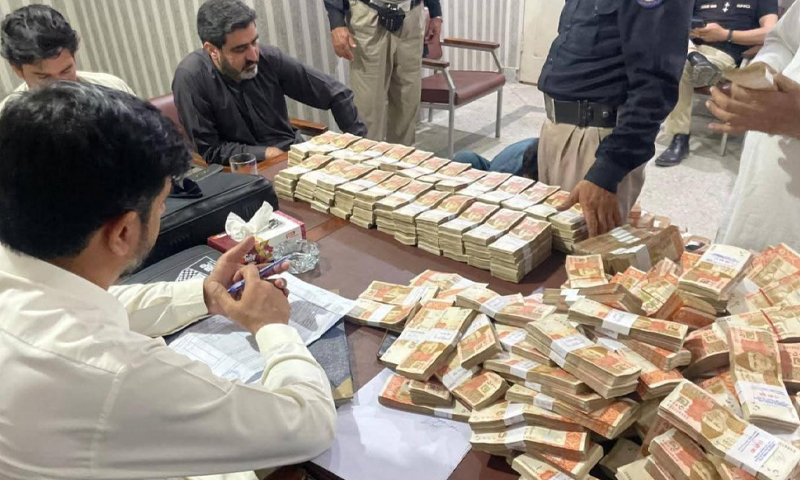
The NAB says more than Rs1.5 billion in cash was recovered after being identified by the arrested suspects.
The seized assets included commercial plazas, flats, houses and shops located in Islamabad, Rawalpindi, Peshawar, Abbottabad and Mansehra.
More plea bargain requests pending
A NAB official said that Qaiser Iqbal has also submitted a Rs14 billion plea bargain request, which has not yet been decided.
The official said that the NAB has arrested Qaiser Iqbal’s wife as well. Investigators recovered Rs20 million on her identification, allegedly hidden inside paint containers.
Earlier, the Peshawar High Court had dismissed petitions filed by the accused seeking to stop NAB proceedings.
NAB investigators also want to question PTI Senator Azam Swati, but he has not appeared before the inquiry team despite being sent a questionnaire.
Swati had filed for pre-arrest bail to avoid arrest in the case, but the request was rejected due to non-prosecution.
At NAB’s request, the Interior Ministry has placed Swati’s name on the stop list, preventing him from travelling abroad.
NAB officials say arrest warrants have not been issued for Swati, but he has been repeatedly asked to join the investigation.
How did the scandal surface?
The corruption case first emerged during a meeting of the Public Accounts Committee (PAC) of the Khyber Pakhtunkhwa Assembly.
Three audit objections related to development funds released for projects in Upper Kohistan were discussed.
A probe involving the Auditor General and other departments found that many projects for which funds were issued did not exist on the ground.
Following these findings, NAB launched a formal investigation.
After amendments to the NAB law, the bureau has authority to investigate cases involving corruption exceeding Rs500 million.
Fake construction firms and ghost projects
A NAB official said the accused had created construction companies under fake names and obtained tenders for various projects with the help of accomplices.
After falsely showing the projects as completed in official documents, fake bills were generated to withdraw billions of rupees from the district accounts office.
The official said these activities had been ongoing for more than seven years.
Funds were withdrawn in the name of development work from departments including irrigation, public health and local government — despite the projects having no physical existence.
NAB claims record recoveries
The NAB chairman recently met the prime minister and said the bureau recovered more than Rs6 trillion in 2025, a record amount.
According to NAB’s report, much of the recovery came from the retrieval of state land in Punjab, Sindh and Balochistan worth trillions of rupees, including land belonging to forest, railways and irrigation departments.
Billions were also recovered from owners of private housing societies after complaints from affected citizens.
Under the amended NAB Act, the bureau can only proceed against a private housing society if it has received complaints from at least 100 victims.
The amendments have also led to more than 200 cases being transferred to the FIA and anti-corruption departments, while financial scandals involving less than Rs500 million are now handled outside NAB.
You May Also Like